
The George Washington Carver Story | The Henry Ford's Innovation Nation
45 Video Views·Jan 19, 2023
When I was in grammar school, I was so jealous of my friend Parker.
Every day her lunch bag was packed with a peanut butter and jelly sandwich,
all soft and gushy and delicious. Don't get me wrong, my lunches were great too, thanks mom.
But I can still smell that PB&J with the Concord grape jelly oozing out the sides.
The fact is, unless you're allergic, peanuts have been a huge part of many of our lives.
And there's one innovator to thank for that, and I cannot tell a lie,
he did not chop down that cherry tree. Wrong George.
The man I'm referring to is George Washington Carver.
While George Washington is known as the father of our country, Carver is considered the father
of something extremely important to the South, to this country, and to the world.
He was an agricultural scientist. I would call him one of the first organic farmers
because he believed in returning to the soil nutrients and biomass from natural things.
I met up with the Henry Ford's curator of agriculture and the environment,
Deborah Reed, in front of Carver's memorial cabin in the museum's Greenfield Village.
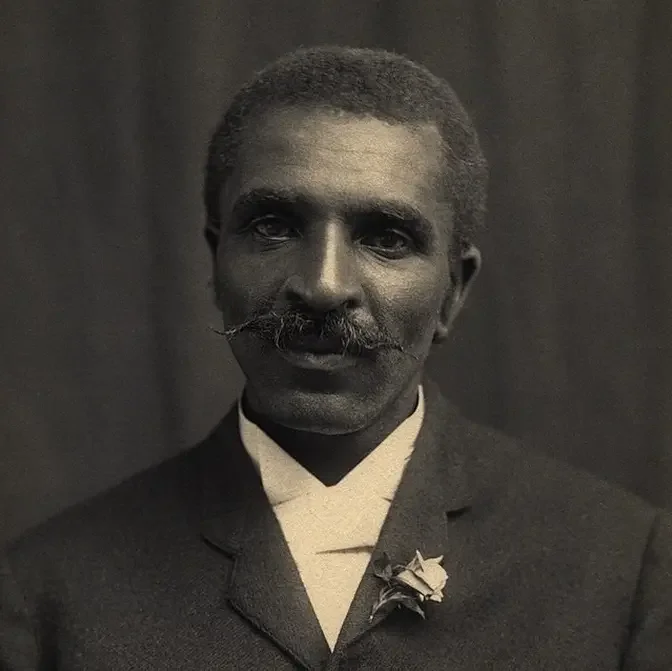
Look at this portrait. Irving Bacon did this,
so Ford's favorite artist, but it's a tribute a year after George Washington Carver died.
What is his legacy? What did he succeed in doing?
He was the first African American to hold a master's degree in agricultural science in the
country and went to Alabama. Their soil had been depleted, soil that had been planted in cotton for
generations. So he had to change all forms of their agricultural practice.
Not only was the farmland of the South depleted of vital nutrients such as nitrogen,
but a boll weevil infestation in 1915 wiped out nearly 75% of its cotton crop.
Farmers were desperate for help. Why do most people associate George
Washington Carver with the peanut? The peanut would fix nitrogen. I know,
what does that mean? Yeah, that's a complicated thing.
It is. He wrote bulletins and he illustrated this. He drew artwork that helped people understand
that if they planted the peanut, that the ways that the roots worked helped fix nitrogen in the
soil. So it didn't deplete it, it held it there. This is his home. Is this a replica?
In 1937, Henry Ford asked George Washington Carver to come and speak and Ford was smitten
with him. They were taken with each other. Ford wanted to honor him and so he asked for
his memories of his boyhood home. Henry Ford built this cabin in Greenfield Village
and Carver personally showed up for the dedication, even spending the night in it in July 1942.
I believe Henry Ford built the cabin because he wanted to honor this very well-known and
respected black scientist in 1942. In the context of World War II and debates about
civil rights and equality in the military, it was a statement.
And Carver's selfless efforts to innovate agricultural and economic opportunities
for all farmers makes him one of our great American heroes.