
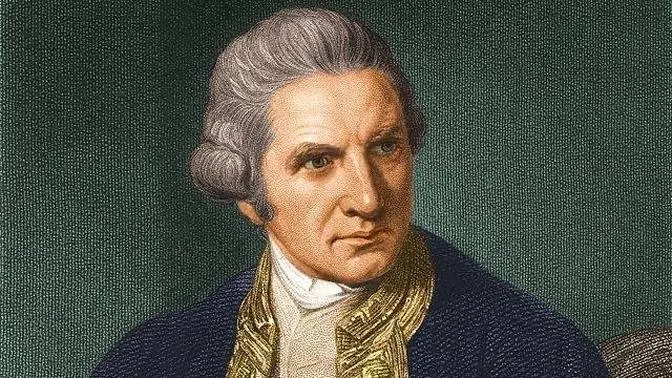
Captain James Cook
6 Video Views·May 3, 2023
An introduction to the famous British explorer.
The story of Captain James Cook. Captain James Cook was born on the 27th of October in 1728.
He was born in a small village called Mwaten in Yorkshire.
His father was a farmer and he grew up on the farm.
However, he was very interested in the sea and travelling on the seas.
When Cook was 17 he moved to the coast in Whitby, North Yorkshire.
Here he got a job as a coal merchant,
working on ships transporting coal from the River Tyne to the River Thames.
During his time as a coal merchant he demonstrated excellent sailing skills.
He also had a great interest in astronomy.
In 1755 he joined the Royal Navy and he learned how to sail.
He also developed his skills in making maps
and was so good at it that in 1768 and at the age of 40
he was promoted to commander of a ship called the HMS Endeavour.
The HMS Endeavour was massive and weighed 368 tonnes.
It was 32 metres long and held a crew of 94 men.
The HMS Endeavour departed from the port of Plymouth, England on the 26th of August in 1768.
In 1769 the planet Venus was due to pass in front of the sun,
a rare event visible only in the southern hemisphere.
The British government sent an expedition to observe this event
and as commander of HMS Endeavour, Cook led the expedition.
Having observed the transfer to Venus in Tahiti,
the Endeavour and her crew sailed south to explore new uncharted waters.
Cook promised his crew that the first person to see the new land
would have the area named after them.
It was on the 6th of October in 1769
when the 12-year-old surgeon's assistant named Nicholas Young
spotted land on the horizon.
It was headland on the east coast of the North Island of New Zealand.
As promised, this headland became known as Young Neck's Head.
Cook spent the next few months mapping out the North Island,
then the South Island.
On the 15th of January 1770,
Cook anchored the Endeavour at Ship Cove at the top of the South Island.
He observed the narrow tunnel of water between the islands
that is now known as Cook Strait.
127 years before Cook's arrival in December 1642,
a Dutch explorer named Abel Tasman had been the first European
to discover what later would be called Tasmania.
He also sighted New Zealand,
but bad weather prevented further exploration.
On the voyage with Cook were two botanists and collectors,
Joseph Banks and Daniel Sullender.
Their job was to study and record the plants and animals
that they discovered in New Zealand and Australia.
Together they collected over 1,000 plant species
that were previously unknown in Europe.
For example, eucalyptus, acacia and banksia,
which was named after Banks.
Cook and his crew sailed to the Pacific Ocean
and watched the planet Venus pass across the sun.
In April 1770, they spotted the east coast of Australia,
the first Europeans ever to do so.
They continued to sail along the Australian coast
and eventually set foot on land in Australia at Botany Bay.
They claimed it as British territory
and named it New South Wales.
At the time, early Dutch explorers
who first spotted Australia
had referred to the land as New Holland.
Cook was the first European
to see the southeast coast of Australia
and so wanted to give it a name
to distinguish it from the rest of New Holland.
New England had already been used elsewhere.
After they had claimed Australia,
they sailed north along the coast.
They were almost shipwrecked along the Great Barrier Reef
due to rough weather conditions.
However, they were still able to sail
into what is now called Cooktown in North Queensland.
Here they repaired their ship.
They returned home to England in 1771,
having sailed over 48,000 kilometers
and charted over 8,000 kilometers of coastline.
Cook used all of this information
to tell people about everything he had discovered
and became very famous.
In 1772, not satisfied by his previous expeditions,
Cook set out on a second voyage
to discover more about the Pacific Ocean.
He wanted to know if there was a huge continent
to the east of New Zealand.
Returning to New Zealand and using it as a base,
he sailed east and then south into unexplored ocean.
The second voyage confirmed
that there was no great continent
and they returned to England in 1775.
Cook's third voyage was to discover the Northwest Passage,
which was thought to link the Atlantic and Pacific Oceans.
However, they were unable to find this area
and sailed south to explore the island of Hawaii.
This third voyage was to be Cook's last.
On the 14th of February, 1779,
he was involved in a dispute with a Hawaiian tribe
and was captured and killed.
When Cook's crew found him,
they buried his body at sea.
Captain Cook is considered
one of the world's greatest explorers
and was the first person to create an accurate map
of the Pacific Ocean.