
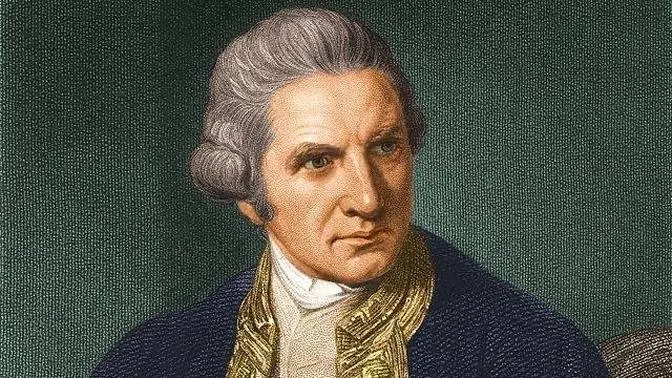
Captain James Cook Biography The man behind the legend
2 Video Views·Jul 14, 2023
Captain James Cook was born on the 27th of October 1728. Cook was an English explorer,
navigator and cartographer. He made three voyages to the Pacific Ocean,
mapping many areas and recording several islands and coastlines on European maps for the first time.
He is most notable for the British finding the east coast of Australia,
finding the Hawaiian islands and the first mapping of Newfoundland and New Zealand.
During his lifetime, he sailed twice around the world. He crossed the Antarctic Circle
and found new islands and landscapes in North America and the South Pacific.
During his trips, he spent a lot of time on science experiments and mapping new areas.
He also wrote a lot of books about what he found.
James Cook was born in Martin in Yorkshire, but as a child moved with his family to Great Ayton.
As a teenager he developed a fascination for the sea, teaching himself map making,
and travelled to Whitby to find employment on the coal ships there.
During the Seven Years' War he served in the Royal Navy. He showed a talent for surveying
and cartography and was responsible for mapping much of the entrance to the St Lawrence River.
His surveying skills were put to good use in the 1760s mapping the jagged coast of Newfoundland,
which brought him to the attention of the Royal Society.
Cook's distinctive and huge achievements can be attributed to a combination of excellent
seamanship, his superior surveying and cartographic skills, map making,
courage in exploring dangerous locations to confirm the facts, for example dipping into
the Antarctic Circle repeatedly and exploring around the Great Barrier Reef, and boldness both
with regard to the extent of his explorations and going beyond the instructions given by the
Admiralty. So Captain Cook was assigned on his travels and his mission was, to find the southern
continent, terra Australis incognita, to make astronomical measures of Venus, to map new lands,
to take over the land for the British King George III, to watch for good places for new military
bases, to find new routes between the Pacific and the Atlantic. Cook attempted to resume his
Shortly after leaving Hawaii Island, however, the resolutions foremost broke, so the ships returned
to Kila Kekua Bay for repairs. Tensions rose, and a number of quarrels broke out between the
Europeans and Hawaiians at Kila Kekua Bay. An unknown group of Hawaiians took one of Cook's
small boats. Cook was forced into a wild goose chase that ended with his return to the ship
Frustrated, he attempted to kidnap and ransom the King of Hawaii, Kalaniapu. That following day,
the 14th of February, 1779, Cook marched through the village to retrieve the King. Cook took the
King by his own hand and led him willingly away. The King began to understand that Cook was his
enemy. As Cook turned his back to help launch the boats, he was struck by the villagers which
resulted in his death. The Hawaiians carried his body away towards the back of the town,
still visible to the ship through their spyglass. Four marines, Corporal James Thomas,
Private Theophilus Higgs, Private Thomas Thatchert and Private John Allen,
were also killed and two others were wounded in the confrontation.