
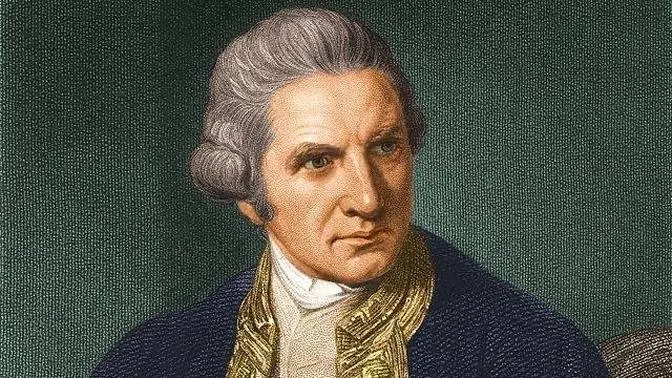
Story of James Cook - Part 1 (Early Life and Career)
2 Video Views·May 5, 2023
Episode 1 - https://www.youtube.com/watch?v=M_zkZhJVI8U
Early Life and Career
Episode 2 - https://www.youtube.com/watch?v=aOjTF-pXMLg
Voyage to Tahiti
Episode 3 - https://www.youtube.com/watch?v=YLKwaXhEXBU
James Cook in New Zealand
Eternal Hope by Kevin MacLeod is licensed under a Creative Commons Attribution license (https://creativecommons.org/licenses/by/4.0/)
Source: http://incompetech.com/music/royalty-free/index.html?isrc=USUAN1100238
Artist: http://incompetech.com/
Luminous Rain by Kevin MacLeod is licensed under a Creative Commons Attribution license (https://creativecommons.org/licenses/by/4.0/)
Source: http://incompetech.com/music/royalty-free/index.html?isrc=USUAN1100169
Artist: http://incompetech.com/
James Cook's name as the man who claimed Australia for the British Empire earned him his place as
one of history's greatest explorers. Yet despite his notoriety as a famous navigator, who was
James Cook? Born in Martin Yorkshire, he was the second of eight children. As a child,
he attended local school at the age of 13. Upon leaving school, his search for work would take
him across varying occupations such as farming, shopkeeping and tailoring. In his leisure time,
Cook enjoyed every opportunity for solitude. Whilst living in Stiles, Cook's love for solitude
became further evident by the time he dedicated towards constantly gazing at the sea from the
shop window. Proving to be unsuitable at his job, he would eventually leave in search of further
employment. This occurred upon travelling to the port of Whitby under business accompanying his
boss. This led to his introduction to the Walker Brothers, who were prominent ship owners involved
in the coal trade. Sensing the opportunity, he enlisted as the Merchant Navy Apprentice in the
Walker Brothers' trade fleet. His service to the brothers would take him across the English
coastline. As part of his new occupation, Cook would become inversed in math, navigation and
astronomy. Upon completing his three-year apprenticeship, he spent the next few years
in the Baltic Sea working alongside several British merchant ships. In 1752, at the age of 24,
he completed his naval examination, which promoted him to first mate on board the British Friendship.
Two years later, he volunteered for service in the Royal Navy when war rubbed it between Britain
and France in the Seven Years' War. Having been designated upon the HMS Pembroke, he first saw
action during Britain's 1758 siege of Louisbourg, which was captured from the French. A year later,
at the Battle of Quebec, he let the first ships through the St Lawrence River, where he successfully
landed James Wolfe and his invasion party, despite attempts by French fire ships to disrupt the
landing. In the events after the war, he relocated to the HMS Grinville, where he spent much of his
time mapping the coast of Newfoundland. His talent at surveying both the adverse layout of the island
brought him to the attention of both the Admiralty and the Royal Navy. This came at a crucial moment
when British exploration was now being directed into the Pacific and Indian Ocean.