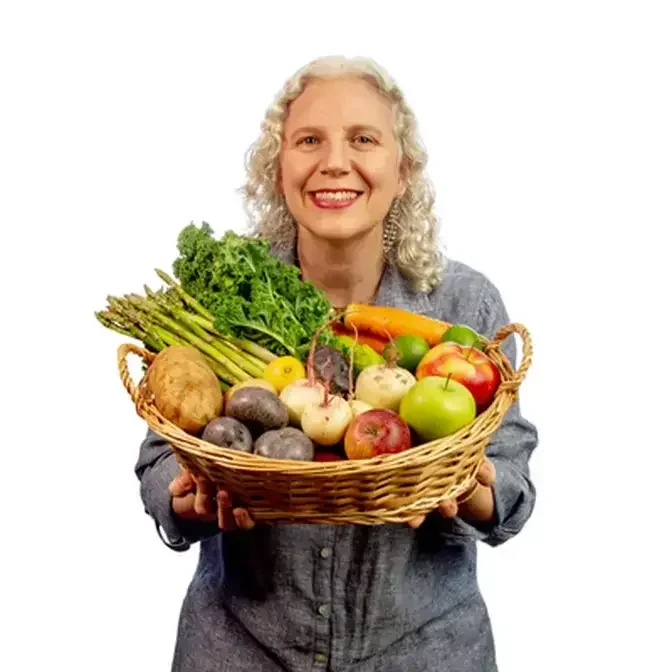
About the Episode Are you curious about the science of Ayurveda? Would you like to know how it works? This conversation with integrative medicine pioneer Kerry Harling offers a modern scientific perspective, as well as evidence that the ancient science works.
Kerry is a pioneering Ayurveda practitioner who completed her education in neuroscience after the age of 40. She now uses genetic testing in her clinical practice, and she’s discovered that modern genetics is basically just Ayurveda dressed up in different words.
What I particularly love about Kerry is her tenacity and can-do attitude, particularly how she recovered from an abusive marriage and debilitating illness through Ayurveda, then paid it forward working with clients using the genetics, all the while working on the recent launch of her groundbreaking personalized skincare system where AI and algorithms take into account over 87 factors to arrive at her unique skincare recommendations.
Ladies, you will not want to miss this conversation. It’s loaded with nuggets of wisdom, as well as the promise of a revolutionary skincare solution … Do I have your attention now?
In this episode you’ll learn: 00:24 Who is Kerry Harling? 02:13 Why Kerry make the transition from Genetics to Ayurveda? 05:01 What was the Ayurveda program like for Kerry? What were she thinking when she started? 06:47 How did Kerry understood Ayurveda as an ancient science versus the scientific knowledge that she had? 08:57 How did Kerry's Ayurveda business started? 10:37 How did Ayurveda transformed Kerry's health? 15:53 The Big 5 Health Issues 19:28 Modern Medicine vs Ayurveda 20:23 Summary
About the Host: Andrea Hayley-Sankaran is an Ayurvedic community leader, nutritionist, and gut health expert who’s on a mission to empower individuals with strategies and tools to Eat, Live, and Feel Better!
Ayurveda becomes truly preventative.
That's the other approach of Ayurveda that I love.
It's not reactive.
Modern medicine today is reactive.
You have the symptom, let's react to it and give you something
to take that symptom away.
Whereas Ayurveda says, no, we have to get to the root cause.
What's right for me is not right for you.
And we have to prevent anything coming down the pike.
In this inaugural episode of the Eat Live Feel Better podcast, I
sat down with Keri Harling, a pioneering Ayurveda practitioner
who uses genetic testing in her clinical practice.
I can tell you that this is very unique.
Genetic testing is modern science and Ayurveda is an ancient
science after all.
But Keri says the two are actually one in the same.
Keri completed her education in neuroscience after the age of
40, then went on to become a thought leader in integrative
medicine, bridging Eastern and Western medicine in her practice,
and most recently launching a groundbreaking personalized
skincare system.
What I particularly love about Keri is her tenacity and can-do
attitude, particularly how she recovered from an abusive marriage
and debilitating illness, ultimately through Ayurveda.
From the moment I met her, it was clear to me that she's not
a person who's going to settle for the status quo, and she's
not going to let her clients settle either if the status quo
isn't serving them.
Guys, don't miss this conversation about resilience, curiosity,
invention, integration of past and present, and moving forward
in life.
So Keri, Keri Harling, thank you for being here.
I'm so looking forward to getting to know you better and all
the nuggets of wisdom that I'm sure that you're going to share
with us.
Well, thank you.
I am thrilled to be here with you.
I really am.
So I'm very excited.
And thank you for inviting me.
Absolutely.
Well, you're actually my first inaugural podcast interview.
I love coming in first.
Yes, she's picturing me, loves coming in first.
Exactly.
Yes.
We have a lot of firsts, I think, to discuss today.
So to get us started, I'm curious.
I noticed that you went to school for neuroscience and you have
a master's in higher education leadership, and you were a dean
in a community college.
And that makes perfect sense as a career trajectory.
But then you pivoted to Ayurveda.
I'm curious.
Why did you make that transition to Ayurveda?
I suspect there's a story there.
You're right.
There's always a story everywhere, isn't there?
That was my career path.
And yes, I was a dean of institutional effectiveness, which
meant it was my job to make sure that we did what we said we
were going to do.
Loved doing it, reported to the president, had over 150 different
people reporting to me.
It was a high-stress job.
It really was.
And then one day I walked in and the unbelievable happened.
I got fired.
And I was devastated, Andrea.
I thought my world had come to an end.
So I did what we all do.
I brushed off my resume and sent it out there for the exact same
job that I had just left.
And I got invited to interview.
And then all of a sudden, something, and I don't know what it
was, just pulled me up sharp and sort of said, hang on a minute.
Do you want to do this, Kerry?
The same old thing?
And I looked around at all my colleagues who were in sort of the
same level as me and I thought, hmm, I don't know.
They're living that same life.
I did a double take and I actually turned down the job, which was
a big shock for me and for everybody.
I mean, my husband's like, you have no other fallback here.
What are we doing?
And I took some time, Andrea, just to reflect.
Did I want to do this?
And I was fortunate.
I could take the time to do that.
But in that time, a flyer came through from Kropalo Institute
advertising their Ayurveda program.
And I took one look at it and I thought, this is it.
This is what I want to do.
So I called them up and said, I want to come to your next program.
And they said, well, here's the sticker price.
And I said, oh, I can't afford that.
I just got fired.
There's no severance package here.
So they offered me a scholarship to go.
So I went on a scholarship and that was it.
I've never looked back.
Wow, that's brilliant.
I was getting a little moved there and excited because a very similar thing
happened to me.
I was in a high-stress job and one day I quit and my feet just walked me right
out the door.
I didn't even know it was going to happen.
Like, it was very sudden and I just walked out one day and I never looked
back.
It was my soul.
It was my inner self speaking to me and saying, you know what?
You keep going down this path.
It is not a good path and you need to take a different direction.
And we're fortunate, Andrea, we could take that different direction.
There are many people that recognize they need to and can't and then they end
up coming to see us because that stress is affecting their lives.
But yes, that was the pivotal moment for me.
Amazing, amazing.
So you started studying Ayurveda and what was the program like?
Well, what were you thinking when you started?
You know, I was excited and I was very nervous because it was a residential
program where you're on for 10 days in each month.
It's actually quite difficult sort of moving there for 10 days, coming back
home, moving there for 10 days.
I did that for a year.
And like anything, it's the people that you meet that really become sort of
lifelong friends.
But I do remember walking into class and saying something about Ayurveda and
the Dean came up to me and said, you know what, Kerry?
If you're going to study this, you need to learn how to pronounce it
correctly because I wasn't even pronouncing it right.
And I went in full of my science.
I've got this.
I'm going to combine this science background and I'm going to change the
world.
I mean, the picture in me was going to do it all.
And I remember the Dean who was Hillary at the time saying to me, just go
with it.
Just enjoy one day at a time.
And that was so wise.
And of course, I didn't do that.
But in retrospect, yes, it taught me a lot about where you think you should
go and where you actually end up with two very, very different things.
But I loved it.
It made so much sense to me.
And as rigorous as it was, it just makes sense.
And I find my clients say that too.
It just makes sense that we're doing these things.
And I started feeling better.
I mean, you're in a situation where you feel good.
You're studying something that feels right.
I mean, it's the best place to be.
During the studying of Ayurveda, I think a lot of people don't realize how
incredibly rigorous the programs are.
You know, I've had people say to me, oh, I did a two-day, you know, Ayurveda
retreat with my yoga class.
And so I know a lot about Ayurveda.
The programs and the training are very extensive.
And I'm curious, too, about how you understood Ayurveda as an ancient
science versus the modern scientific knowledge that you had from your
university studies.
When I went for my first interview, I remember the assistant dean turning
around to me and saying, it may be challenging for you, Carrie, with your
science background.
So I was prepared to go in as the sketch chick because it had already been
set up.
It had already been told that you may be challenged by this.
And it was like, okay, I have my science training.
I've done all these, you know, biostatistical courses.
I can figure out what's right and what's woohoo.
Actually, the opposite happened.
I got in there and it's like, this makes sense.
And it is science.
It's based on observation.
It's based on years and years of observation.
It's based on text.
It's based on pharmaceuticals.
You know that the Ayurveda pharmacopoeia is rich in its history.
So it's based on very real scientific principles that I actually found
pretty easy.
And it was then easy to marry or be the bridge between Western thinking
and this ancient science, as you call it, because it's all the same thing.
Our modern-day genetics is nothing more than Ayurveda saying we can change
our genes according to diet and lifestyle.
And Ayurveda has always known this.
You know, we've just repackaged it and call it genetics.
And we now know we can change our genes according to diet and lifestyle.
All the modern things of today, circadian, seasonal eating, circadian
medicine is only what we've always we knew about with Ayurveda.
I mean, I talk a lot about seasonal eating and seasonal changes.
And the Nobel Prize has just been won in circadian medicine.
It is Ayurveda.
It's the same thing.
We just repackaged and calling it different.
So I love to point out to people it's what we're doing.
It is modern science.
It's just called different terminology.
It's just different words.
You've taken it that far.
I've noticed that your practice is very science-based as an Ayurvedic
practice and much more so than many other Ayurveda practices out there.
And I think that this is your special sauce in a sense.
So you finished all your studies and at some point you started your own
business, your own clinic.
How that started and what were your thoughts?
So I thought I was ready to see people long before I actually was.
And I think we come out of school thinking, okay, I have all this
knowledge that I can help other people.
Yes.
And they're the same people that knew me before I had that knowledge.
It was my, you know, brothers and sisters and, you know, it was close
friends and they looked at me like, yeah, yeah.
They're the hardest people.
They are.
But I did start talking to people and I started at my local gym.
I went to the local gym and I put up my little table and I had a little
lemonade.
I had little lollipop sticks with pain points on and that's where I
started and I just talked.
And the more people told me about their stories, in the end, it didn't
matter whether I was an Ayurveda practitioner.
People just wanted relief from what they were going through.
And if I could help them with that, if I could use my lens through
Ayurveda to help, then that's what was important.
I was just really sort of imparting what I had learned to help others
and still working on a lot myself too and getting used to sort of
living this way.
But it was always very important for me, even when I started off in
the early days, to be outcomes-based.
We don't know how far you've come unless we can measure where you
started.
So we've got to have baseline measures.
We have to have measures on route.
We need to be able to graph those measures.
We need to see that you're progressing.
You were teaching, you were sharing, you were helping, you were taking
action, but you were also, you said, working on yourself.
So often, the Ayurveda practitioners' greatest testimonial is
themselves.
Would you be okay to share a little bit of your story and how Ayurveda
transforms your health?
When I first came to this country in my late 20s, I got married to
a man who was very, very abusive.
All the things that controlling people do.
But eventually, I did leave with a lot of support from friends, from
domestic violence, counselors.
I mean, I got out.
So I left my marriage and moved to a different state to go to school
in Massachusetts.
In fact, I was thrilled.
Here I was.
So I went back to school, and it was tough as a single parent.
And I thought I was tired, but the fatigue got worse and worse.
And then the pain started.
And I had joint pain.
I had headaches.
I wasn't sleeping well.
Digestion played up, and I didn't know what was going on.
I thought perhaps I'd caught something.
I did what we all do, went to the doctor and ran all the tests and
got told, yep, there's nothing wrong. Fatigue got so debilitating.
I'd be out for the count for the rest of the week.
I wouldn't be able to do laundry.
Or if I stayed up late studying, then I'd have to sleep the next
day really late.
And it becomes your new normal.
I get used to it.
And I guess that's the only way you can survive.
It is a very common story, especially for women in their 40s, 50s.
Busy lives, raised the children, worked on everything, and then
like health catches up with them.
For you, it happened a little early because of the trauma you
were experiencing.
So still things didn't get better.
I got worse and worse.
Went back to the doctors, got diagnosed for fibromyalgia.
They ran Lyme disease tests.
I mean everything.
And then got told I was depressed.
Eventually, two things happened.
One, because of the fibromyalgia, somebody suggested restorative
yoga. It felt wonderful.
And the yoga teacher also happened to know a little bit about Ayurveda.
So she would bring some of those Ayurveda principles in.
I didn't pay much attention to it.
I thought perhaps Ayurveda was a religion.
I wasn't quite sure what it was.
And then I also got to see an MD, alternative practitioner.
And he did a mercury test on me, heavy metals test, and it came
back absolutely over the moon with mercury.
Then I had to undergo chelation therapy, which is where you
remove the mercury from the tissues.
But it has to come out of the brain too.
So they're pretty hardcore drugs to take, to affix to the mercury
and take them out of the system.
Did they identify what was the source of all this mercury?
No, they kept asking me, had you ever lived next to a fisheries?
Had you ever lived next to a hatter company?
So there was no reason that I did get asked those questions a
lot. So fast forward five years.
I'm mercury free, but I didn't feel any better.
I still felt tired.
I still had some brain fog.
I still had digestive problems.
So it was recommended to me because I'm still doing the yoga
that I actually go see an Ayurveda practitioner.
So I did and she said to me, well, you're totally depleted.
The very chemicals that they use to take the mercury out of
your system has taken everything out.
You have very little odors, which as we know in Ayurveda, it's
your sense of vitality, your immunity.
We need to rebuild.
We need to do a lot of Rasyana, which means rebuilding and
restoring and rejuvenating the body.
But the first thing she did was an Ayurveda cleanse and I
wasn't sure about that.
I embarked upon this because anything was better than I was
feeling. I was pretty desperate. In a month, I started feeling
better and it wasn't, oh, I feel fine one day.
I just woke up and had a little bit more energy.
I found I wasn't quite so tired at the end of the day.
My skin looked a little better.
I didn't look so old and tired, but most importantly, I started
thinking clearer.
So, you know, when you start feeling better, you carry on doing
whatever somebody's telling you to do.
Yeah, so I carried on and then after that, she put me on some
Ayurveda herbs for rebuilding.
That was my first introduction to Ayurveda and that cleanse
was so powerful for me that years later, I got approached by
a publishing company to write about cleansing in Ayurveda.
So now I have a book, The 25-Day Ayurveda Cleanse, because
it was so powerful for me.
There are many people that don't get the opportunity to work
one-on-one with me.
So it's a way for them to sort of take that base level of just
sort of detoxifying a little from the incredible lifestyles
we lead so that they can feel a little bit better.
I love that, the story behind the book and I just want to
celebrate that.
I have this thing that I do.
It was like, ah, so I usually do that when the food tastes
amazing and perfectly balanced, but we'll do that for you because
that is an incredible story that after, you know, so much
struggle and suffering, within one month doing an Ayurveda
cleanse, you were feeling a whole lot better.
And remember, the doctors couldn't tell you what was wrong
either. And then Ayurveda comes in and whoosh! As you were
also telling your story, I was thinking this is exactly now
what you do for people in your practice.
You eventually did start your Ayurveda practice.
I think it's called The Holistic Highway.
So you started seeing practice at a client one-on-one.
Tell us a little bit about that and what you specialize in
and I want to make a pivot to your newest endeavor, which
has to do with skincare.
So when you started seeing clients, I understand everybody
cares about their appearance and that you started having
questions about that.
So it soon became apparent when I started seeing clients
that the kind of big five came up and the big five were things
like digestive issues first and foremost.
The other thing I saw was a lot of fatigue. Women were tired.
Weight's a big one. Normally too much weight and as we know
in Ayurveda, weight has a lot to do with stress levels, has
a lot to do with being out of balance. People had gone on
diet after diet.
What really saddens me is people would come to me and say
it's me.
I'm just not disciplined enough.
They didn't realize, no, dieting doesn't work.
So the diet failed you. Just have to do it again.
They have to be more disciplined with it and then skin
issues came up.
You know, psoriasis, eczema affects how I feel about myself
or I don't like to show my arms because it's got all these
bumps on it.
So that's where the skin issues started coming up and then
sleep issues, either not being able to get to sleep or
not being able to stay asleep.
So these big five were the huge ones.
So because I'm fortunate that I can bridge the gap between
Western and Eastern medicine, I use all kinds of tools and
resources from genetics testing to observation in Ayurveda
to tongue analysis to really be able to fine-tune what was
going to work for that person because you know, you with
psoriasis is going to be very different to me with psoriasis.
People don't realize that but that is Ayurveda's specialization
is that individualization for every case.
Absolutely, and it kind of makes difference and I tell a story
to some people to try and illustrate.
Bob, for example, Bob goes to the doctor and says, I've got
a headache and the doctor turns around and says, okay, Bob,
you know, take some Tylenol, come back and see me in five days
if you've still got problems.
Joe also goes to the doctor and says, I've got a headache
every night and the doctor says, okay, take some ibuprofen
come back and see me in five days.
Well, if the doctor had known that Bob drinks a bottle of
wine every night, you'd be like, no wonder he has a headache
every morning and then if the doctor had known that Joe gets
hit with a bottle of wine every night, you'd be like, okay,
we understand why he gets a headache too, but the physician
not understanding the underlying root cause, which is what
we look at that imbalance in Ayurveda, not understanding
that it's going to treat them the same way and that's what
my clients come to.
Yes, I'm on anti-inflammatories.
I'm on steroids.
I'm on high blood pressure, but nobody says, but what's creating
the high blood pressure?
What's creating that inflammation?
Because that's what we need to look at.
We can just blindly medicate symptoms.
Absolutely.
That is the medical model, but whilst you're on some of those
very important drugs, I'm not anti-drugs, you know, uncontrolled
blood pressure is dangerous.
Uncontrolled depression is dangerous, but while you're managing
the symptoms, let's look at the underlying root cause and
really work on that, what we call the imbalance in Ayurveda
and by doing that through all the skills that I have, my toolbox
of genetics, as well as my Ayurveda research and training,
then we can come up with a personalized plan that's right
for you.
I go under stress.
I get migraines.
What happens to you, Andrea, when you go under stress?
I have mild headache usually, yes, same, and if it progresses
further, it can turn into a migraine and then that makes me
feel nauseous.
So that's when it's really bad.
And what I've learned to help myself with that, the biggest
medicine is letting go, because it's my Pitta getting too
focused, too sharp.
The medicine is actually letting go.
And I just wanted to highlight those five main areas that you
saw in terms of concerns.
A lot of people don't realize that someone may be feeling these
ways and just like you, going to the doctor and there's no
diagnosis, but in Ayurveda, there's a pathogenesis or progression
of disease, which has six stages and only in the fifth stage
does the disease kind of start to get a name or manifest.
But prior to that, there's all these signs and symptoms that
we're talking about that if left untreated will lead to disease.
But the beauty of Ayurveda is that we can actually halt that
disease process in these early stages with these kinds of
remedies. And that way, I think Ayurveda becomes truly preventative.
That's the other approach of Ayurveda that I love.
It's not reactive.
Modern medicine today is reactive.
You have the symptom, let's react to it and give you something
to take that symptom away.
Whereas Ayurveda says, no, we have to get to the root cause.
What's right for me is not right for you.
And we have to prevent anything coming down the pike.
Everyone, that was Carrie Harling on life and her discovery of
Ayurveda. Carrie's penchant for modern science led her down
a path of integration of ancient and modern ideas.
Her story continues in the next video where she founds her
clinical practice and starts to observe five common threads
in the concerns that people have.
One of those concerns is skin health and it leads Carrie into
an unexpected and exciting new business venture that is
revolutionizing the skincare industry.
Don't miss this video because there's a gift in it for you too.
But you have to watch to find out what it is.