
The Wines of Champagne
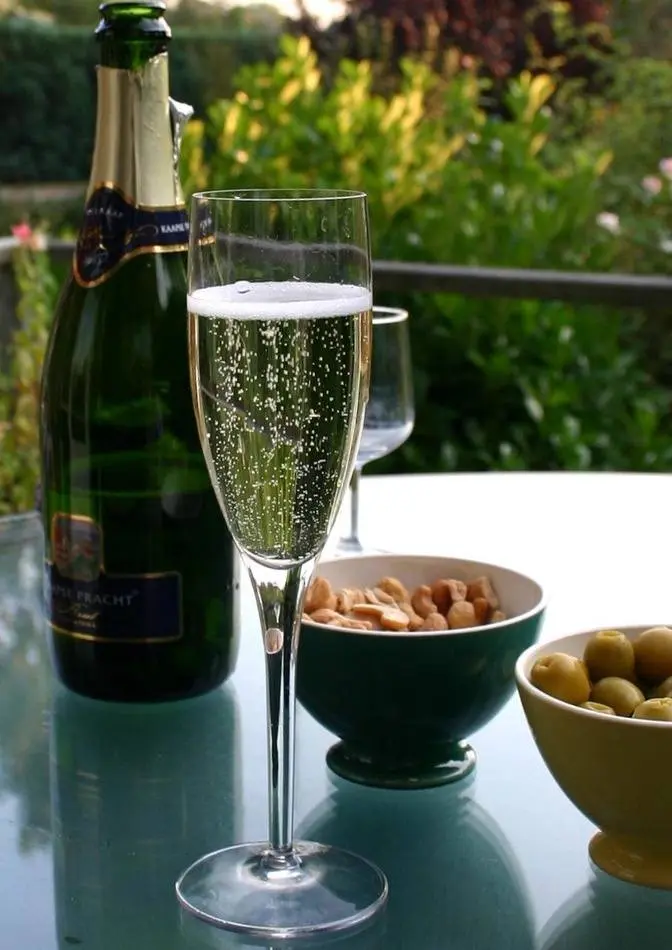
Champagne is perhaps the most recognizable wine in the world,
and its effervescence is synonymous with luxury and celebration.
First of all, you know that Champagne is about 150 kilometers from Paris,
in a region called Le Bassin Parisien.
Bassin means a cup, and it's a cup because it's an old sea.
That's very important to understand Champagne.
The evolution of Champagne started with Benedictine monks of the late 1600s,
but a complete understanding of the second fermentation at the heart of sparkling Champagne
took almost two centuries to develop.
Legends may have him seeing stars,
but Dom Perignon's most important contribution was in making a white wine with red grapes.
As time passed, winemakers refined the style and the grape varieties
used to make today's modern sparkling wine.
Today, we have three grape varieties, which are the Chardonnay, Pinot Noir, and Meunier only,
because I think they are the three best ones for maybe the best quality and the best maturity.
The cities of Reims and Epernay are the twin hubs of the Champagne business,
and the region is divided into five districts that specialize in particular grapes.
The three core districts are the Côte de Blanc, Montagne de Reims, and the Vallée de la Marne.
Two lesser-known districts are to the south, the Côte de Cézanne,
and the larger Aube, which spans 150 kilometers, extending toward Chablis.
The Marne River runs through the center of the region, forming the valley that bears its name.
So we are in Mareuil-sur-Ailly. Part of the Vallée de la Marne here is generally called
the Grande Vallée de la Marne, the Greater Marne Valley, because it's quite wide.
Since it's facing south, and since the soil is generally of chalk, it's a very, very good
terroir, a very good climate for Pinot Noir. And that's what we grow here, is our preferred grapes.
More to the west, people tend to grow more Pinot Meunier.
We can say that you will find mainly Pinot Meunier in the Vallée de la Marne.
This region is very sensitive to the frost in spring,
and the main advantage of the grapes variety of the Meunier, it's because the cycle
vegetation starts later than the Chardonnay and the Pinot Noir.
The Côte de Blanc is south of the Marne River.
The Côte de Blanc is a kingdom for Chardonnay in Champagne.
It's about 15 kilometers long coast, a south-north, that means exactly the same
exposure as the Burgundy coast. And the vineyard is planted east-face,
which is, you know, a very important thing for the Chardonnay.
Côte de Blanc's vineyards are characterized by chalky white soils.
The bedrock where we grow our vine is old sediment of a very, very old sea.
So it's small, small shells.
North of the Marne is the Montagne de Reims.
Montagne de Reims is mainly planted with Pinot Noir,
because our soil is clay and chalky soil.
And this is maybe the best expression for the Pinot Noir.
The Montagne de Reims and its Pinot Noir from Grand Cru villages, such as Ambonnet,
Verzenay, and Bouzy, have long been associated with Champagne's most full-bodied wines.
Champagne has a turbulent history as a wine region, famously illustrated by the controversial
inclusion of the aube in the beginning of the 20th century and the riots that ensued.
The historical situation in 1911 was quite different from what it is today.
So Aube, for many years, was considered like a subpar region.
In 1911, we were in the middle of the phylloxera crisis.
The Champagne producers were lacking grapes, and they were buying grapes or wines
outside the Champagne appellation.
And in 1908 and 1911, some regulation was passed to stop that.
This was the beginning of the official Champagne appellation.
When the Aube wanted to turn to Champagne, then the people in the Champagne region,
like in the Marne region especially, didn't want it.
So there was a big fight between the Aube and the other, you know,
the traditional Champagne region, I must say.
Every grand-grandparents go on the road with their bicycle and go to Epernay
to say, no, we want to stay in Champagne.
And it was, obviously, it was ugly.
I mean, it resulted in people dying.
You're talking like serious, serious village fights, in a way.
The army came from Paris and had to calm everybody down.
So, you know, it was pretty ugly.
And that is precisely why they passed, in a very urgent manner,
this regulation that let the Aube out.
And of course, the people in the Aube, the wine growers in the Aube,
reacted immediately and requested that they be reintegrated into the region,
which was done almost immediately.
So in my mind, they've always belonged to Champagne.
In Burgundy, single vineyards are designated as Grand Cru,
whereas in Champagne, entire villages bear the designation.
Of course, it's not the perfect classification.
Of course, you can imagine vine or grapes coming from the vineyard close to the forest
are not the same quality as grapes downtown to the vineyards,
the heart of the vineyards, same for the bottom.
In the past, grape prices were set according to a village's status.
Grand Cru villages received 100% of the established price,
and the other villages earned a reduced amount.
What made a Grand Cru in the past
was how much the negotiation were willing to pay for the grapes.
A few years ago, that fixed price became illegal.
So even though the scale has disappeared in terms of when you buy grapes,
it's now a bit different,
though the classification remains as Grand Cru vineyards, Premier Cru vineyards, and Cru.
In recent years, there has been an increasing focus on grower-producers
who often craft wines from individual villages with regional characteristics.
Simply, it means that our wine, our Champagne,
are made from our grapes, our vineyards exclusively.
That means we don't buy grapes, we don't buy juices,
we don't buy wine to make our Champagne.
While there is no inherent quality difference between a grower-producer and a negotiant,
each has unique challenges and advantages.
The benefit is you are able to manage your way of farming by yourself,
but it's risky if you have bad weather conditions,
if you have hailstorms, if you have spring-frozen, strong spring-frozen,
you can lose your crop.
While grower-producer bottlings may highlight a particular village or vineyard,
the traditional Maison makes an art out of blending components from multiple sources
to achieve consistency in their non-vintage offerings
and realize the finest expression of Champagne in their Tête de Cuvée.
The key of Champagne's success was the blend.
A negotiant can really aim at recreating the same style
and same consistency of taste year after year,
and also using reserve wines and all the tools it has.
Customers and consumers that are loyal to the brand,
to a certain brand, are expecting year after year.
The stylistic range of Champagne is broader than many consumers realize.
One reason for its continued success with true aficionados
is the wine's ability to pair with a surprisingly wide range of foods.
Oysters or scallops.
I like to pair Champagne with dishes that you'd normally pair with red wine,
especially when they're made from Pinot Noir,
can go all the way down to meat, even red meat.
Old cheese, especially matured hard cheese, Parmigiano.
Champagne has changed in style over the years.
In the 1800s, it was a sweet wine typically consumed after dinner.
Today, it's much drier and often sipped at the start of a meal.
The exact level of sweetness is controlled by the winemaker
and governed by the fashion of the day.
Little by little, Champagne got drier and drier.
The trend now is lower dosage.
It's a strong, strong trend.
Recent decades have seen a growing interest in wines
from individual crew villages and even single vineyard bottlings,
a marked divergence from Champagne's history as a blended wine.
Champagne used to be a blended wine from a very wide array of origins of grapes.
And the result of this very, very wide blending
was a certain homogeneity in the wines themselves,
between vintages and also between producers.
What I see today among the better producers
is that they are trying to put more personality into their wines.
From the 18th century salons of Paris to the modern dinner party,
Champagne has become an indispensable ally
in the pursuit of good conversation and a celebration of life.
Sommeliers have rediscovered the wine as an asset at the table
and lovers of Champagne have more choices in style and quality than ever before.
The Guild of Sommeliers is a non-profit membership organization for wine professionals.
To join our online community, visit us on the web at guildsomm.com.