
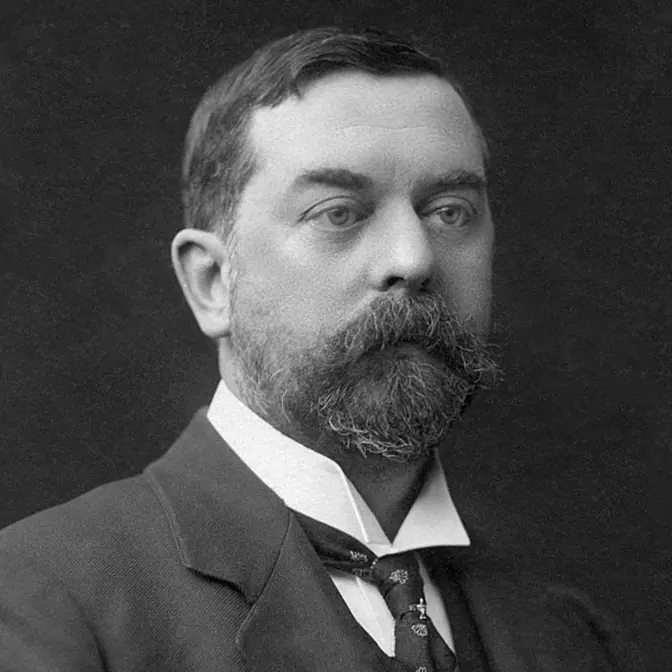
JOHN SINGER SARGENT Documentary
Welcome to the future, PBS Digital.
By 1900, John Singer Sargent was the most admired,
the most sought after portraitist in the Western world.
He exquisitely portrayed in oil and watercolor
the elegance of the Gilded Age,
the last days of Queen Victoria,
a time of extravagant clothing and extravagant tastes.
Yet after his death, his work was quickly dismissed
as superficial and passé.
Now, a reexamination of not only his portraits,
but his numerous landscapes, figure paintings and murals,
reveals Sargent to be one of the great painters
of the late 19th and early 20th centuries,
an artist consistently pushed outside
the framework of acceptability
to capture the essence of his times
and the carnage of the First World War
that brought his era to its bloody end.
John Singer Sargent, outside the frame,
is made possible by a generous grant
from the Eugene B. Casey Foundation.
The Gilded Age, it is the time of George Bernard Shaw,
of Claude Monet, of Oscar Wilde.
The height of aristocracy in Edwardian society.
Few suspect that beneath that beautiful veneer,
lie the seeds of revolution and world war.
John Singer Sargent captured both the beauty
and complexity of this time by standing apart from it.
In Paris, he was the expatriate American.
In London, the radical French painter.
In America, the sophisticated European.
He spoke many languages.
He moved very freely through all sorts of society.
But he wasn't out, so he never fully belonged.
That's not easy, but it has an artistic benefit
because it does give you a certain objectivity,
a certain distance.
You stand outside of traditions, of conventions
that can be inhibiting for artists
who have to work within them.
It's very much a part of his angle of vision,
of his artistic point of view.
His friend, Vernon Lee, wrote,
Sargent's life was absorbed in his painting.
And the summing up of a would-be biographer
must, I think, be he painted.
John Singer Sargent was born in Florence, Italy, 1856.
His parents had left Philadelphia,
where his father was a surgeon.
They came for a trip to Europe and never went home.
They used to spend winters down in Rome, Nice, Florence,
and then migrate north to Pau, Switzerland, Dresden.
It was a fairly rootless existence.
For companionship, John relied on his sister, Emily,
just one year his junior.
A second sister, Violet, was born when John was 14.
The children grew up among the wonders of Europe,
becoming fluent in English, French, Italian, and German.
Dr. Sargent was responsible for their education
and religious training.
But it was Mary Sargent, herself an artist,
who took them to every museum, palace, and garden she could.
Not a day went by that John, spurred on by his mother,
didn't complete a sketch.
She wrote, John appreciates the beauties of nature and art,
which are lavishly displayed in these old lands.
He sketches quite nicely and has a remarkably quick
and correct eye.
Sargent, from about the age of 10,
is determined to be an artist.
And he studies in various art schools,
Florence, Dresden, Berlin.
And so then this father concedes,
and all right, if he's going to have the best education,
where's the place you go to?
Paris, 1874.
The streets are filled with rubble left
from the Franco-Prussian War.
The word impressionism is coined.
Monet, Pissarro, Degas, and Renoir
are ridiculed in the city press.
Sargent is 18 and studying at the Ecole des Beaux-Arts.
I'm in the midst of my exam and very busy.
It seems unreasonably long, difficult, and terrible.
The supreme moment is one of 12 hours,
wherein we must make a finished drawing
of the human form divine.
The next order of business was to join a studio
associated with a master artist.
Sargent chose carefully.
Emile Kairoulas-Duran was known for harsh criticism
and rare praise.
Recognizing talent, he accepted Sargent on the spot
with this admonition.
You have studied much,
but much that you have learned, you must forget.
The training at the Ecole des Beaux-Arts in Paris
in the 19th century
was very thorough, very intensive,
very time-consuming.
The best in the world
attracted people from all over the world,
but it was highly disciplined,
put a great deal of stress on drawing,
drawing from casts, from the antique, as it was called,
and only then working up then through the live model
to painting.
Kairoulas-Duran, in a sense,
turned that on its head
and got people painting right away.
They learned, not the laborious sort of academic craftsmanship,
but how to paint
what they saw in terms of tonal values.
Kairoulas-Duran used to say,
search for the half tone, the half tone.
Each stroke of the brush had to give you a tone
and it was through the modeling of tone,
through how you approach light and dark,
that his pupils learned to translate what they saw
into terms of decisive single brushstrokes.
Sargent seems to have absorbed, with extraordinary facility,
this ability to, in a series of brushstrokes,
to conjure up form and to model form.
Paris was the center of artistic innovation.
Sargent navigated his way through impressionism,
naturalism, and realism,
charting his own course.
He made sure his work was acceptable to those
who could make or break a career,
but he stretched the limits of convention wherever possible,
challenging both himself and the viewer.
Combining traditional methods
with a new emphasis on spontaneity,
he painted Oyster Gatherers of Cancale in 1878.
The painting became Sargent's first major success
at the career-making Paris Salon.
He was only 22 years old,
an American, and a student for only four years,
yet he had achieved the official Salon recognition
that contemporaries like Van Gogh and Cézanne never enjoyed.
Sargent continued to stretch his artistic muscles.
He experimented with impressionism,
creating a Degas-like portrait of a Paris orchestra rehearsal.
He continued to travel each year,
across the continent as in childhood,
but now with a purpose.
Certainly after he enters Carlo Sturgeon's studio,
his traveling becomes more focused
because it's combined with his training
on the threshold of an artistic career.
He now becomes something of a careerist in his travel.
He's no longer really an amateur.
He never does a full-scale view of the Piazza San Margo
or the Duomo.
Instead, he seeks out elements of the Venetian environment
which are pictorially arresting,
filled with deep, even profound elements of Venetian life.
It was the exotic, far-fetched quality
which always attracted John Sargent.
The words strange, weird, fantastic were on his lips.
That word curious was his dominant word for many years.
Vernon Lee.
He traveled to Tangier,
where he was struck by the unsparing light of North Africa
and found exotic, mysterious subjects.
Novelist Henry James, upon seeing the painting,
I know not who this stately Mohammedan may be,
nor in what mysterious domestic or religious rite she may be engaged,
but in her muffled contemplation and her pearl-colored robes,
she is beautiful and memorable.
The picture is exquisite,
a radiant effect of white upon white,
of similar but discriminated tones.
Henry James.
It boosted Sargent's meteoric rise,
receiving rave reviews at the Paris Salon of 1880.
The story goes, of course,
that by the end of his four years,
he had not only met Carolus' criteria,
but probably surpassed them.
And the wonderful demonstration of this
is his portrait of his teacher in 1879,
which was both a kind of valediction to his four years of training
and, I think, a statement of competition for the future,
because he not only learned Carolus Duran's lessons,
but goes on, in fact, to outstrip Carolus.
Spanish music was being performed in concerts
at the Parisian concert halls, the Opéra Comédie,
and probably given a fashionable gloss
when performed in Paris.
So that would have introduced Sargent
to a kind of landscape of Spanish cultural possibilities.
Carolus Duran had urged his students
to study the Spanish masters.
In 1879, while on a visit to Spain,
Sargent was struck by the realism of Velázquez and Goya
and began work on a very large canvas.
El Jaleo translates as ruckus or uproar.
Using it as a title,
Sargent drew attention to the sound
that emanates from his masterwork,
the stamping heels of the dancer,
and the cries of encouragement from the unseen audience.
There's a kind of haunting, even tragic quality
to the kind of fury and impassioned emotion
of an accomplished gypsy flamenco dancer in the flesh.
The light falls exclusively on her,
her satin skirt and long train,
the dark shawl that she flings around her,
and he carefully drags his brush
to articulate the tendrils of the fringes
as they fill the air around her whirling figure.
The way in which he painted El Jaleo
clearly positioned him within the more liberal
and avant-garde end of artistic accomplishment
at the time in Paris.
El Jaleo is the picture of the year, 1882.
He's seen as a superstar,
and that, again, is unusual for a foreigner,
because the French are rather chauvinistic.
With the success of El Jaleo
came a growing demand for portraits.
Now the young artist had to consider his client's desires,
in addition to his own vision,
a balance he found difficult to maintain.
His daring composition of the Daughters of Edward D'Arleboit
confused critics,
one of whom referred to it as
four corners and a void.
However, Henry James,
who would become a close friend, understood.
The treatment is eminently unconventional,
and there is none of the usual symmetrical balancing
of the figures in the foreground.
The light, the free security of the execution,
the sense it gives us of assimilated secrets and instinct
and knowledge of playing together,
all this makes the picture an astonishing work
on the part of a young man of 26.
When was a pinafore painted with that power
and made so poetic?
Costume was as important to Sargent as composition.
He dressed the diabolically handsome Dr. Pottsy
in a deep red robe
and posed him in a theatrical setting,
possibly a bedroom,
reflecting his client's reputation
for vanity and romantic escapades.
Pottsy's many lovers are said to have included
actress Sarah Bernhardt
and the tantalizing Madame Gautreau.
She was a native of Louisiana,
brought to Paris by her mother
when her father died in the Civil War.
Her odd beauty and natural grace
attracted attention.
She married well.
And as Madame Gautreau,
she became a celebrity in Parisian society
and the constant subject of rumor and speculation.
While visiting her family home in Brittany,
Sargent sketched her in preparation
for a much larger painting,
one that would change the course of his life.
He wrote to Vernon Lee,
In a few days I shall be tackling
the portrait of a great beauty.
She has the most beautiful lines.
He sought her out, wanted to paint her,
got mutual friends to arrange an introduction.
He worked very hard
on developing that picture.
There are a number of oil sketches, drawings
in which he looked at her from different angles
and different settings, doing different things.
He saw her as a representative
of modern times.
The end result is an
extraordinary distillation.
It's so simple, it's just Madame X.
It was his seventh consecutive year
showing at the Salon.
Ironically, in an exhibition
full of female nudes,
the clothed Madame X
caused a scandal.
Sargent's friend Ralph Curtis reported,
Yesterday, the funeral
of John Sargent.
He was very nervous, but his fears
were far exceeded by the facts.
Madame Gautreau and her mother
made a fearful scene.
I fear he has never had such a blow.
Most shocking
was the strap
which originally fell seductively
from the subject's right shoulder
until repainted back
in place by a chastened Sargent.
It bombs partly
because it is so extreme
in its statement, the outturned arm,
the black, sheath-like dress.
This was an insolent woman
insolently displaying her beauty
in a highly erotic way
and it was an insolent work of art.
Sargent had overplayed his hand.
What conditions there were,
dried up.
The call of friend and anglophile
Henry James lured him to England
and a fresh start.
Young John Sargent
has high talent,
a charming nature, artistic and personal
and is civilized to his fingertips.
I take a great interest in him
and am very desirous
to witness his future.
Henry James.
There is perhaps more chance
for me in London as a portrait painter
although it might be a long struggle
for my painting to be accepted.
It is not beastly French.
It was the 1880s.
The first skyscraper,
ten stories high,
was completed in Chicago.
An underground train system
opened in London
and Kaiser Wilhelm II
ascended the German throne
anxious to challenge the power
of the vast British Empire.
In England,
Sargent joined the artists and writers
who gathered in the village of Broadway
in the Cotswolds.
He began again
to explore the theories of Impressionism.
Sir Edmund Gosse,
a Broadway regular,
remembered Sargent's work
in the fields.
He was accustomed to emerge
carrying a large easel
to advance a little way into the open
and then suddenly to plant himself down
nowhere in particular
behind a barn
opposite a wall
in the middle of a field.
The process was like that
in the game of musical chairs
where the player has to stop dead
wherever he may happen to be
directly the piano stops playing.
His object was to acquire
the habit of reproducing
precisely whatever met his vision.
In those days,
this was a revolutionary doctrine.
You see the wonderful picture
of the Ellu painting,
Paul Ellu with the bony knees
and his wife looking thoroughly bored.
The background is
swept in
with these great weeds
but he's absolutely got Ellu.
Sargent continued to visit colleagues in France
once capturing his old friend
Claude Monet
at work in the woods near Giverny.
Music
Indoors, Sargent was no less daring
continuing to push
beyond the traditional rules of composition.
Upon his commission
to paint the Vickers family
he wrote to Vernon Lee
I am to paint several portraits
in the country and three ugly young women
at Sheffield.
His portrait of the Mrs. Vickers
with its unbalanced use of space
and the very unusual downcast eyes
of its central figure
received good reviews in France
but was thoroughly panned
by the English Royal Academy.
The Paul Moll Gazette
voted it the worst picture
of 1886.
Determined to win out
over what he perceived to be English prejudice
Sargent jumped at the opportunity
to paint author Robert Louis Stevenson
whom he called
the most intense creature
he had ever met.
Stevenson described Sargent
as a charming, simple
clever, honest young man.
He wrote to friends
Sargent was down again
and painted a portrait of me
walking about in my own dining room
in my own velveteen jacket
and twisting as I go
my own moustache.
It is, I think, excellent
but is too eccentric to be exhibited.
I am at one extreme corner
my wife in this wild dress
and looking like a ghost
is at the extreme other end.
All this is touched in lovely
with that witty touch of Sargent's
but of course it looks damn queer
as a whole.
Robert Louis Stevenson
Never confined to portraits alone
Sargent continued working
on outdoor figure paintings.
A specific event at Broadway
had caught his eye.
I'm trying to paint a charming thing I saw
the other evening.
Two little girls in a garden at twilight
lighting paper lanterns among the flowers
from rose tree to rose tree.
I have two good little models
I shall be a long time about it
if I don't give up in despair.
The progress of the picture
was a matter of excited interest
to the whole of our little artist colony.
At the exact moment
which of course came a minute or two earlier
each evening
the painter was accompanied to the scene of his labours.
At a certain notation of the light
he ran forward
planting rapid dabs of paint
and then retiring again
only with equal suddenness to repeat
the wagtail action.
All this occupied
but two or three minutes
the light rapidly declining
and then Sargent would join us again
in a last turn at lawn tennis.
Edmund Goss
Capturing this twilight moment
occupied many months.
Sargent pushed on past the summer growing season.
Now my garden is a morass
my rose trees, black weeds
with flowers tied on
from a friend's hat
and ulsters protruding from under my children's white pinafores.
I wish I could do it
with the right lighting in the right season
it is a most extraordinary sight.
Music
Carnation Lily, Lily Rose
was a popular success at the Royal Academy
in 1887
but some English critics were still not ready
to embrace Sargent.
His work had a sense of immediacy
that smacked too much of French impressionism
for conservative English taste.
However, when Sargent
made his first professional visit to the United States
that same year
his reputation as a European artist
made him an instant success.
Sargent came
to America
first of all to Boston
and he was really mobbed.
Everybody wanted to be painted by him.
He had quite powerful backing from
people like McKim, Mead and White
who were prominent architects
and of course Sargent portraits
looked terrific in the context of
those sort of houses.
He was a returning prodigy
but he represented European
high style.
In London
neutral friend Henry James
had introduced Sargent
to Isabella Stuart Gardner
a leader in Boston society
she, like Sargent
was well travelled, well educated
and sophisticated.
She
represented for Sargent
a figure of accomplishment
and he represented for her
an artist of accomplishment
and also a cultural personality
of American extraction
who epitomized
the kind of taste
and breadth
of cultural
awareness that she herself
acquired in her lifetime.
She commissions
a full length portrait from him.
In keeping with his and Mrs. Gardner's
penchant for the exotic
Sargent placed his friend
in front of a 16th century Italian
brocade, letting it form
a halo around her.
Henry James referred to the work as
a Byzantine Madonna.
Mr. Gardner was less pleased.
He's reported to have said to his wife
it looks like hell
but it looks like you.
It shows off
her figure possibly a little bit
too conspicuously.
Her husband decreed that the portrait
would never be shown publicly again during his lifetime
and his wife apparently
agreed with him and honored his wishes
and it wasn't. Their friendship
survived into old age
bringing the opportunity for another
very different kind of portrait.
At the end of her life in 1922
during one of these visits where he's
allowed still to come and
have tea with her and just
chit chat for a while and so on.
She's not bedridden but she
spends most of her time on a kind
of sofa and
not too many people see her
and he asked to paint her
and she consents. She makes an exception
because she's obviously not
in a situation where one would
want a likeness to be taken
and he does it as a watercolor.
She's swaddled
in what apparently was a white
blanket but he makes it look like
a Moroccan robe
and he endows her
with the spirit of a kind of
wise, even prophetic
dignified
mature personality
which is of course exactly what she was.
From 1887 on
Sargent would periodically travel throughout America
painting usually on commission
the nation's most prominent men
and women including Boston
philanthropist Henry Lee
Higginson
and Frederick Law
Olmsted, the landscape architect
responsible for New York's Central
Park. Posing in the gardens
he designed for the Vanderbilt
Mansion.
During an extended stay in Florida
Sargent agreed to paint
patriarch John D. Rockefeller
Here I am
in temperature like a Turkish bath
about to begin work on the old gentleman
who looks like a medieval
saint.
Sargent's immense
popularity and his friendship with
influential architects Charles McKim
and Stanford White
brought a new challenge
the opportunity to create
murals for two of Boston's most
prominent buildings.
He considered such an offer one of the
highest honors an artist could receive
but he could not foresee the
controversy it would cause.
For the Boston Public Library
Sargent chose to illustrate the progress
of religion. He traveled extensively
through Egypt, Greece
and the Middle East to gain
inspiration for symbolizing
early pagan beliefs.
His first murals were well received
but his two symbols of Christian
and Judaic traditions caused
a scandal.
Sargent personified synagogue
as a tragic figure
blindfolded and shrouded in the
veil of the temple.
Church on the other hand was portrayed
as powerful, triumphant
and distant.
He intended to
unify the images with a central panel
of Christ preaching.
Early viewers of synagogue however
were quick to denounce Sargent as anti-Semitic.
Surprised
he denied the charge
and tried to explain his choice of imagery.
Ultimately he retreated
from the controversy and the project.
The central panel remains blank.
While working on the library project
Sargent had accepted the additional task
of creating murals for Boston's
Museum of Fine Arts.
The museum's murals are really
a wonderful decorative ensemble
populated with figures
from classical mythology
and there are a lot of individual
stories told in the different pictures
but in total
what they talk about are
the sanctity of the arts
particularly the visual arts
and the museum's role as the guardian of culture
so it's really a celebration
of the museum, its contents
and its mission.
The trustees originally suggested that
Sargent decorate three little
lunettes and he said well I have bigger ideas
and proposed that they cover
over the entire dome
to make spaces for his
paintings and sculpture.
They agreed.
When the murals were unveiled here
the press went crazy
people flocked to see them
they were a tremendous success.
It's a classical building and so it was
inevitable that he chose
to illustrate a number
of scenes from classical mythology
so in some of the
murals you see
stories such as Hercules in the Hydra
or Perseus
cutting off Medusa's head
stories of that sort.
These are giant
paintings
some of them were done in Boston, some of them were done in London
so they were transported from Sargent's
studio, unrolled here
and held in place
with giant wooden supports
until the glue was able to dry.
I don't think it makes sense
to look at each
individual painting and try
to assess it as a specific work
of art, that's not how Sargent meant you
to see them, he meant you to see them as a
totality, a great decorative ensemble
and viewed that way
they're spectacular.
Sargent worked on the Boston murals
over a period of 30 years
all the while pursuing his career
painting portraits, landscapes and figures
the enormous success of his
initial visit to America in 1887
made him all the more popular
upon returning to London.
Clients like Elsie Palmer
a resident of England
but also daughter of the man who founded
Colorado Springs, helped Sargent
bring his American success home to
England.
He asked to paint the celebrated English actress
Ellen Terry.
Terry has just
come out as Lady Macbeth and looks
magnificent, but she has not
yet made up her mind to let me paint
her in one of the dresses until she is
quite convinced she is a success.
From a pictorial point of view
there can be no doubt about it
magenta hair.
In 1893 Sargent's
portrait of Lady Agnew of Lochnor
was shown at the Royal Academy
was hailed by the Times as
the finest example of portraiture
that has been seen here for a long
time. While Mr Sargent
has abandoned none of his subtlety
he has abandoned his mannerisms
and has been content to make a
beautiful picture of a charming subject.
He had come a long
way since the dismissal of the
Mrs Vickers as the worst picture
of 1886.
It's a more
flamboyant age. His pictures
I think are just so stylish
and so alive
and so
brilliantly painted.
Unlike other pictures with their rather flat
backgrounds, rather stylised
kind of images, rather
working in sort of dull
browns and all of that, here's Sargent
taking it all apart.
His career took off.
He was inundated with an international
demand for his portraits, painting
20 in 10 months alone.
People describe him
in the studio. He wore out
the carpet going back
and forth from the easel
looking at the person then back
and then forth, standing away
and then rushing in shouting
demons, demons and
sort of suppressed. So you have
to think of him as I think of a sort of kettle
constantly on the boil.
Henry James wrote to fellow author
Edith Wharton,
I am to sit tomorrow to Sargent for the
third time. I have an
impression that he may make a fresh start.
If he does, he will probably over
the known, the learnt ground go
much straighter, but he may pick
himself, or me, up
and dash along as it is.
Gretchen Fisk Warren of Boston
was an intellectual who had declined professorships
at Wellesley and Radcliffe
and was not afraid
to argue with Sargent about how
she would be portrayed.
She wanted to be seen
in sombre green velvet
that befitted her temperament.
Sargent insisted on a more
feminine gown.
The artist
won, dressing his
client in a gown borrowed at the last
moment from her sister-in-law.
He asked
to paint Thomas Lister
the fourth Baron Ribblesdale,
the epitome of the Edwardian aristocrat.
Sargent portrays him
in his buff, hunting outfit
with a riding crop and
Chesterfield overcoat.
Of the painting,
Lord Ribblesdale,
author of Stag-Hunting
Recollections, said,
It has forced a greatness upon me,
which is quite embarrassing.
He was criticized for just painting
costume, but he did paint costume.
He did paint dresses, he did paint suits.
He chose them because he realized that the clothes
were part of the meaning.
Manet, Whistler, Degas, they were all
very keenly concerned with costume
and there is nothing
more current, more timely,
more time-bound,
nothing that speaks
of a particular moment as clearly as fashion.
It was a new century.
Peter Pan soared for the first time
over London, and the Wright
brothers flew over the dunes
of Kitty Hawk.
In Japan, the Russian fleet was destroyed,
laying the seeds
for revolution.
Change was in the air.
Sargent was internationally
acclaimed as the portraitist
of the time, but in
1903, he began to shift
away from portraiture,
allowing a public exhibition of his
landscapes and figure paintings.
In 1907, a year after his mother's
death, Sargent completed
a rare self-portrait, saying,
I have long been sick and tired
of portrait painting, and when I was painting
my own mug, I firmly
decided to devote myself to other
branches of art.
He shocked the art world,
announcing,
No more portraits.
I abhor
and abjure them, and hope never to do
another, especially of the upper
classes. Above all,
I must get abroad to see the sunlight
and everything that is to be seen.
The power of selection
will follow.
Venice, as always, was a welcome refuge,
and Sargent captured its
character in both oils and watercolors.
Watercolors, of course, are
very mobile, I mean, very easy to
paint, because you don't have to set out the easel,
and it's much simpler, and
he just responds to
the light and color and activity
in Italy in a very
spontaneous, free style.
It's often a view from the gondola,
and it's just a fragment, something that's caught
its attention, but he's very often
cropping pictures, as a photographer
would do.
His landscape's so radically different
in style and subject from his portraits
confused the critics yet again.
Many could not accept Sargent's
drastic career change.
Critic Roger Fry led the attack,
saying,
Frankly, we like Mr. Sargent better on parade
at the Academy, for here
we see, alas,
that Mr. Sargent, when he goes to Venice,
reacts to the new surroundings
for all the world like an ordinary
tourist.
A more sympathetic critic
wrote, Why the most fashionable
portrait painter of the time should give up
the work that brought him fame while still in
the possession of health and eyesight
is a subject that gossip would love to feed upon
in any age.
But gossip this once was thwarted.
Gossip can do nothing
with the silent Sargent.
In a letter to a patron, Sargent
did once confess,
Very few writers give me
credit for insides, so
to speak.
He was known for his shyness
and kept his private life private.
He never married
and his personal life reveals no romantic
liaisons, creating some
conjecture.
Well, there has been talk recently about
Sargent's sexuality
as possible homosexuality.
Some
people feel that there's simply not
enough evidence for it to
talk seriously about it.
There are
drawings by Sargent that have a distinct
homoerotic character.
Does it affect his art?
I don't think if it's so that it's
the key to Sargent's art
that unlocks dimensions
of it that we haven't seen
before. Maybe
Sargent's insistence
on privacy, his secrecy,
his protection of his
private life
has maybe explained
by that. He felt very deeply that he was
endowed with a special gift
and that he felt a deep-seated responsibility
to use that gift
to its fullest. And this drove
him through the relatively long
career that he had.
Sargent was an artistic nomad,
constantly painting that which
caught his eye.
He travels
religiously and habitually
every summer to a number
of the same spots that he had
first visited as a young boy.
And he generally takes
with him a group of
close friends.
Often included were
other artists such as Ambrosio, Raphael,
with whom Sargent enjoyed
comparing techniques.
He took great delight in portraying
the daily activities of his friends.
Companion Jane de Glen wrote
to her mother,
Yesterday I spent all day posing in Turkish costume
on the mossy banks of the brook.
He has stacks of lovely oriental clothes
and dresses anyone
he could get in them.
He's interested in views that are
unique to him.
The Swiss Alps,
the Canadian Rockies, Boston,
are all stops on his
constantly
evolving personal itinerary
as he goes along.
They endure what we would consider to be physical
hardship in order to do it. They camp out
in remote locations
in mountain lodges and things of that
kind.
While in the Alps he captured the stark mountain
sunlight on the white gowns of his favorite
niece, Rosemarie Ormond,
and her friend.
In his painting,
The Repose,
Rosemarie appeared again,
causing one critic to declare,
Mr. Sargent,
while pretending to be occupied with pose
and distribution of drapery,
has given us one of those delightful
representations of femininity.
Another niece,
Rain Ormond,
posed for all seven figures in the
mysterious and soulful painting,
Kashmir.
Sargent and his
friends continued their travels
and their work, unaware that
their world was coming to an end.
On June the 28th, 1914,
the Archduke Ferdinand,
heir to Austria and Hungary,
was assassinated in Bosnia.
The precarious balance of European
power collapsed.
War was declared,
and Sargent returned to England,
apparently unconcerned
by the hostilities, he proceeded to
America to install his mural
and to sketch the Rockies.
It was raining
and snowing, my tent flooded,
mushrooms sprouting in my boots,
porcupines taking shelter in my
clothes, canned food, always
fried in a black frying pan,
getting on my nerves, and a fine
waterfall, which was the attraction
to the place, pounding and thundering
all night.
The war came home
to Sargent, at last, in its final
year. In March 1918,
his niece, Rosemarie, was
attending a concert at St. Gervais in Paris,
when a German bomb struck.
She and 70
others were killed.
That June, Sargent
accepted a commission from the British government
to be an official war artist.
I shall feel tempted to go
out and have a look at it, but would I
have the nerve to look, not to speak
of painting? I've never seen anything
the least horrible
outside of my studio.
He was totally unfamiliar with a military campaign.
He once said to
a general, I suppose there
is no fighting on Sundays.
But he did not hang
back, and at 62 years
old, chose to travel to the very
center of the conflict, the Western
Front.
He lived in a dugout for a time.
He went to the trenches
and witnessed that kind
of aspect of the war.
He sought out a kind of
grassroots, hands-on,
and probably
at times rather dangerous, direct
experience of what
it was like to be fighting.
Sargent was placed in a field hospital
while recovering from a bout of influenza.
In a hospital tent
were the accompaniment of groans of wounded
and the choking and coughing of gassed men,
which was a nightmare.
It always seemed strange
on opening one's eyes to see the
level cots and dimly lit
long tent looking so calm
when one was dozing in pandemonium.
His charge
was to celebrate on canvas the union
of British and American forces
for a proposed war memorial.
The project has set heavily on me,
for the naked eye cannot catch it in the act,
nor have I so far
forged the Vulcan's net in which the act
can be imprisoned and
gaily looked upon.
I have only seen three fine subjects
with masses of soldiers,
one a harrowing sight,
a field full of gassed and blindfolded
men.
It was not the glory of war,
nor its decorated officers,
but rather the image of enlisted men
blinded by mustard gas
that inspired one of his greatest works.
Sargent may have been
innocent when he went into the war,
but certainly he seems
to have lost his innocence
when it came to painting that picture.
He chose to show us
this row of soldiers,
this frieze of figures.
It's a classical frieze
in which things have gone horribly wrong
and these soldiers are stumbling
blind towards what end.
Is it towards healing?
Is it salvation? I think it's a very spiritual picture.
The guy ropes
he's very dominant on the right there
look tremendously like
the guy ropes in Tintoretto's
Crucifixion of the Crests Being Raised.
Gassed is physically a huge picture,
but it was very emphatically a public picture.
When you stand close to the picture,
you're in there with that
jumble of figures in the foreground
making the experience all the more intense,
all the more intimate.
Who else has ever expressed the tragedy of war
as he has done in his group of
gassed soldiers?
Its horror conveyed without contortion
or grimace.
And war's tragedy assigned a subordinate
and transitory place in the order of things
by that peaceful
landscape and the game of football
in the middle distance.
While for the emotions of the beholder
it is terrible, like a
chapter of Tolstoy,
Vernon Lee.
Sargent completed the work
in his studio only months after the war
ended.
New winds are blowing,
there's a new political climate.
The lifestyle that went with
the kind of glamorous
Anglo-American society that Sargent, of course,
immortalized in his portraits
has been said to have been gone
forever, and I think that's true.
The science of those aristocratic families
that Sargent painted
were lost in the trenches in France.
One can hardly
exaggerate, I think, the
fact that a certain kind
of lifestyle, the Edwardian lifestyle, if you will,
was annihilated
with the advent of the First World War.
By the end of his career, John Singer
Sargent had become the most prolific
American painter of the 19th century.
He had painted over 800 portraits
and over 1,800
landscapes and figure paintings.
On April the 14th,
1925, John enjoyed
an intimate dinner party hosted by his
sister Emily. They celebrated
the completion of his decades of work
for the Museum of Fine Arts.
The final murals had been rolled
and packed that afternoon, ready to sail
with their creator to Boston.
A tired Sargent
quipped,
Now the American
things are done, and so
I suppose I may die
when I like.
He was found the next
morning, his glasses pushed up
on his forehead. A copy of
Voltaire's Dictionary Philosophique
opened beside him.
He had died in his sleep.
Although still loved by many, Sargent's
work rapidly fell out of fashion in the
new post-war world. The emergence
of modernism and abstract
painting quickly overshadowed his legacy.
Within a few years of his
death, he was no longer taken
seriously, dismissed as a
mere society painter.
When I studied the history of art, when Sargent
was at issue, he was held up as an example
really of almost everything that was wrong.
With art he was superficial, he was
just concerned with fashion, he only
painted pretty people and so on.
What I think we now begin to
see, over and over and over
again, is that this simply isn't true.
Or if he did, if he was
concerned with dress, with costume,
with fashion, that was a very
deliberate and
significant part of his art.
We also, I think, begin to see that
Sargent is not at all superficial.
That his paintings are often charged
with psychological meaning.
The inscription on Sargent's tombstone
in Latin reads,
or, to work is to pray.
It refers, obviously,
to his industriousness,
his indefatigability, his
physical vigor. To work
is to pray suggests, of course,
that his industriousness was also
a form of spirituality.
For Sargent, painting
and life were inseparable.
From early youth with his
mother's encouragement, he had
worked every day of his life.
He had reached the pinnacle of
artistic success on both sides
of the Atlantic. He had travelled
the world. He had witnessed
the glitter of high society
and the deep horrors of the battlefield.
And all of it
he captured on canvas.
More and more
it has seemed to me that Sargent's life
was absorbed in his painting.
And the summing up of a would-be
biographer must, I think, be
he painted.
John Singer Sargent
Outside the Frame
is made possible by a
generous grant from the
Eugene B. Casey Foundation.