
The Roman Reconstruction of the Sphinx
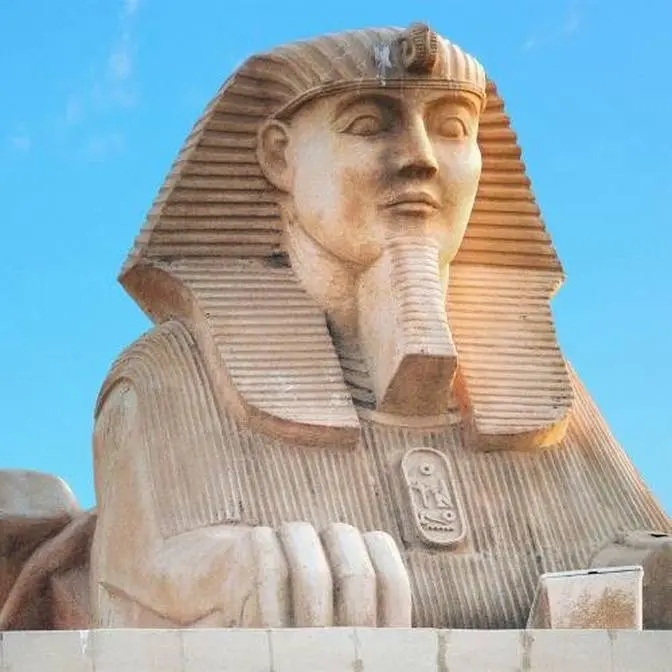
The Great Sphinx of Giza dates to the 26th century BC,
when it was carved from a limestone outcropping by the fourth dynasty pharaoh, Khafre.
After the First Intermediate Period, when the Giza necropolis was abandoned,
the temple in front of the sphinx, which had never been completed,
fell into ruins, and the sphinx itself was largely covered by windblown sand.
Over the centuries, the stones of the adjoining temple
were carried away for use in other building projects.
The sphinx remained buried until the reign of the 18th dynasty pharaoh, Thutmose IV,
who cleared the sand away and built a mud-brick wall around the monument.
The so-called Dream Stele, carved from a lintel block of the original temple,
records that Thutmose was inspired to do this by a dream in which the sphinx offered him the throne.
That's the stele there ahead of us, between the sphinx's paws.
By this period, if not before, the sphinx was being revered as the god
Horus in the Horizon, a symbol of kingship.
Nearly a millennium later, under the 26th dynasty,
the sphinx, still revered as Horus in the Horizon, was restored again.
The famous Inventory Stele, found nearby, dates to this period.
Finally, after Egypt had become a Roman province, a series of restoration projects,
dating at least from the reign of Nero to that of Septimius Severus,
revitalized the sphinx.
Sand was again cleared away from the monument, and the court in front of the sphinx was repaved.
Many of the paving blocks between the sphinx's paws date to this period.
The limestone from which the sphinx was carved is soft and easily eroded by sand and wind.
To repair the weathered areas, the Roman era restorers laid the brick-sized blocks
that make up most of the sphinx's casing.
Although they were reset in the 1930s,
the blocks that line the sphinx's paws are Roman in origin.
The most impressive Roman intervention is unfortunately almost invisible,
since the archaeologists working here in the 1930s removed it to expose older remains.
In front of the sphinx, leading down to it over the buried remains of the old kingdom temple,
the Romans built a monumental staircase 40 feet wide.
Although this has vanished, a narrow staircase that paralleled it at a higher level
is still visible, even with the sphinx's farther paw.
The staircase led to a platform from which,
to judge from the inscriptions found there, dignitaries viewed and revered the sphinx.
Some of the graffiti around this platform were very interesting.
One compared the sphinx to the monster slain by Oedipus.
Another, a poem, celebrated the sacred banquets held in order of Harmachis,
the Greek name of Hormakhet, the deified sphinx.
Tourists and pilgrims came here by the thousands,
drawn by curiosity or piety to this relic of Egypt's ancient grandeur.
But as the Egyptian religion faded in late antiquity,
the stream of visitors slowed to a trickle,
and desert sand began, yet again, to bury the great sphinx.