
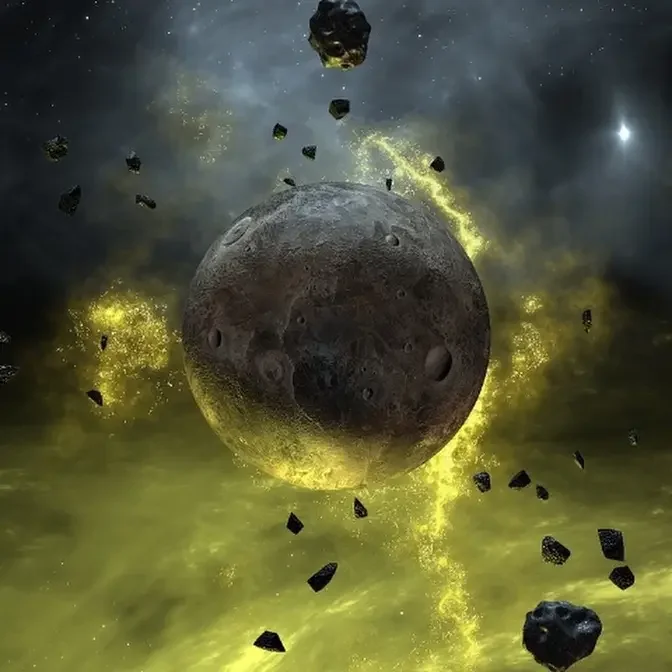
Something Terrifying Happened When A Planet Size Object Passed Through Our Solar System In the Past
#astronomy #science #spacetelescope #oumuamua #interstellar #interstellarobject #interstellarvoyage #voyager #nasa #solarsystem
our solar system has always been AC
Crossroads for Interstellar Travelers
mysterious objects that originate from
other star systems and pass through our
Cosmic neighborhood while many of these
objects simply drift through without
causing any disturbance but some
especially those the size of planets or
even Stars can leave a significant
impact on our solar system structure
there has been much debate and
speculation about these Interstellar
visitors
some scientists believe they are just
natural space debris While others
suggest they could even be artificial
spacecraft sent by intelligent
civilizations from distant planetary
systems the idea of alien technology or
unknown Cosmic forces influencing our
solar system has sparked curiosity and
controversy among astronomers in today's
video we will explore some of the most
intriguing Interstellar objects that
have passed through our Solar system
more importantly we'll discuss an
exciting new study that suggests a
massive Interstellar object possibly as
big as Jupiter may have dramatically
reshaped our planetary system billions
of years ago how did this giant object
enter our solar system what effects did
it have on the arrangement of planets
and could it have played a role in
shaping the solar system as we see it
today join us as we Analyze This fascin
fting Discovery in detail and uncover
the secrets of this ancient Cosmic
Intruder consider this billions of years
ago our solar system started as a huge
cold cloud of gas and dust floating in
space over time gravity pulled parts of
this Cloud together causing it to
collapse and form the early Sun as the
sun took shape the leftover gas and dust
around it didn't just disappear it began
spinning flattening out into a giant
disc-shaped Cloud called the
protoplanetary disc inside this disc
tiny dust particles stuck together
forming bigger and bigger clumps over
millions of years these clumps grew into
asteroids moons and eventually the
planets we see today as we can see all
the planets were born from this same
spinning disc they naturally continued
moving in the same general direction and
in nearly the same flat plane around the
Sun and this is why when we look at the
solar system from the side it appears
mostly flat like a thin disc with
planets neatly orbiting in a line but
wait scientists noticed something
puzzling about this Theory according to
their models most planets should have
formed much closer to the Sun than where
they are now but if that's the case how
did they end up so far away this mystery
puzzled scientists for decades to
explain this they developed a new Theory
called planetary migration this Theory
suggests that planets didn't stay in
their original positions instead
interactions with leftover gas dust and
even other planets caused them to slowly
drift to new orbits some moving farther
from the Sun and others shifting inward
for example Uranus and Neptune likely
formed closer to the Sun but later moved
outward to where they are now
meanwhile some smaller planets that were
forming got thrown out of the solar
system altogether while this planetary
migration Theory helps explain to some
extent why the solar system looks the
way it does today however there are
still some unanswered questions left
like the orbits of the gas giants like
Jupiter Saturn Uranus and Neptune aren't
perfectly circular and show strange
patterns that current migration theories
can't fully explain these irregular
orbits suggest that something else may
have happened in the past surprisingly a
recent study published on December 5th
2024 by Garrett Brown and his team sheds
new light on the eccentricities in the
orbits of these gas giants their
research introduces the intriguing idea
of interstellar flybys as a potential
explanation for these Oddities offering
a more satisfying answer than current
migration theories
Brown and his team suggest that the
configuration we see today may not be
the result of internal mechanisms alone
but could also be influenced by
something much larger passing through
our solar system according to their
calculations if an object between 2 to
50 times the mass of Jupiter flew within
20 astronomical units away from our
solar system center it could account for
the unusual orbits of the gas giants
through computer simulations they
estimate the odds of this happening at 1
in 100 which is fairly high for an event
of this nature currently this is only a
proposed Theory to explain the unusual
eccentric orbits of the gas giants in
our solar system you might think this is
just a theory and that the chances of a
massive object passing through our solar
system in the past are very low but
here's the surprising part scientists
have gathered strong evidence showing
that many giant objects have passed
through our solar system over time and
even more astonishing research suggests
that a star once came very close to our
solar system in the past in 2013 during
one of his regular visits to Santiago
Chile Professor Eric mamek of the
University of Rochester was shown an
interesting Discovery by a fellow
astronomer Valentine Ivanov the finding
involved a nearby by star nicknamed
Schultz's star this star caught their
attention because it seemed almost
motionless typically Stars shift
slightly across the sky each year a
movement measured in tiny units called
ark seconds but Schultz's star hardly
moved at all even though it was only 22
light years away a close Distance by
Cosmic standards Mama realized there
could only be two explanations for such
Behavior either the star was heading
straight toward us or moving directly
away to solve the mystery they examined
its Doppler shift a shift toward red
would mean it was moving away while a
shift toward blue would indicate it was
approaching after some quick
calculations mam confirmed that the star
was moving away from us at 80
km/s this meant that about 70,000 to
880,000 years ago Schultz's Star had
passed extremely close to our solar
system within just one light year for
comparison the closest stars to the sun
today the alpha centari system are about
four light years away Schultz's star
pass through the outer edges of our
solar system even grazing the ort Cloud
which is a region of icy bodies
surrounding the sun this was a rare and
extraordinary event as no other known
star has come this close to the Sun done
in recorded history this finding
supports the idea that in the distant
past Interstellar objects as massive as
stars may have passed through or near
our solar system disrupting the
arrangement of planets with their
gravitational pull even more fascinating
and potentially concerning is that such
events are not rare astronomers estimate
that a star passes through the or Cloud
roughly every 100,000 years and a closer
encounter within 52,000 astronomical
units might occur about once every 9
million years these near misses could
significantly impact the solar system
potentially altering the paths of comets
or even planets this discovery raises
important questions could another
massive object pass near Earth in the
future how might it affect our solar
system while such events are rare on
human time scales they remind us of the
dynamic and everchanging nature of the
universe however this new Theory
suggests that even the sun's powerful
gravity may not be enough to protect us
from disruptions caused by large foreign
objects from outside the solar system
this kind of event could have thrown the
entire arrangement of planets into chaos
demonstrating how vulnerable even our
well-ordered solar system might be to
the influence of interstellar objects