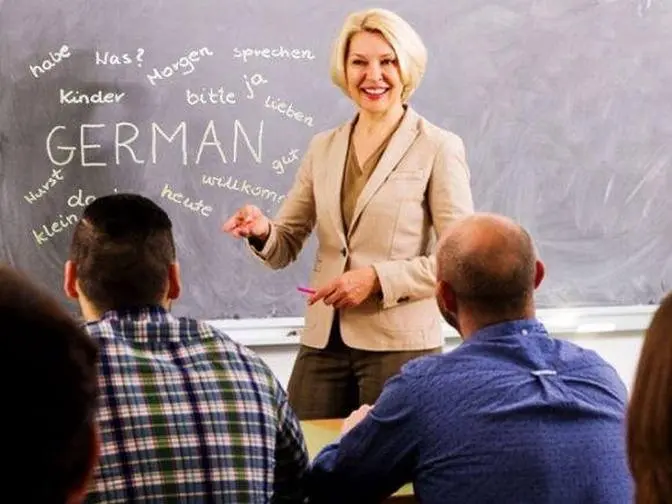
Step 1: Go to https://bit.ly/3YhwSa5 Step 2: Sign up for a Free Lifetime Account - No money, No credit card required Step 3: Achieve Your Learning Goal and master German the fast, fun and easy way!
With this video compilation you'll be able to get started with the German language and introduce yourself fast!
You've decided to start learning German, so let's build up your vocabulary! In this video, you'll learn some of the most important words and phrases in the German language. If you want to start learning German, this video is made for you. Our host expresses herself in simple German, with subtitles. This video will challenge your listening comprehension skills and help you progress in your German study.
This is the fastest, easiest way to pick up basic German!
Also, please LIKE, SHARE and COMMENT on our videos! We really appreciate it. Thanks!
Do you feel like you don't speak enough German?
That you need to know more words?
Then stick around.
With these lessons, you'll pick up some of the most common words in just a few minutes.
Now, this video is a small portion of our learning program.
To get the full lessons, translations, and fluency fast study tools,
click the link in the description and sign up for your free lifetime account.
Yay!
Hi, it's Alisa.
Welcome to a new video lesson.
10 lines you need to know for introducing yourself.
Let's begin!
Mein Name ist Alisa.
My name is Alisa.
Mein Name ist Alisa.
What's your name?
Was ist dein Name?
Hallo, es ist schön, Sie kennenzulernen.
Hello, it's nice to meet you.
Hallo, es ist schön, Sie kennenzulernen.
Hello, it is nice to meet you.
As in English, when you introduce yourself and you meet somebody for the first time,
you just add, of course,
Es ist schön, Sie kennenzulernen.
It is nice to meet you.
Eines meiner Hobbies ist, mit meinem Hund spazieren zu gehen.
One of my hobbies is to walk my dog.
Eines meiner Hobbies ist, mit meinem Hund spazieren zu gehen.
One of my hobbies is to walk my dog.
If you've seen some of my other videos, you know that I have a dog, a German Shepherd,
and I actually love to go on a walk with him and play with his ball.
He loves it.
Yeah, what is your hobby?
Ich bin Jahre alt.
I am years old.
Ich bin … Jahre alt.
I am … years old.
Wie alt bist du?
How old are you?
Ich bin Grafik- und Textildesignerin.
I am a graphic and textile designer.
Ich bin is used for many, many things.
It's something you should definitely learn and memorize because it's for almost everything.
Ich bin hungrig.
I'm hungry.
So ich bin, in this case, is referred to your profession.
So please tell me, what do you do?
Ich komme aus Deutschland.
I am from Germany.
Ich komme aus Deutschland.
I am from Germany.
Woher kommst du?
Where are you from?
Leave me in the comments.
Ich höre gerne Musik.
I enjoy listening to music.
Ich höre gerne Musik.
I enjoy listening to music.
What is your favorite kind of music?
Was ist deine Lieblingsmusik?
Ich lebe in … I live in …
I live in … Ich lebe in Köln.
I live in Cologne.
I used to live there.
Now I don't, but Cologne is a very fun city.
If you have a chance, go visit.
Yeah, where do you live?
Wo lebst du?
Leave in the comments.
Ich lerne seit … Jahren Deutsch.
I've been learning German for … years.
Ich lerne seit … Deutsch.
I've been learning German for blank.
Obviously, I grew up talking German.
Ich lerne Deutsch auf GermanPod101.com.
I'm learning German at GermanPod101.com.
Ich lerne Deutsch auf GermanPod101.com.
I'm learning German at GermanPod101.com.
How long have you been learning German with GermanPod101.com?
Thank you for watching the top 10 lines you need to know for introducing yourself.
Please don't forget to subscribe and leave me in the comments what was your favorite line.
Bye!
Back to the basics.
Mein Name ist Alisa.
My name is Alisa.
So that is a very important sentence you need to know.
Okay, that was so not funny.
Hi, okay.
Welcome to Can Do German by GermanPod101.com.
Hallo zusammen, ich bin Katrin Preußler.
Hi everyone, I'm Katrin Preußler.
In this lesson, you'll learn how to tell someone where you're from in German.
Want to know if your German skills are improving and what your real learning level is?
Get your language skills assessed with our free level assessment test.
Just click the link in the description and sign up for a free lifetime account to get assessed.
This is Mark Lee and he's on a plane to Germany.
Marvin Maas, a passenger sitting next to him, asks, where are you from?
Listen to the conversation and focus on Mark's response.
Note the speakers in this conversation use informal German.
Ready?
Once more with the English translation.
Where are you from?
I'm from New York.
Let's take a closer look at the conversation.
Do you remember how Marvin Maas asks, where are you from?
First is
meaning where from.
Next is
come as in you come from.
is from the verb
meaning to come as in to come from in this context.
Last is
you
Note in German
is used when addressing someone in a casual conversation.
Altogether
literally where from come you.
But it translates as where are you from?
Remember this question.
You'll hear it again later in this lesson.
Now let's take a closer look at the response.
Do you remember how Mark Lee says, I am from New York.
First is
Next is
come as in I come from.
is from the verb
to come
Next is
meaning from in this context.
Last is the city.
Altogether
This literally means I come from New York.
But it translates as I'm from New York.
The pattern is
I'm from location.
To use this pattern, you can simply replace the location placeholder
with the name of your hometown.
Note this pattern requires a proper noun
and works with the names of cities, villages, towns and countries.
Imagine you're from Sydney.
In German
Say I'm from Sydney.
Ready?
Note on German language formality.
Mark and Marvin are using informal language in this conversation.
So Marvin asks
Where are you from?
To make the question formal replace
with the
Therefore in a formal setting.
Where are you from?
Please be aware of this as you will see it again later in the lesson.
Let's look at some examples.
Listen and repeat or speak along with the native speakers.
Ich komme aus Kiel und du?
Ich komme aus Seattle.
Ich komme aus London und sie?
Ich komme aus Deutschland.
Ich bin Australierin.
Did you notice how the last speaker uses a different pattern?
Wondering how you can master these conversations even faster?
Here's how.
1. Read along.
You get the lesson conversation and translations inside our dialogue tool
so that you see each word as you hear it and understand it all.
2. Practice speaking.
By shadowing what you hear, you can also record and compare yourself
with native speakers with our voice recording tools.
And 3. Take our assessment tests and see how much you remember.
These tools are part of our CanDo course.
Just click the link in the description to get them.
I'm Australian.
First is
I
Next is
Am
As in I am
Is from the verb
Meaning to be
Together it's
I am
After this is
Meaning Australian
Australierin
Note
Is feminine as the speaker is female.
This pattern is
Ich bin nationality
I'm nationality
To use this pattern, simply replace the nationality placeholder with your nationality.
Note this pattern requires a noun and its gender will depend on the gender of the speaker.
Mia Martin uses a feminine noun
to identify herself.
A male speaker from Australia would use the masculine noun
I'm Australian
You can use this pattern to answer the question
You should be aware of this pattern, but you won't need it for this lesson.
Let's review the new vocabulary.
Germany
Male Australian citizen
Female Australian citizen
And you? Informal language
And you? Formal language
Let's review.
Respond to the prompts by speaking aloud.
Then repeat after me, focusing on pronunciation.
Ready?
Do you remember how to say New York?
New York
And how to say from?
Do you remember how to say I?
Do you remember how Mark says I'm from New York?
Literally, I come from New York.
Ich komme aus New York.
Do you remember the informal way to say you?
And how to say where from?
And do you remember how Mother Mars asks where are you from?
Do you remember how to say London?
And how to say Seattle?
Do you remember how to say Germany?
And the formal way to say you?
Sie
Do you remember the formal way to ask where are you from?
And the informal way to ask and you?
Let's practice.
Imagine you're Jack Jones from London.
Respond to Marvin Moss's question.
Ready?
Listen again and repeat.
Let's try another.
Imagine you're Emma Eckert from Seattle.
Respond and add the informal and you.
Ready?
Listen again and repeat.
Let's try one more.
Imagine you're Katrin Preussler from Germany.
Ready?
Listen again and repeat.
Ich komme aus Deutschland.
This is the end of this lesson.
Now, here's what you can do to cement this conversation in your head.
Review the conversation with our dialogue tool and lesson transcripts.
Study the key words and phrases with our spaced repetition flashcards.
Review the key grammar and cultural tips inside the lesson notes.
And test yourself with our assessment tests.
So click the link in the description right now
and sign up for your free lifetime account to access our CanDo course.
Now you know how to say where you're from in German.
That's all there is to it.
Keep practicing and move on to the next lesson.
In this series, we are going to learn basic German expressions.
It's super easy and it only takes three minutes.
In this lesson, we are going to learn how to introduce ourselves in German.
We'll start speaking right away.
But first, it's important to clarify that in German,
there is a difference between the formal and the informal language.
Let's first see how German people introduce themselves in an informal situation.
Hallo, ich heiße Laura. Schön, dich kennenzulernen.
Hi, I'm Laura. Nice to meet you.
Hallo, ich heiße Laura. Schön, dich kennenzulernen.
Start by saying Hallo, ich heiße, then say your name.
Hallo, ich heiße Laura.
Finally say Schön, dich kennenzulernen.
Hallo, ich heiße Laura. Schön, dich kennenzulernen.
And now, let's see the same sentence in formal speech.
Guten Tag, ich heiße Laura Maier. Schön, Sie kennenzulernen.
Good day, I'm Laura Maier. Nice to meet you.
Guten Tag, ich heiße Laura Maier. Schön, Sie kennenzulernen.
So, what has changed from the previous introduction?
Let's take a close look at these expressions together.
Hallo has been substituted with the formal greeting Guten Tag, German for good day.
Ich heiße Laura has not been changed. Ich heiße simply means I am.
However, during a formal self-introduction, we also say our last name.
So, I said Laura Maier. Here, you would say your full name.
Finally, pay attention to the ending.
We went from dich kennenzulernen to Sie kennenzulernen.
What is changing is the German word for you.
In a formal sentence, we use the more polite word Sie.
One more time.
The informal way to introduce yourself in German is Hallo, ich heiße Laura.
Schön, dich kennenzulernen.
The formal way to introduce yourself is Guten Tag, ich heiße Laura Maier.
Schön, Sie kennenzulernen.
Now it's time for Laura's insights.
When you introduce yourself, it's a good habit to shake hands.
If you're not sure whether to use Schön, dich kennenzulernen or Schön, Sie kennenzulernen,
just say simply Sehr erfreut, as I said at the beginning of this lesson.
If you use the correct sentence with German people,
they're definitely going to be impressed.
That's it for this lesson.
Do you know how we say thank you in German?
We'll learn how to say this and many other words in the next lesson.
Bis bald zur nächsten Lektion.
See you then.
Hey everyone, Alisha here.
Welcome to Conversational Phrases.
We've found that the best way to learn a language is to speak it from day one,
and the best way to start speaking is to learn phrases that you'll use in real conversations.
In this lesson, we'll learn conversational phrases to answer the question,
How's your mother?
After watching this video, you'll be able to talk about well-being and ask how someone is doing.
And if you want to learn more vocabulary,
phrases and example sentences you can use in real-life situations,
click the link in the description to download your
Conversation About Family Well-Being PDF Cheat Sheet for free.
Now let's take a look at some conversational phrases.
Listen to the dialogue.
Wie geht es deiner Mutter?
Once more with the English translation.
How's your mother?
She's fine.
First of all, you'll need to learn how to say,
How's your mother?
That's
Listen to it again.
This German sentence literally means,
How goes it for your mother?
But it translates as,
How's your mother?
in English.
Now, how do you answer this question?
The pattern is,
state of well-being.
She is state of well-being in English.
For example,
She's fine.
Here are a few expressions related to well-being that you can use with this pattern.
Great
Fine
So-so
Not good
Let's look at some examples.
Listen and repeat or speak along with the native speakers.
Okay, now it's your turn.
Do you remember how to say,
How's your mother?
Imagine she's great.
Do you remember how to say,
Great?
Say,
She's great.
Now, answer the question saying,
She's great.
Now imagine she's so-so.
Do you remember how to say,
So-so?
Say,
She's so-so.
Now, answer the question saying,
She's so-so.
Now imagine she's not good.
Do you remember how to say,
Not good?
Say,
She's not good.
Now, answer the question saying,
She's not good.
In this lesson, you learned new vocabulary and phrases you can use in your everyday life to
talk about well-being.
You're now able to talk about how someone is feeling like a native speaker.
Start by practicing in the comments below.
Tell me how you are today.
Lastly, don't forget to click the link in the description and download your PDF cheat sheet.
You'll get useful phrases you need for everyday life for free.
See you in the next lesson.
Bye.
Remember, here's what you can do to learn all of these words by heart.
Drill these words with our spaced repetition flashcards,
which will help cement these words into your long-term memory.
Save them to the Word Bank, your personal vocabulary collection,
where you can print out your own study sheets,
or review the words with our looped vocabulary slideshow,
and play it until you know all of the words.
So click the link in the description right now
and sign up for your free lifetime account to get these lessons and study tools.