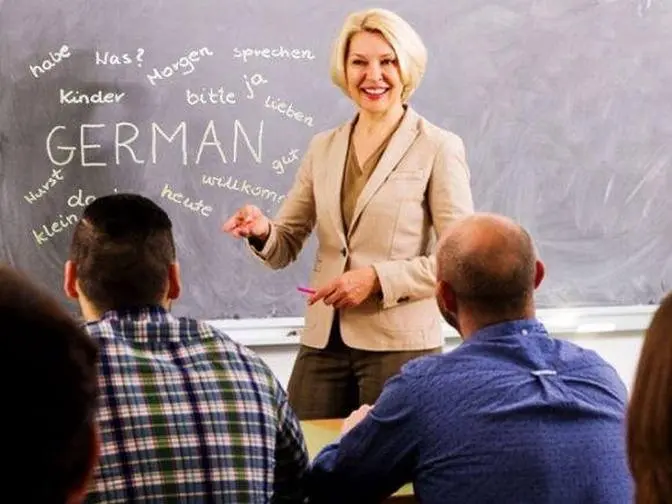
In diesem Video zeige ich dir eine Methode, mit der du schneller, fließender und sicherer Deutsch sprechen lernst, ohne zu viel zu überlegen!
🔔 Vergiss nicht, unseren Kanal zu abonnieren und die Glocke zu aktivieren, um keine weiteren hilfreichen Tipps zum Deutschlernen zu verpassen!
Viel Spaß beim Zugucken!
Hier findest du weitere Tipps, wie du es schaffst, auf Deutsch zu denken und nicht alles in deine Muttersprache zu übersetzen: • Hör auf, alles zu übersetzen! So schaffst ...
🚀Hör dir unseren brandneuen Podcast auf Spotify an und lerne Deutsch ganz nebenbei: https://t.ly/uO3b6
Welcome back to our channel.
I'm Laura, German native speaker and German teacher.
In today's lesson, I would like to introduce you to a method
that can help you speak German more fluently and safely.
Namely, learning with so-called chunks.
What do I mean by that?
Maybe you've never heard the term before.
But chunks are a real key to natural and authentic German.
In this video, I will explain what chunks are,
why they are so helpful,
and how you can use them in your everyday life.
I will also show you some examples
that you can use right away.
So let's get started. Let's go!
The term chunk actually comes from English
and means as much as building blocks or pieces.
In language lessons, you use it to describe fixed word groups
that are often used together.
In other words, they are small units
that you don't have to analyze word by word,
but can learn as a whole.
A simple example.
This is a typical chunk that you can use in many everyday situations.
You don't have to worry about which preposition
or which verb you should use.
You learn this chunk as a fixed expression.
So you don't think,
It depends on it.
Or on top of it.
Why actually on top of it?
It depends on it.
You save these thoughts and doubts
by learning certain expressions as such building blocks, chunks,
and storing them in your brain.
The special thing about chunks is that they help you
not only to speak grammatically correctly,
but above all more naturally.
Mother tongues use such fixed expressions all the time,
often very unconsciously.
Pay attention when you speak your mother tongue.
You don't analyze every sentence and think,
Which word do I need next?
Where is the verb?
Which preposition comes here?
But certain word groups also automatically come out of you as a unit.
So when you use chunks,
your German seems more fluid and less memorised.
It also saves you time and energy
because you don't have to think about the grammar in every sentence.
Maybe you know the situation.
You have a conversation in German
and suddenly you can't think of the right word.
Or you are unsure how to formulate a sentence correctly.
That can be quite frustrating.
And this is where chunks come into play.
Chunks are like small tools that you can use directly.
They help you to express yourself clearly
without having to think for a long time.
Instead of learning a single word,
you learn a whole conversation that is complete in itself.
Another advantage is that chunks are flexible.
You can use them in different contexts.
In addition, learning chunks trains your language sense.
You get used to typical sentence patterns and conversations
as they are really used in German.
So you build up a foundation step by step
that supports you in many everyday situations.
I have chosen some of these chunks
that we can hear especially often in everyday life.
It's best if you repeat after me loudly
and then read the example with me.
Now you.
Do you happen to know where my cell phone is?
I have no idea. I'm sorry.
Do you know when the train to Munich leaves?
I got lost.
That means something like I got lost or mistaken.
Oh, sorry. I sent you the wrong address.
I got lost. Here is the right address.
Now you.
I thought the meeting was at 3 p.m.
I'm already looking forward to it.
Pay attention to the pronunciation here.
In many regions of Germany, the A is swallowed.
We say I'm already looking forward to it and not to it.
But as I said, that's regionally different.
So we'll meet at 4 p.m.
Yes, I'm already looking forward to it.
You're going on vacation next week, aren't you?
I forgot that.
How do you say residence permit in English again?
I forgot that.
Now you.
Did you bring the cake?
I can't remember.
How do you say residence permit in English again?
I can't remember.
Now you.
Do you remember which year Uncle Fritz was born?
I'm busy right now.
Can you help me?
I'm sorry. I'm busy right now.
Maybe later?
Now you.
Have you already called Anna?
That's happened to me before.
Oh man, I forgot my house key again.
That's happened to me before.
Very annoying.
I accidentally deleted an important document.
I can't imagine that.
Have you heard?
Tom wants to quit his job and travel the world.
I can't imagine that.
He just started here.
Now you.
Maria said she wants to jog 50 km today.
That doesn't make sense.
Why do we have to fill out two forms that are exactly the same?
That doesn't make sense.
Such a waste of time.
Why is the store closed on Mondays but open on Sundays?
That's unbelievable.
I heard Tanja won the lottery.
That's unbelievable.
How much did she win?
I read that some turtles can be over 150 years old.
Can you do me a favor?
Can you upload the presentation for me?
Of course.
Now you.
Of course. I'd love to.
Please let me know.
Please let me know when you have time tomorrow.
Then we can meet.
Now you.
I'll do that.
So, those were some of our everyday jokes.
I'm sure you already knew some expressions, right?
Try to remember them now
and use them in the next opportunity.
It's best to write your own example in the comments below
to practice.
And if you want more tips on how you can
speak German more fluently and spontaneously
without thinking too long,
check out this video.
See you there.
Take care.