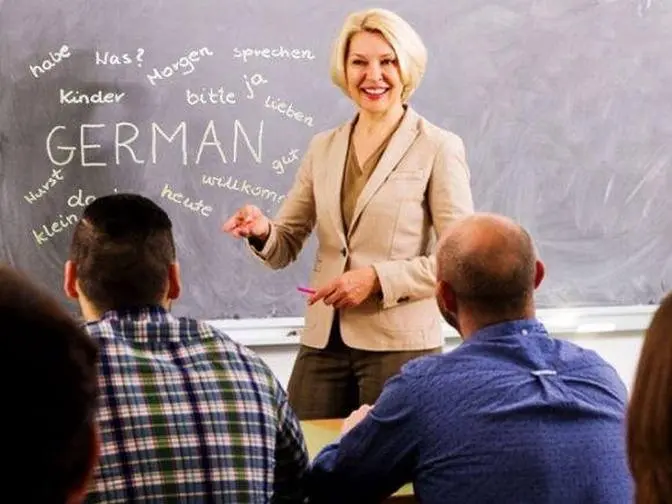
In diesem Video zeige ich dir 10 wichtige Chunks für den Alltag – also feste Wendungen und Ausdrücke, die du als Ganzes lernen kannst. So musst du nicht jedes Mal über Grammatik oder Artikel nachdenken, sondern kannst spontan, flüssig und natürlich Deutsch sprechen.
Du lernst: ✅ Wie du mit Chunks stressfrei auf Deutsch antwortest ✅ Formulierungen, die Muttersprachler täglich verwenden ✅ Sprechtraining mit Nachsprechen und Mini-Dialogen ✅ Warum lautes Üben dein Sprachgefühl verbessert
Wir üben gemeinsam – und du bekommst zu jedem Ausdruck ein kleines Rollenspiel. So trainierst du nicht nur deine Reaktionsfähigkeit, sondern prägst dir die Struktur und den Klang der Sätze ein.
🔔 Vergiss nicht, unseren Kanal zu abonnieren und die Glocke zu aktivieren, um keine weiteren hilfreichen Tipps zum Deutschlernen zu verpassen! Viel Spaß beim Zugucken!
🚀Hör dir unseren Podcast auf Spotify an und lerne Deutsch ganz nebenbei: https://t.ly/uO3b6
Hello and nice to have you back!
If you're new here, I'm Laura, a German teacher and native speaker
and I've been teaching German for adults for 15 years now.
My goal is to help you speak German more fluently, naturally and with more confidence.
And maybe you know this.
You want to say something, but suddenly a thousand questions shoot through your head.
Was that an accusative or dative?
Is it der, die or das?
And in the end, you don't say anything.
This happens to many people.
But there's a method that helps you with this exact point.
It's tested, it comes from linguistics and it works.
I'm talking about so-called chunks.
These are solid linguistic components that you learn as a whole,
instead of thinking word for word.
With chunks, you don't have to think about the grammar every time.
You just remember the complete formulation and can use it right away.
You can imagine it like driving a car.
In the beginning, you have to think about everything.
Clutch, indicator, gear.
But the more you drive, the more everything happens automatically.
And it's the same with learning languages.
The goal is that you can spontaneously say sentences and sentences without thinking.
And that's why I'm going to show you 10 important chunks for everyday life today.
And we're going to practice them together.
With a technique that seems to be indicative.
Speaking to the sound.
Why?
Because your brain builds up connections between hearing, speaking and remembering in this way.
You better remember the sound, the rhythm and the structure of the sentence.
And you get used to your own voice in German.
This is an important step if you want to speak more fluently and safely.
Before we start, an important note.
There is a free PDF for this video,
in which all chunks and example sentences can be read and spoken again.
You can simply download it via the link below the video.
This is ideal if you want to repeat the expressions regularly or express the PDF.
But now we're going to start with our examples. Let's go!
I'm going to read each chunk to you twice.
And you repeat after me.
Then we're going to play a mini role-playing game.
I'm going to ask you a question and you're going to answer me.
This way, you're not only training your sense of speech, but also your ability to react.
And let's start with our first expression.
That's not what I meant.
You say that if you notice that someone has misunderstood something and you want to explain yourself.
That's not what I meant.
Now you.
Why did you answer so strangely?
Now you.
That's not what I meant. I didn't want to hurt you.
Let me think for a moment.
With this expression, you gain time to think without it looking impolite.
Repeat after me.
Let me think for a moment.
Do you have time tomorrow afternoon?
Let me think for a moment.
Yes, it's okay from 3 p.m.
Unfortunately, that's not possible.
This is a polite way of saying no when something is not possible.
Repeat after me.
Unfortunately, that's not possible.
Can we meet at 5 p.m. today?
Unfortunately, that's not possible. I already have another appointment.
As always.
This expression means I take or do what I usually take or do.
Nothing has changed.
As always.
What can it be? Cappuccino or espresso?
As always. A cappuccino, please.
I don't know exactly.
This is a typical answer when you are not sure or have to check something.
Repeat after me.
I don't know exactly.
When is your German course again?
I don't know exactly. I have to check again.
I'm not sure about that.
This is a more formal version of I don't know exactly.
I'm not sure about that.
Do you know if the bus at line 17 has already left?
I'm not sure about that, but I would wait a little longer.
This is really annoying.
This is what you say when something really bothers you or happens over and over again to express frustration.
This is really annoying.
My laptop has hanged up again.
This is really annoying.
I'll be right there.
A typical sentence in everyday life when you are about to be there but still have to finish something.
I'll be right there.
Dinner is ready.
I'll be right there. I'm just about to finish something.
Sounds good.
This is a relaxed, positive reaction when you agree with a suggestion.
Sounds good.
Do you want to cook something tonight?
Sounds good. I'm in the mood for pasta.
Let's see.
With this you keep a decision open. Friendly, but not binding.
Let's see.
Are you going to Anna's party?
Let's see. I decide spontaneously.
This type of practice is particularly effective if you do it regularly.
Take a few minutes every day.
Repeat the sentences loudly or speak them into a language memo app and listen to them again later.
The more often you do this, the better your brain stores these structures.
And at some point you will realize that you don't have to think so long anymore.
You just speak.
And that's exactly our goal.
Not speaking perfectly, but naturally, intelligently and spontaneously.
And with the right method, this is possible.
Think again about the PDF for the video.
You will find all the chunks and examples there, collected and clear.
The link is directly below the video.
And if you want to continue practicing right now,
on our channel there are already more chunks videos with voice training, dialogues and examples.
I look forward to seeing you there.
See you there. See you soon.