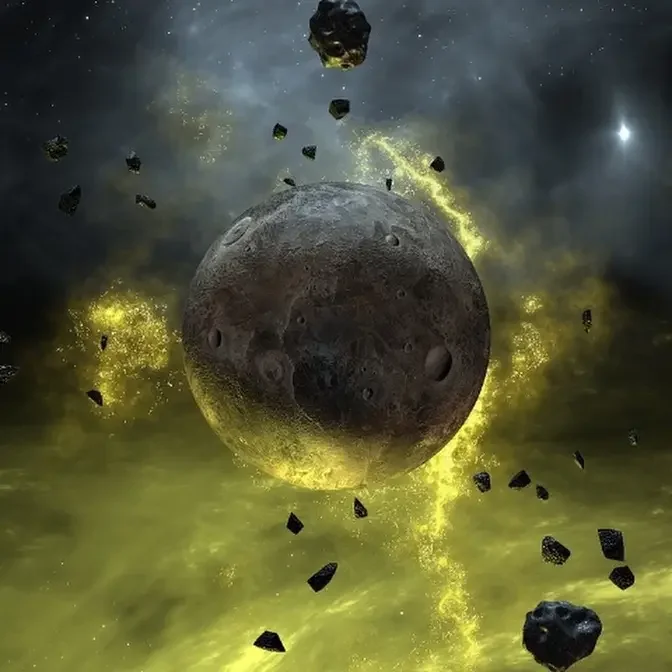
interstellar visitor to our solar system zipping in at an incredible speed of about 137,000 miles per hour. Right now, this mysterious object has entered the asteroid belt, the region of space that lies between Jupiter and Mars. Scientists say it will safely pass through this area without any danger. Like most comets, its speed is increasing as it gets closer to the Sun, and by late October 2025, it is expected to hit its peak speed of 152,000 mph. But here’s the surprising part: ever since its discovery, 3i-Atlas has been puzzling scientists with strange and unpredictable behavior.
Recently, it shocked researchers by suddenly glowing much brighter than expected, completely defying earlier predictions. No one knows what caused this outburst of brightness. What’s even more mysterious is that when 3i-Atlas was first spotted, it didn’t look like a normal comet at all. Unlike typical comets, where light comes from a glowing cloud of gas and dust around them, the light from this object seemed to come directly from its surface.
This raised a big question: Is the object producing its own light? Some scientists even suggested it might be an alien spacecraft disguised as a comet, though others argued that its reddish color and thin layer of dust could simply be reflecting sunlight in an unusual way.
On July 1st, 2025,
astronomers detected the third
interstellar visitor to our solar
system, zipping in at an incredible
speed of about 137,000 mph.
Right now, this mysterious object has
entered the asteroid belt, the region of
space that lies between Jupiter and
Mars. Scientists say it will safely pass
through this area without any danger.
Like most comets, its speed is
increasing as it gets closer to the sun.
And by late October 2025, it is expected
to hit its peak speed of 152,000 mph.
But here's the surprising part. Ever
since its discovery, three Atlas has
been puzzling scientists with strange
and unpredictable behavior. Recently, it
shocked researchers by suddenly glowing
much brighter than expected, completely
defying earlier predictions. No one
knows what caused this outburst of
brightness. What's even more mysterious
is that when threeey atlas was first
spotted, it didn't look like a normal
comet at all. Unlike typical comets,
where light comes from a glowing cloud
of gas and dust around them, the light
from this object seemed to come directly
from its surface.
This raised a big question. Is the
object producing its own light? Some
scientists even suggested it might be an
alien spacecraft disguised as a comet,
though others argued that its reddish
color and thin layer of dust could
simply be reflecting sunlight in an
unusual way. But the mysteries didn't
stop there. As this strange interstellar
object moved closer to Mars, it started
doing things we've never seen in natural
comets. First, its color suddenly
changed from red to green, which is
extremely unusual. Then, as it entered
the asteroid belt, its brightness shot
up dramatically. When first detected,
the comet's brightness was extremely
faint, around 18th magnitude. Recently
it has brightened dramatically to about
12th magnitude. To put this into
perspective in astronomy a lower
magnitude means greater brightness. So
this is a massive jump. While comets
normally brighten as they approach the
sun. Three eye atlas hasn't followed the
expected smooth curve. Instead its
brightness has been fluctuating in
sudden unexplained bursts. On top of
that, the green glow of the interstellar
visitor is still a mystery. Many comets
in our solar system shine green because
of dicarbon molecules evaporating from
their surface. Yet, surprisingly,
observations of three atlas show very
little evidence of dicarbon. Instead,
data from the James Web Space Telescope
revealed a strange chemical mix
containing unusually high amounts of
carbon dioxide along with traces of
nickel and cyanogen. But none of these
are known to create the bright green
glow we are seeing. The molecule that
normally causes green fluoresence simply
hasn't been found. This means three eye
atlas must be glowing green because of
some other unknown gas. Or as a few bold
scientists suggest, perhaps it's being
powered by a hidden artificial energy
source like a nuclear reactor.
Scientists suggest the sudden
brightening of three eye atlas could be
explained by rapid evaporation of
volatile materials on or near its
surface as it gets closer to the sun.
When a comet heats up quickly, it can
release huge amounts of gas and dust,
making it look brighter almost
overnight. This is called an outburst,
and we've seen it happen with comets
before. Now, when this outgassing
becomes too intense, it can put a lot of
pressure on the comet's surface and
interior. If the nucleus isn't stable,
parts of it can break off into large
fragments. Astronomers have observed
this with several comets. For example,
comet Shoemaker Levy 9, which broke into
multiple pieces before colliding with
Jupiter in 1994.
But some scientists believe that it
cannot be a mere coincidence that this
object is behaving exactly like a
spacecraft while approaching Mars. This
is where things get even more
interesting. In a recent article on
medium, Harvard astronomer AI lobe put
forward a bold idea. He suggested that
threeey atlas might not be a natural
object at all but a spacecraft from
another civilization. According to him,
this interstellar traveler could be
capable of releasing many probes while
passing through our solar system. And he
believes that three eye atlas's sudden
intense brightness could break off small
pieces and send them hurdling toward
Mars, similar to a mother ship releasing
many probes.
Well, there are two possibilities. If
it's a technological object, then it
might maneuver
uh itself. Uh we haven't seen such a
maneuver so far. But the other
possibility is that it may release some
other objects that reach uh the planets
and it will continue along its course to
the next star. He even speculated that
the sudden appearance of comet C2025F2
or swan could actually be a fragment or
probe released by three eye atlas
itself, possibly on purpose as it passed
near Mars. However, further observations
by Avi Loab and his team showed that the
newly discovered comet C2025F2
is actually traveling from the opposite
direction of three eye atlas. This ruled
out the idea that it might be a fragment
or probe released by the interstellar
visitor. Still, Loab suggested that we
shouldn't dismiss the mystery so
quickly. He advised keeping a close
watch on this strange interstellar
visitor, hinting that it could still do
something unnatural when it passes near
Mars on October 3rd. We should not
forget that this object is far stranger
than a normal comet. Interestingly, it
came from the same region of the sky,
the direction of the Sagittarius
constellation, where strange and
unexplained radio signals have been
detected for decades. Among them is the
famous WOW signal, one of the biggest
mysteries in astronomy. This connection
adds another layer of intrigue. Some
scientists have even suggested that
threeey atlas might not be a natural
comet at all, but possibly a spacecraft
designed by another civilization to look
like one. What makes it even more
puzzling is its unusual path through our
solar system. Its trajectory runs almost
perfectly parallel to the plane of the
solar system, something too precise to
dismiss as mere coincidence. Even more
curious, threeey atlas makes close
approaches to several neighboring
planets. Yet, it seems to deliberately
avoid Earth. And when it reaches
perihelion, its closest point to the
sun, it will be positioned exactly
behind the sun from Earth's perspective,
as if hiding from our view. This too
feels like more than just chance. If an
alien object is cleverly disguised as a
natural comet, hiding behind the sun at
perihelion could give it the perfect
cover. From Earth's point of view, the
sun blocks our telescopes and
instruments from seeing what's happening
in that region. This means the object
could change its speed, alter its
course, or even release smaller probes
without being noticed. The sun's glare
would mask all these activities. At the
same time, being close to the sun
provides a strong source of energy. If
the object were artificial, it could use
this moment to recharge using solar
power or even refuel in some unknown
way. Adding to the mystery, before 2017,
we had never detected a single
interstellar object. But within less
than a decade, we have now spotted three
Umuwa Mua, two I Borisov, and now three
Atlas. Is this just a coincidence or
have such visitors always passed through
and only now we have the technology
sensitive enough to detect them? Well,
this combination of strange features, a
glowing surface instead of a normal gas
cloud, a sudden shift in color from red
to green, its extremely rare path
through our solar system, its origin
from the same direction where mysterious
signals were once detected, and its
recent unpredictable jumps in brightness
has made three eye atlas one of the most
puzzling cosmic objects ever observed.
Scientists are planning to observe this
new interstellar visitor when it will
pass very close to Mars on October 3rd,
2025.
NASA's Mars Reconnaissance Orbiter,
which carries the powerful high-rise
camera, is expected to try capturing
images of the object. The camera could
show details as small as about 30 km per
pixel, which though not sharp enough to
see small features, will still provide
valuable information. This can make it
clear whether the object produces its
own light or not. Scientists are excited
because this might be the first time an
interstellar object is imaged from
another planet. Other spacecraft such as
NASA's Psyche mission and ESA's Juice
Probe might also get close enough in
late 2025 to observe it. That's the end
of this video. If you found it
interesting and informative, let us know
your thoughts in the comments. We'd love
to hear from you. Also, if you'd like to
support our work, you can do so by
purchasing our t-shirts or donating via
Superthanks. Your support helps us
create more amazing content. Thank you
for watching.