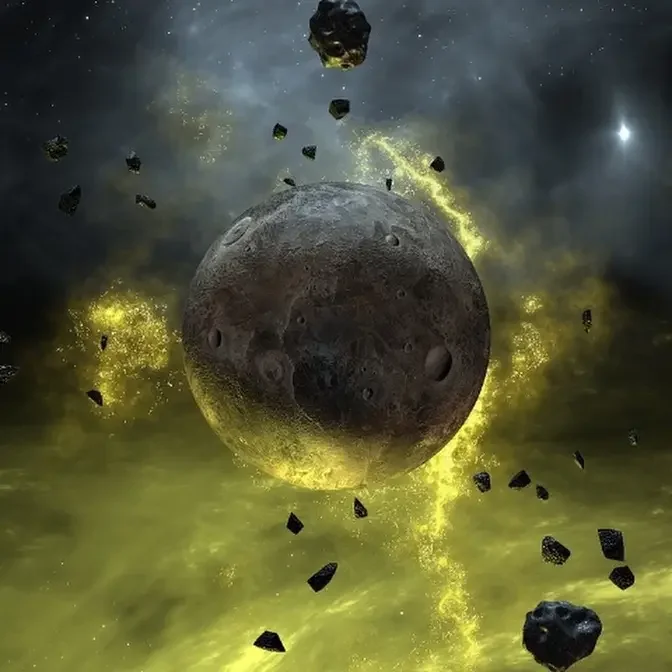
Scientists may have just made one of the biggest exoplanet discoveries in history.
For the first time, Harvard astronomers have detected a confirmed atmosphere around a rocky planet in the habitable zone of another star. The planet, LHS 1140 b, located about 48 light-years from Earth, is now considered one of the most promising candidates in the search for another Earth.
In this video, we'll explore how scientists first predicted this discovery using theoretical calculations, why they selected LHS 1140 b from thousands of known exoplanets, how they detected helium in its atmosphere, and why this discovery is such a major milestone in the search for life beyond Earth.
We'll also discuss what makes LHS 1140 b so similar to Earth, whether it could have oceans or a nitrogen-rich atmosphere, why astronomers are so excited about its potential, and whether humanity could ever travel to this fascinating world.
Could this be the closest thing to a second Earth we've ever discovered? Watch till the end to find out!
If you enjoy videos about space, astronomy, black holes, the James Webb Space Telescope, and the search for alien life, don't forget to Like, Share, and Subscribe for more fascinating science content.
Harvard astronomers have discovered LHS 1140b, a rocky exoplanet 48 light-years away that is one of the most Earth-like worlds ever found. Located in its star's habitable zone, it is the first rocky planet confirmed to have an atmosphere. This discovery validates theoretical models regarding planetary evolution and provides a prime candidate in the search for extraterrestrial life.
We may have finally found an exoplanet that is astonishingly similar to our own Earth.
For decades, scientists have searched the universe for planets that could potentially
support life.
They have discovered thousands of distant worlds, but until now, there has never been
strong evidence of an Earth-like rocky planet with a confirmed atmosphere inside its star's
habitable zone.
But that may have just changed forever.
In one of the most important exoplanet discoveries in recent years, a team of Harvard astronomers
has detected the first confirmed atmosphere around a rocky planet orbiting within the
habitable zone of another star.
And what makes this discovery even more exciting is that this world may not be some strange
alien planet unlike anything we've ever seen.
It could be one of the closest things to a second Earth ever discovered.
But the most fascinating part of this story is how the discovery happened.
The astronomers didn't stumble upon this planet by accident.
Years before making the observation, they used theoretical calculations to predict that
planets like this should exist.
Their model suggested exactly what kind of planet to look for, and what type of atmosphere
it should have.
Then they turned some of the world's most powerful telescopes toward the best candidate.
What they found was astonishing.
The observations matched their predictions.
This is a really exciting planet, it's called LHS 1140 b, it's about 70% larger than Earth.
And we now know that this planet has all three of those key ingredients, not to mention it
orbits a star that's relatively quiet, meaning the star doesn't flare too much, it doesn't
have too high X-ray radiation.
So this planet is the current best place to look for life outside of our solar system.
Several years ago, astronomers at Harvard started asking a simple but profound question.
What happens to the atmosphere of a rocky planet over billions of years?
Their theoretical calculations suggested something remarkable.
When rocky planets first form, many are expected to be surrounded by thick atmospheres made
mostly of hydrogen and helium, the two lightest and most abundant elements in the universe.
But planets don't remain the same forever.
Over billions of years, hydrogen, the lightest element of all, slowly escapes into space
because a planet's gravity struggles to hold onto it.
Helium is heavier, so it leaks away much more slowly.
The researchers predicted that there should be a stage in a planet's life where hydrogen
has mostly disappeared, but helium still remains.
In other words, somewhere in our galaxy, there should be rocky planets surrounded by helium-rich
atmospheres.
It was a fascinating prediction.
There was just one problem.
Nobody had ever found one.
As the researchers explained, the mathematics suggested these planets should exist, yet
they had remained completely hidden from observation.
So the team decided to search for them.
By today, astronomers have discovered more than 6,000 exoplanets orbiting distant stars
across our galaxy.
Search every one of them would be impossible.
Instead, the scientists carefully examined this enormous catalog, looking for planets
that matched their theoretical predictions.
They searched for rocky planets with the right size, the right mass, the right temperature,
and an orbit that would allow astronomers to study their atmospheres as they passed
in front of their stars.
Eventually, the search narrowed from thousands of worlds to only a handful of the strongest
candidates.
Among them, one planet stood out, a distant world known as LHS 1140b.
Located about 48 light-years from Earth, LHS 1140b may sound unimaginably distant, but
in our galaxy, it is actually one of our nearby neighbors.
And that is exactly what makes it so valuable.
Unlike many exoplanets located hundreds or even thousands of light-years away, this planet
is close enough for astronomers to study in extraordinary detail.
LHS 1140b belongs to a small planetary system orbiting a star called LHS 1140.
So far, scientists have confirmed at least two planets in this system.
The outer planet, LHS 1140b, lies inside the habitable zone.
The inner planet, LHS 1140c, circles much closer to the star and is far too hot to be
considered potentially habitable.
Then the researchers noticed something incredibly fortunate.
During one observing session, both planets would pass in front of their star almost at
the same time.
This rare alignment gave astronomers a perfect natural experiment.
If both planets showed helium, perhaps both had atmospheres.
If only one did, that difference could reveal how planetary atmospheres evolve.
Using the powerful Wienerd spectrograph on the Magellan Telescope in Chile, the team
carefully watched as both planets crossed in front of their star.
As each planet passed across the star's face, a tiny fraction of starlight filtered
through the planet's atmosphere before traveling toward Earth.
Any gas surrounding the planet would absorb very specific colors of light, leaving behind
an incredibly faint fingerprint hidden within the starlight.
Finding that fingerprint is like detecting a single drop of ink mixed into an entire
swimming pool.
It requires extraordinary precision.
When the scientists analyzed the data, they found something remarkable.
The smaller planet, LHS 1140c, showed no evidence of an atmosphere.
But LHS 1140b told a completely different story.
Hidden within the starlight was the unmistakable fingerprint of helium escaping from the planet's
atmosphere.
For the first time, astronomers had confirmed an atmosphere around a rocky planet orbiting
inside the habitable zone of another star.
A prediction that once existed only on paper had become a real discovery.
But this story is also about the star itself.
Unlike our sun, LHS 1140 is a red dwarf.
Red dwarfs are the smallest, coolest, and faintest stars in the universe.
In fact, nearly three-quarters of all the stars in the Milky Way are red dwarfs.
Because they produce much less heat than our sun, planets must orbit much closer to them
to receive enough warmth for liquid water.
That is why LHS 1140b completes one orbit in only about 25 days, yet still receives
less energy than Earth gets from the sun.
However, red dwarfs have another side.
When they are young, they can be extremely violent.
They frequently produce enormous stellar flares and intense ultraviolet radiation capable
of stripping away the atmospheres of nearby planets.
For years, this raised a serious question.
Could any rocky planet orbiting a red dwarf hold onto its atmosphere long enough for life
to ever emerge?
LHS 1140b may now provide the strongest evidence that the answer is yes.
And that is why astronomers are so excited.
Now let's talk about why are scientists calling LHS 1140b one of the most Earth-like planets
ever discovered.
It's not because they've found life.
It's because this distant world shares several remarkable similarities with our own planet.
And when we think about life on Earth, we look for kind of three big things when we
think about habitability outside of our solar system.
We need a planet that's mostly rocky, right?
It can't be a gas giant like Jupiter.
It has to be the right temperature to support liquid water on its surface, which we know
is essential for life on Earth.
And it needs an atmosphere to shield that water from escaping the planet, to shield
the surface from harmful radiation.
And we now know that this planet has all three of those key ingredients, not to mention it
orbits a star that's relatively quiet, meaning the star doesn't flare too much, it doesn't
have too high x-ray radiation.
So this planet is the current best place to look for life outside of our solar system.
But perhaps the most exciting clue comes from observations made with the James Webb Space Telescope.
Earlier studies suggested that this planet may have a nitrogen-rich atmosphere, much
like Earth's atmosphere today.
Nitrogen makes up about 78% of the air we breathe, and finding evidence that another
rocky planet could also be rich in nitrogen is incredibly exciting.
Those earlier observations also hinted that the planet might even contain a vast liquid
ocean, although scientists are still working to confirm this.
The new discovery of helium doesn't contradict those results.
Instead, astronomers believe the helium they detected exists in the planet's upper atmosphere,
where light gases can escape into space.
Deeper down closer to the surface, the atmosphere could have a very different composition, possibly
dominated by heavier gases such as nitrogen, carbon dioxide, and water vapor.
The gravity would also feel different.
Because LHS-1140b is about 1.7 times wider than Earth, and roughly 5.6 times more massive,
you would weigh significantly more than you do on Earth.
Simply walking would require much more effort.
With all these discoveries, scientists now believe that LHS-1140b is mostly similar to
our planet Earth.
But suppose one day scientists confirm that life really does exist there.
Could humanity ever visit it?
Sadly, not anytime soon.
This planet is located about 48 light-years away.
One light-year equals nearly 9.5 trillion kilometers.
That places this planet roughly 450 trillion kilometers from Earth.
The fastest spacecraft humanity has ever built, NASA's Parker Solar Probe, reaches astonishing
speeds approaching 700,000 kilometers per hour.
Even at that incredible speed, a journey to LHS-1140b would still take more than 70,000
years.
Voyager 1, which has been traveling through space since 1977, would require hundreds of
thousands of years.
With today's technology, such a journey remains impossible.