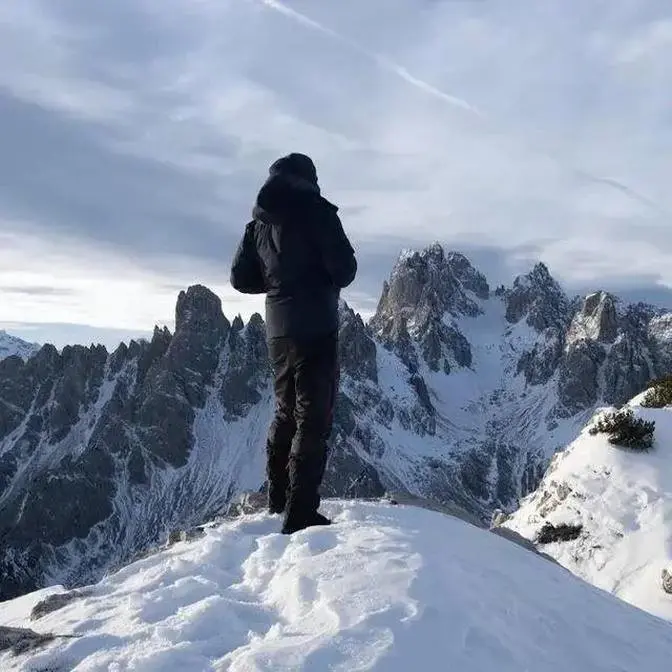
If you’d like to join me for a landscape photography workshop, there are still some places left on my 2026 workshops and I'm now opening waiting lists for 2027. Check my website for more information https://www.andymumford.com/workshops/
If you're interested in purchasing any of the gear I use in this video, and you enjoy my videos, please consider supporting my work by clicking on the affiliate links below.
This is the final forest in Madera and
it's a really really magical place.
[music]
So, I'm here in Meda and we're doing a
workshop here, which is nice for me.
It's probably the first time I've led a
a landscape photography workshop in in
my own country in Portugal for about 10
years. So, it's nice to actually be
doing something a little bit closer to
home and a little bit more familiar.
Now, I've been to this forest quite a
few times before, and it's one of those
places that you can return to again and
again and again and always find
something different. It's an ancient
forest about 1,000 meters up on the
island. And the trees here have these
incredible shapes, all kind of twisted
and bent. They've got these really nice
graphic forms that are really good if
you want to make sort of simple
minimalist compositions. But what really
makes this place special is when there
is low cloud and mist in here, which in
Madera is relatively reliable. You can't
always get it, but this is a warm island
in a cold ocean, so it tends to generate
a lot of cloud. And that cloud often
sits quite low on the island. Because
this place is quite high up at about
1,000 mters, it's often sitting in cloud
which gives it this really moody
atmospheric look. And you can just
wander around here seeing these trees
emerge from the mist and just finding
these really simplistic compositions.
Now, at the moment we're here, there's
not really any mist. It's quite clear,
but we can see the mist rising up the
hill. It's probably going to roll over
and hopefully later on the mist will
settle down and we'll get some really
nice conditions to shoot in.
So what is it about mist that makes it
such a magical such a desirable
condition for landscape photography?
Well, mist makes it very easy to create
simplistic images. What you find is mist
will remove all the background and
remove a lot of clutter. So in a place
like this, which is a forest, if you're
shooting it without the mist, you'll
find that if you find a particular tree
that has a nice interesting shape, the
trees behind that, the trees in front of
it will kind of get in way get in the
way and they will clutter the
composition. It makes it very difficult
to to find clean forms because the the
forms of the trees are overlapping the
forms of the trees behind it. And it
makes the shapes much more complicated.
And what we're seeking often in
landscape photography is simplicity.
simple form, simple line, very graphic
images. When you have an incredibly
complex forest, there's just so many
shapes there that you get this sort of
visual confusion. It's very hard to know
for the eye to know where to focus, what
the subject is. And even in a place like
this, which has these wonderfully shaped
trees, when you don't have mist, the
trees just get in each other's way and
create very complex, very chaotic
images. But when the cloud comes down
and when you get that mist, everything
changes. It makes it much easier to
create simple images. Background just
disappears. You no longer have a
horizon. You can't see the trees behind
the ones that you're shooting. They kind
of disappear into the fog. Or even if
they don't disappear, they become sort
of semi-visible, which makes it much
easier to separate it. And then you can
really focus on the line and the shape
of the trees here. And the other thing
about mist is it just makes everything
feel so clean. you just have this kind
of white background which if you expose
correctly, if you're careful with your
white balance, just feels makes the
image feel incredibly clean, which again
adds to the simplicity, adds to the
minimalism that I kind of look for in a
lot of my images.
So, when shooting a place like this, so
much of what you're going to do in the
image is about composition. And it kind
of seems deceptively easy when you first
arrive. You just find an interesting
shape tree and and photograph that. But
it's the kind of place that you can
really dive down deep into composition.
You can really sort of drill down and
and and look at what makes composition
work. What what are the elements that
are that make an image stronger? What
are the elements that make an image
weaker? So the first thing that you
really want to do is to find a tree with
an interesting shape and to make that
prominent in the image. So a big part of
that is removing any distractions. And
the distractions that you will usually
find here are other trees. So you'll
find that you what you often find is
that there's a very interesting shape,
but in the top corner there'll be the
the branches of another tree coming in.
So, there's a lot of scanning the edges
of the frame here, just trying to make
sure that you've not got anything
invading the edge of the frame because
that's going to really pull your eye
away from the main subject of your
composition and make the image feel a
little bit weaker, make it feel a little
bit less confused and less focused. So,
what we've been doing is just walking
around and identifying trees that have
particularly interesting shapes and that
also interact well with other trees
around them. Because sometimes you can
find single trees on their own that work
very well, just a single shape. And then
in other places, you can find quite
interesting groupings of trees where
you'll have a line of trees that work
really well, particularly if you're
going to shoot it as a panorama, or
you'll find groupings of trees that work
well because the trees together have a
particularly interesting shape. So what
I found is that there was a lot of sort
of wandering around trying to find
things that work and then you get into a
groove and it gets much easier. You
start to see things much more clearly.
You you get your eye in uh and it
there's a lot of kind of looking around
you walking and looking because you
might see something from one side but
you walk around the other side of the
tree. The angle changes completely. The
shape of the tree changes completely.
The background, what trees it has in
front of it, what trees it has behind
it, the way that it's interacting with
those change completely. So, this is the
kind of place that really rewards
exploration, getting here very early. We
get here 3 hours before sunset and give
ourselves plenty of time to walk around
and just really explore the trees, get
to know the locations, and just find
compositions, just find different things
that work. So, everything I've been
shooting has been with a wide angle lens
because I want to get relatively close
to the trees to fill the frame with
them, and I want to be able to see just
a little bit of detail on the trunks
because the mist does tend to kill quite
a lot of the detail. You have to get
quite close before it becomes apparent.
But you also need to have quite a bit of
breathing space around the tree. I find
that if you get the branches too close
to the edge of the tree, you make things
feel a little bit cramped. So I try to
get as much space at the top of the tree
and to to the left and right as
possible. And when it comes to
foreground here, it's just grass. This
isn't the kind of place where you need a
foreground. Foregrounds should always be
elements that support the subject. So
you want a foreground that leads your
eye towards the tree. Something like
that. And that kind of doesn't work
really as well with minimalist
compositions. Minimalist compositions
generally I want to reduce it to as
fewer elements as possible. And the
foreground is an extra element. So I've
been kind of avoiding not really looking
for them. Just working with an almost
two-dimensional feel. And the depth
comes from the contrast from having
darker areas and lighter areas from
having perhaps some trees in the
background that are partially obscured
by mist. That's where the depth comes
from.
>> And you can see another aspect of
composition in this shot here. Now, when
it's misty, there's no horizon. But when
we had the horizon, when the horizon was
visible in these sunset shots, for me,
it's very important to put the line of
the horizon as low down as possible so
it goes through the main trunk of the
tree and not through the branches
because that again will make the image
feel more cluttered, more confused. It's
just much neater to get a little bit
lower with the camera and put the
horizon across the middle of the trunk
of the tree. Now, when it comes to
exposure, that's a little bit more
straightforward because the dynamic
range here is very very small. There's
no bright light. There's no particularly
dark shadows. So, you've got a very very
limited uh dynamic range. But what I do
tend to do is expose to the right. So, I
expose with all of the data in the
histogram towards the right side of the
histogram, towards the brighter, towards
the highlights part because I want the
mist to be bright. I want it to feel
very white. When the mist starts to be
around the mid tones, it looks very
gray. It starts to look dirty. You want
the mist to be clean. You want it to be
white. Again, it just [music] adds
towards the simplicity and the
minimalism of the image. Gray mist
starts to blend with the shadows and
doesn't really really work as well. Now,
if we're really lucky, we'll get some
direct light where the the last light of
the day shines through the mist. So, you
get a kind of diffused glow just
illuminating the mist, which gives some
nice sidelight on the trees. It picks
out the greens. It just gives everything
more depth and just really gives it
another level, but I don't think that's
really going to happen. I got that a few
years ago when I was shooting here
before, but it's not something that I I
really expect is going to happen today.
So, it looks like we're starting to get
a little bit of mist now. I'm going to
go and do some shooting.
[music]
[music]
[music]
>> [music]
>> And you can see from this image, we did
get a little bit of light breaking
through. The sun did break through a
little bit when we had the mist. And
when we were shooting the sunset images
at the end of the day, we did get a
little bit of mist just come in before
the final color went away, which just
adds that little bit of mystery, that
little bit of extra to the sunset
images. And that's it from the finale
and from this amazing magical forest.
It's always such a pleasure to come here
and shoot. And I'm sure we'll be back
here again before the end of the trip
because this really is the kind of place
that you can come to again and again and
find different things, find different
compositions or find different ways of
shooting the same compositions. And of
course, it's not the only place that
we've been to in Madera. We've been all
around the island. We've been shooting
from from Picadier, the mountains at the
top. We've been shooting coastal
watercapes. It really is such an amazing
island with so many different things to
shoot. And we'll be back here again next
year with another workshop in 2026. So
that's it for this video. I hope it's
been interesting. Let me know if you've
got any comments. And if you enjoy the
channel, please like, please subscribe
because it really does help support the
channel. And if you enjoy my photography
and you'd like to join me on a workshop
like this, as I say, we will be back
here in Madera next year, but we've also
got workshops in Nepal, in Utah, in
Namibia, in Japan. We're planning
workshops in the Draensburg, in South
Africa. You can find full information on
all the tours that I've got coming up on
my website. So, please check that out
and drop me an email if you've got any
questions. And as ever, thanks so much
for watching and good luck with all your
photography. I'll see you next time.
Take care.