
What Is The Kodaly Method Of Teaching Music? - Classical Serenade
Comments are disabled for this video.
If you're curious about how music can be taught in a fun and effective way,
especially for children, you're in the right place.
Let's explore the Kodaly method, a unique approach to music education
developed by the Hungarian composer and educator Zoltán Kodaly.
The Kodaly method is all about using the voice as the primary instrument.
This approach makes sense because everyone has a voice and it's free to use.
Kodaly believed that music education should start very early,
even suggesting that the best time to begin is nine months before birth,
highlighting the importance of early exposure to musical principles.
This method is built around three key phases, prepare, present, and practice.
In the preparation phase, students are introduced to musical concepts
without using standard notation.
For example, they might learn quarter and eighth notes
by moving in walk and jogging patterns,
or sing high and low in minor thirds to prepare for sol and mi.
This sound-before-sight approach helps students experience music
before they learn the technical aspects.
In the present phase, the concepts are made conscious
by naming them with standard notation and conventions.
So after learning the sounds, students learn to read and write the music
using solfa, do re mi, and other musical symbols.
The practice phase is where students apply what they've learned
using the standard notation and conventions.
This phase involves a lot of repetition and the introduction of new repertoire
that includes the targeted musical elements.
Kodaly's method emphasizes several key principles.
First, it believes that anyone capable of learning a language can also learn music.
Singing is seen as the best foundation for musicianship,
and music education should begin with very young children.
The method also stresses the use of folk songs from the child's own culture
as the basis of instruction, ensuring the music is familiar and meaningful.
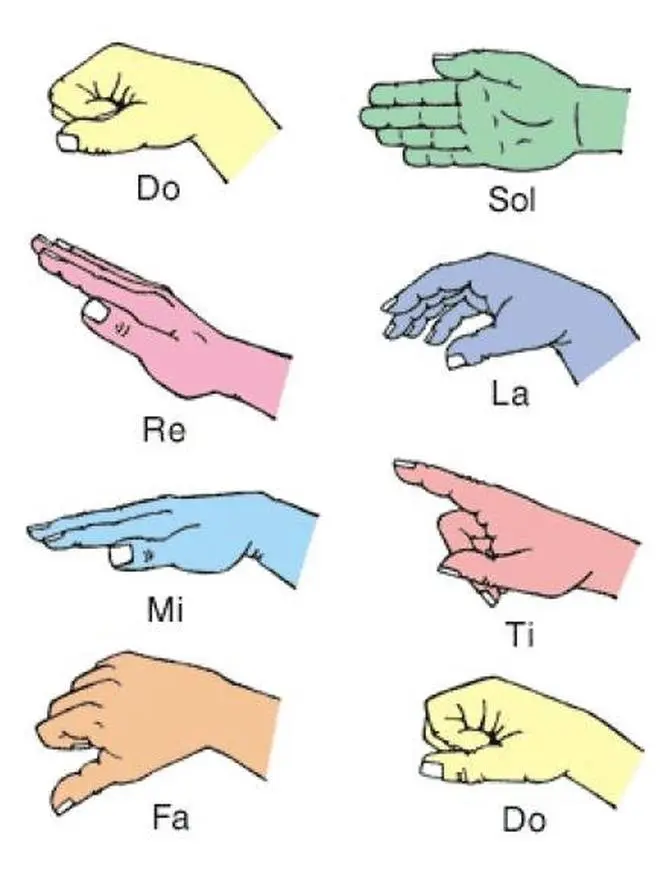
Another important aspect is the use of solfa,
a system that assigns syllables to notes.
This helps students develop relative pitch and musical literacy.
For instance, the do in the solfa system is movable,
meaning it can be adjusted based on the student's vocal range.
The Kodaly approach is highly interactive and collaborative.
Students learn through singing together, performing duets, rounds,
and other group activities.
This social aspect of music learning is central to the method,
making it fun and engaging.
Classes often include rhythmic movement, clapping games,
and other activities that help students feel the musical pulse
and develop their sense of rhythm.
Kodaly's vision was to create a musically literate society
where music is a part of everyday life, not just a profession.
He believed that music should be taught in a logical and sequential manner,
and that learning should be a joyful experience.
In summary, the Kodaly method is a comprehensive and engaging way
to teach music, focusing on singing, folk songs,
and a structured approach to learning.
It's adaptable for all ages and abilities,
making music education accessible and enjoyable for everyone.