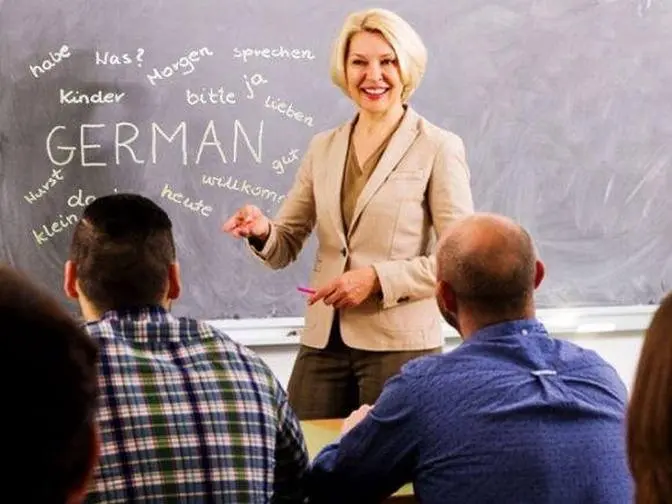
In diesem Video lernst du einige Wörter der deutschen Alltagssprache!
Außerdem trainierst du dein Hörverstehen, indem du einer authentischen Konversation unter Muttersprachlerinnen folgst. Tipp: Hör dir das Gespräch mehrmals an, es ist absolut normal, dass du beim ersten Hören noch nicht alles verstehst. Übung macht den Meister und Schritt für Schritt näherst du dich deinem Ziel, fließend Deutsch zu sprechen.
Viel Spaß beim Zugucken!
💛Abonniere unseren Kanal, um keine Tipps rund ums Deutschlernen zu verpassen. ____
🚀Hör dir unseren brandneuen Podcast auf Spotify an und lerne Deutsch ganz nebenbei: https://t.ly/uO3b6
That means German is our native language
Are you sure
Welcome to this new video
We're Teresa and Laura
German language teachers and native German speakers
And today we have a new video
for you in which
Teresa will explain some terms to you She doesn’t know which ones yet
But they're dealing with everyday German language
And we wish you lots of fun watching
Let's go
Before we really get going Laura and I will be speaking
completely naturally in this
lesson German is our native language
That means in this episode we're just talking completely authentically and
at a normal pace—perfect for you if
that's exactly what you want to practice
amely to understand native speakers
You can always turn on the subtitles
so it's easier for you to follow along
And it won't stress you out if you don't understand
everything right away at the
start—this is completely normal
Now I'm curious to see what you've found for me Laura
So Teresa just to clarify
for our listeners and viewers
We have a WhatsApp group where we constantly
collect words that we encounter in everyday life
and where we think they might be interesting for our students
And I took a quick look and found ten words there
which are not as common nowadays
but still absolutely worthy of respect
Okay cool
And feel free to just explain what it
means and how you'd go
about using it Okay
They're all colloquial expressions actually
except the first one
That one is more of a written-language expression I'd say
And that's called a pivot turn
Oh okay
I read about it in a book for example
So someone performs a pivot turn
Okay turn around on the spot
Okay to do that you need to look more closely at the vocabulary related to shoes
After all a shoe has many components:
there's the sole and there's the upper
And in the sole at the back of the heel is the heel For
example there are stilettos also known as high heels
which have a high heel
Or sneakers essentially have no heel like sneakers
But men used to wear suits with shoes just like these back then
ey always had such a small heel
That's probably what this saying is referring to
When someone turns around on their heel it means
He takes a step stops and turns around on his heel
That's what this sudden about-face means
He turns around and changes direction
Exactly that's what that means
Yes in what situation might someone say something like that
For instance if you leave the house and suddenly remember
you forgot something—oh no I left my phone behind—
Then I turn around on the spot and spin around again
Exactly
Or So if something suddenly comes to mind suddenly
and suddenly turns around to change direction
Yes exactly
And that's more of a written-language thing as I
said So you wouldn't just walk to the door and say
Oh I turn on my heel
So this is truly something written-language-like
You'll encounter it all the time in books
Yes exactly Okay
But our other nine expressions are actually colloquial
And the first one is an adjective and it's called pitch-black
DarkenedOkay
Duster means dark
So it refers to daylight
Meaning it gets dark in the evening
That means it gets dark in the evening
And pitch-black is the absolute peak of darkness there can be
Also at midnight it's pitch
black—just plain utterly
completely dark so dark you can't see anything at all
Also really Ah pitch
black you hear that a lot too
It's pitch black completely dark
You can't see anything at all
Dark as pitch or
pitch-black Exactly Okay
Next one is actually a verb
And it means to play with something
I play with something
Oh I'm thinking of a situation—say you
receive a new tech gadget for Christmas
And I'm someone for example who really hates reading user manuals
I just want to try the thing out straight away
Then I say I'm already really eager to play around with it
Which basically means trying something out
And I mainly associate this in fact with technical devices
Yes I wouldn't even say that right now
I was just thinking maybe
something crafty or like that—something that requires patience something
that doesn’t work right away Yes
You first have to experiment with it and figure out how it actually works
Okay Very good
Then the next one is actually a I wouldn't say an insult
but if you tell someone for example that they've got a screw loose
to have a screw loose
Ah ah
What does that mean
That means this person is a bit crazy
It just occurred to me—having one
at the slap works just as well
Clapping in essence is simply making applause
But having one at the slap is probably just like that I don't know where it comes from
Honestly I don't know either
I can't work it out right now
Everyone definitely knows the verb "clap " meaning applause
There was also slapping before for example a slap to the face
That's also a slap
Maybe that's why after being hit too often you eventually
go mad I don't know I have no idea
But the meaning is definitely that a person is somewhat confused or crazy
Would you only use it in negative
situations Because I meant it as an insult
But does it really have to be like that all the time does it
I think you could humorously phrase it in a positive way
But I do believe at its core it's somehow negative
But if for instance someone does something that seems
completely crazy to me I'd say they must have a screw loose
And then it's definitely not a compliment Yes
exactly
That's meant negatively
That's right
Then let's move on to our next word
And that would be a word that actually has two different meanings
It's the tongue
Could you explain what this means
Well first of all it's a body part
We can taste with our mouth on our tongue or using our tongue Exactly
So this is the tongue
And of course also in the shoe
And in a shoe not every shoe but in a sneaker in a tennis shoe there's a tongue Exactly
Those are the two meanings that come to mind
And that fits perfectly with our next informal verb which is "to shop around "
Go shopping
Ah okay
Oh that totally uncomfortable feeling when you try to put on a shoe a sneaker
And you notice you can't get the shoe on properly because the tongue has gotten twisted
The tongue is no longer smooth but has become frayed and compressed as it were
You can no longer get your foot properly into the shoe
Something's gotten caught Or for example even
a sweater sleeve if I want to put on the jacket
and the sleeve slips
backward no longer straight but wrinkled —that’s what
it means to be shopped The sleeve is shopped
Yes exactly
Very good
Okay the next one is another verb I personally find very elegant
And it means to elaborate on something
Ugh
To talk something
out at length in a vague or evasive way
That’s when you're faced with a problem and want to solve it
and you aim to develop a definitive plan for how to overcome it
That's overcomplicating things Overcomplicating
something I'd say is
basically solving a problem Do you have an example
What kind of problem
It's not really about relationship issues or things like that
right now I'd say but perhaps something more tangible again
You might be having trouble again with a technical device or something along
those lines Exactly
When you're dealing with any kind of technical issues
I believe that in this context we've already
written or spoken this word for example
When we encounter a problem with our email program
Then I'd tell you wow we really need to hash this out and figure out the right way to do it
Or maybe tax-related issues something like that
We need to work out how to handle that properly you know
Yes exactly
Also any tangible issue I'd say right now
Very good
Alright then the next one is a word that honestly was completely normal to me
because it's normal for us in southern Germany Austria and Switzerland to use it
I recently said that to someone
from northern Germany and he didn’t
understand what I meant at all That’s the word—this year
This year
Ah this year
Yes exactly
So simple
Right so this year means in the current year
For example I was on vacation in Italy this year
Heuer This year
In the current year
Yes exactly
What are your vacation plans this year
So this year
Yes that's right
But actually there isn't even a word for next year right
No
Only this year is simply
the current year Exactly
And as mentioned this is quite common in southern Germany Austria and Switzerland Thank you
Alright then we have one more adjective and that's "schusselig "
Schusselig Someone is schusselig
That's essentially a synonym for clumsy
And if you don't know that it means a person for example that one
Things like this keep happening to me
For instance if I'm carrying a plate the spoon falls right onto the floor
Or the soup spills over
Then it drips onto the floor
Or you go for a walk and stumble over your own feet
That's careless Or if one writes one
makes spelling mistakes and slips up in
spelling Yes things like that
Also yes one might also have trouble focusing on something or be preoccupied with
The idea is always somewhere else and then suddenly all sorts of things happen
Would you say you're a careless person
In certain situations for sure but I don't think I'd do it for myself
As a personality trait I'd say I'm clumsy or absent-minded
So I wouldn't put it that way
But in certain situations of
course things like that can happen
occasionally Everyone gets distracted sometimes Yes exactly
Alright and our final word I believe is once again regionally influenced—namely
the plörre
What exactly is a plörre
I'd really like to know the situation in which that word came to mind
Honestly I'm wondering the same because I actually don't
think it's all that common here
in southern Germany The mess
It's basically just dirt
right Like a dirty puddle
We might need to clarify what exactly a puddle is
Puddles form when it rains heavily sometimes water
collects in holes in the road or on field paths and so on
That's a puddle
And maybe caused by our dogs
That could be
When walking the dog and the pups roll around in those filthy puddles
Wow what a mess
Just a really dirty puddle
This water in the puddles isn't clear It's not
clean water but a mixture of water dirt and soil
And you'd say that's a
mess Maybe it doesn't
even smell good That's what I'd call a mess
I actually discovered as mentioned that this word is indeed
more commonly used in northern Germany
And there it's used to describe a drink that's very thin
and lacks much flavor—especially
when referring to coffee
Also if you happen to have a coffee that's been sitting around for a while or one that's
If it's just very thin and tastes terrible
you'd say what on earth is this mess
You can't possibly drink that
Okay but it's already very similar if we're using it for dirty puddles
and for a brown nasty soup so to speak
Yes then that fits in a way quite nicely
And if by chance anyone from northern Germany happens to be listening or watching please let us know
Let me know if that's the original meaning of it
Okay great well done
Thank you
Thank you for watching and listening
If some words were new to you please let us know
And we look forward to seeing you again soon
Take care
But I once read that when you look someone in
the face you're actually looking at their nose the most
That was totally funny
I just keep looking at my nose when I talk
That’s so ridiculous
All I can see is my nose