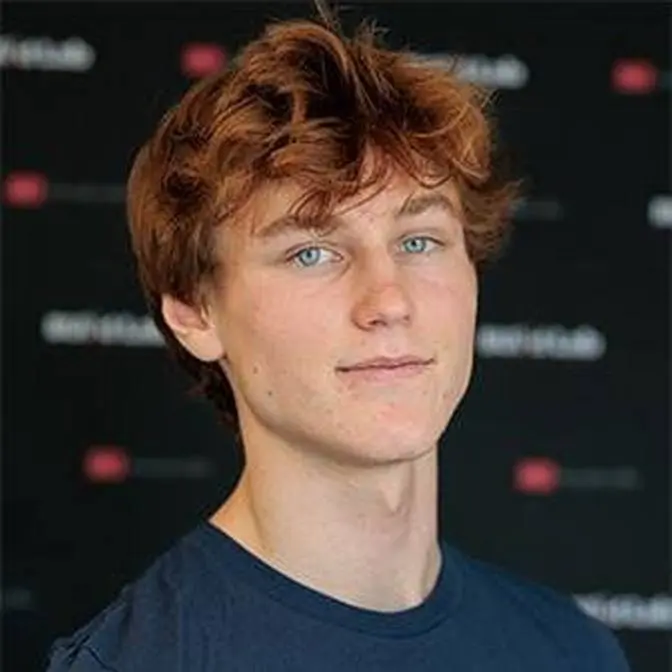
I visited the Aalo Atomics pilot factory in Austin, took a look around, & chatted with the CEO, Matt Loszak. Here's the resulting dive into energy, nuclear, and the company leading the charge to the second atomic age.
CHAPTERS: 0:00 Energy, Nuclear, & Aalo 0:47 Why I'm Making This 1:24 Visiting The Energy Bottleneck 2:03 Why Scaling Energy Matters 2:53 Visiting the Aalo Atomics Factory 3:21 Why Is Nuclear the Right Solution? 3:39 Aalo Taking the SpaceX Approach 4:55 Aalo's Goal 6:00 Aalo's DOE Approach with Matt Loszak 6:29 Yasir Arafat 7:14 Data Center BYOP 7:25 Matt Loszak on Nuclear for Data Centers 8:35 Aalo's First Reactor 9:15 Aalo's Plan
------------------- Clips channel @jonlawclips
I do NOT sell any products of my own. Watch out for scams.
There's this quote that we've all heard of.
Never doubt that a small group of thoughtful, committed citizens can change the world.
And I have never personally seen that to be more true than with the story I'm about to show you.
And that's the story of a group of 140 incredible engineers and physicists
assembled together in the desert with one mission.
To usher in an era of global energy abundance for the benefit of humanity.
So I'm about to go jump on a plane to Texas so I can properly tell you that story.
And it starts with the trillion dollar energy problem in America,
which is also why your monthly bills are going up.
And then we'll get into the nuclear renaissance born of that problem.
And then finally, we'll get into what this company,
Allo Atomics, is doing to lead that nuclear charge.
And that in mind, I hope you all enjoy the video and let's go.
So I'm putting this together as a passion project about the future
and about something that I think is really optimistic
and what I view or experience as an increasingly pessimistic future.
And also to share a new part of my life with you.
And that is this company, which you're about to get a first-of-its-kind look inside.
And now this, I would say, inconspicuous building is a nuclear reactor factory.
And it's located in Austin, Texas, which is why I'm flying there right now.
I'm here with Nicole, a photographer, and Jared.
And we're going to make some content this weekend
while I tell you the story of the second atomic age and the company leading the charge.
Yeah, so this is not a factory, but I did make it to Austin.
And I wanted to start here in the middle of nowhere in Texas
because these little buildings behind me
are part of a trillion-dollar energy problem in America
and cost you money every single month.
See, this is a substation in the electricity grid of America.
And that's what takes energy from where it's made
and gets it to all the homes and the businesses that need it.
The problem is, it's old and regulation makes it difficult to get anything new built.
And this problem is so bad that more than one and a half times
the entire current energy grid is stuck in a line of approvals
just waiting to actually get built.
And that supply crunch is coming at the worst possible time.
And that's because energy is upstream of every single technology period that matters.
You want to desalinate water? Energy.
You want to power the AI tools to create life-saving drugs? You need energy.
And you want to save climate change and create a better world for our kids?
Clean energy.
But there's an even more fundamental level there,
which is that energy directly correlates with quality of life globally.
And to quote Matt, who you'll hear from in a few minutes,
there is no such thing as an energy-rich or country.
The more energy a nation has and consumes,
the more services, education, healthcare and technology
and transportation it can provide to its citizens.
And so all of those reasons are exactly why
electricity demand is skyrocketing in the U.S. and around the whole globe.
But it's these buildings that make scaling energy supply to meet that demand impossible.
So then we actually made it to the factory.
And there is so much in here that I'd love to cover,
whether this robotic arm that will automate reactor building in the future
or the welders and the engineers actually doing the work, the building right now.
And also keep in mind that everything you're about to see is on a Saturday.
Like these guys are working hard. It's super impressive.
But going back to that question,
we've established that meeting energy demand is a big problem.
But what we haven't asked is there are a lot of energy sources.
So why do we care about nuclear?
Well, what if I told you nuclear wasn't just historically
the cheapest and cleanest energy source, but also the safest?
I'll say that again.
This hunk of metal right here is the cheapest,
cleanest and safest form of energy on the planet.
But if it's that good, then why aren't nuclear power plants everywhere?
Well, to think about that, we can talk about rockets.
So before SpaceX, rocket launches were bespoke art projects
that cost billions, launched once and were thrown out and then rebuilt.
And this made costs super high,
the risk of failure and uncertainty around projects equally high,
and space travel just impossible to scale.
But SpaceX, as we now know, flipped the script on its head.
Yes, with reusability, which is a given in nuclear,
but also with a more fundamental shift.
The factory as the product and the ability to mass produce modular components.
And so if you combine that mass production with reusability,
you get this $2 trillion technology behemoth.
And Aloe is copying and pasting that with this.
So this building behind me is the pilot factory
for the most modular reactors to ever exist.
And it's the nuclear equivalent of the Falcon production plant.
And by focusing on this mass production
and this factory as a product mentality,
you've unlocked this shift down the cost curve
that was just never possible with these bespoke,
one-of-one construction projects that used to be nuclear reactors.
And I can barely hear myself in here,
so let's go somewhere where it's a bit quieter.
Aloe's goal over the next decade is to drop the lifetime cost
of energy of nuclear to less than 3 cents per kilowatt hour.
And that's cheaper than solar, natural gas, than wind, than coal.
That would make it the cheapest electricity source on the planet.
And it's clean and completely reliable.
But here's the part that I really think is amazing.
And what that is, is that this company didn't exist three years ago.
It was founded in 2023 and will be going critical with the pilot reactor this year.
That's an incredible three years from founding to vision.
And it's the brainchild of this guy, Matt Lozak,
who's the CEO and co-founder of Aloe.
And so I sat down with him to ask how moving at that kind of speed
in such a traditionally slow and incumbent-heavy industry was possible.
Basically, two years ago, we were two people.
And now we're 140 people.
And within a six-month period,
we built out 40,000 square foot pilot factory space
and a full-scale non-nuclear prototype.
So a big part of how we've gone this fast
is we've had a pretty unique regulatory approach from the beginning.
So we've been doing DOE authorization instead of NRC
for the federal regulatory approval of our power plant.
And so we have a pretty good team, a well-qualified team to do this
because we have the only team in the country
that's ever previously done a DOE approval for a new reactor design.
So this was the Marvel project.
Our co-founder, CTO Yasir, was the chief architect on that program.
And let's pause.
A quick shout out to this guy, Yasir.
He's the co-founder and CTO of Allo.
And he's crazy smart.
Here's just one of his patents that I saw in the office.
And hopefully, we'll get to sit down with him in a future video.
Now, back to it.
And some of our first five hires came from that program.
And then we kind of layered on top a lot of great talent
from SpaceX and Tesla, Microsoft Bloom, and a bunch of others.
It's been a pretty exciting journey.
We've done a lot really quickly.
We've raised $180 million in the past two and a half years.
That's given us the lifeblood to build a lot of stuff really quickly.
And the initial target customer for Allo's power plants are data centers
because they're willing to pay an initial premium
for the reliability that nuclear provides.
Also, what's called the bring-your-own-power trend for data centers
also ensures that the demand for AI doesn't result in your energy bills
going up by pulling energy out of the existing grid.
And here's what Matt had to say about that.
So right now, in the U.S., there's around 92 active nuclear power plants.
And they're all bespoke.
Like, they're all one-off projects that were done
kind of for different utilities, all custom, and so on.
So we've never actually in nuclear mass-produced a consistent product.
And the thing is, now, you have the right type of demand to unlock that.
So in other words, it's like the Henry Ford of nuclear.
It's how do you create a product that is consistent, the same every time.
It's no longer a nuclear project that has a lot of variance from project to project,
but it's the same thing you do at every site.
And that's kind of this big unlock
because there's two main ways to make nuclear cheaper.
Either you make it bigger, which makes sense
if you're only doing one power plant every few years,
or you make tens of thousands of them.
And so finally, there's the right customer who can unlock that second category,
economies of numbers, instead of economies of scale.
And so this behind me, literally this exact piece of metal,
is Allo's first product, and in a few months,
will be the first nuclear reactor ever to exclusively power an on-site data center.
So in a few days, this component and all the other modular components in the factory
are going to be shipped from this site, the pilot factory in Austin, Texas,
to the Idaho National Lab in Idaho Falls.
And the Idaho National Lab is a historic site.
This was the first place where workable nuclear energy
was ever generated in the US, something like 70 years ago.
But what's the plan?
How do you get from a pod like this, and just one of them,
to ushering in global energy abundance in the second atomic age?
So Allo's plan is to prove that this reactor works in the next few months of 2026,
then deploy the first commercial power plant with five reactors just like this,
and then build the gigafactory to pump out dozens of these, upward of 100 per year.
Then you copy and paste these gigafactories all over the world
to scale global energy abundance, accelerate advanced technology,
end global warming, and raise quality of life.
And so that's the Allo mission and story,
and it's all happening next to a highway in Texas near Austin.
Out of mind, I appreciate y'all being here, spending some time with me today,
in with Allo, and I'll see you in the next one.
Cheers.