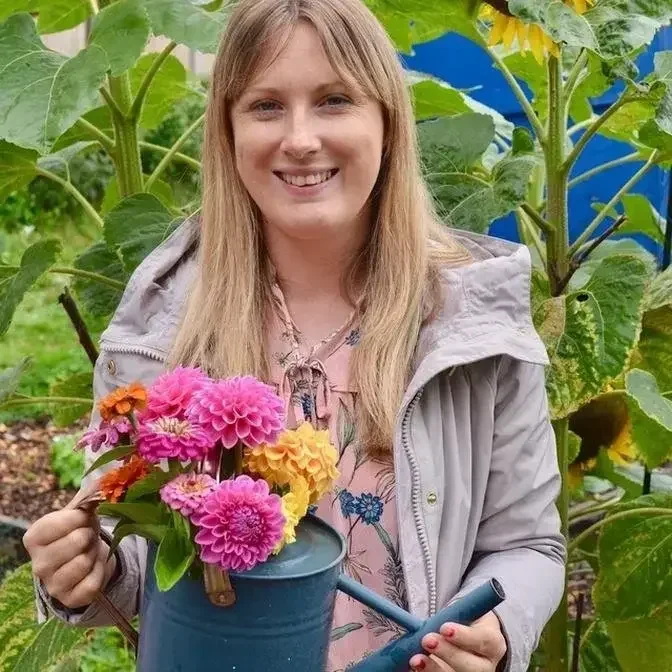
Emma provides updates on her UK allotment, focusing on essential May maintenance. She covers tomato pruning, recovering potato crops from late frost, and implementing pest control for brassicas and beans. Additionally, she prepares garden beds by clearing invasive nettles to make room for main crop potatoes, kale, and sunflowers, all while documenting local wildlife encounters.
One will start to develop in the middle, that's the one we take out, the one in the middle.
Oh my gosh it's one of the babies. Guys do we think that's borage?
Now that is a pile of wood chip, oh my goodness me. They must be taking down quite a few trees
at this time of year, that is monstrous. Pretty chippy too, pretty wood chippy,
not many leaves in here and it's pine as well, it's like those Christmas tree, pine trees whatever
you call them, which I think actually keeps away slugs and snails because they don't like the
smell of them. So these are a really good wood chip to use on pathways because they deter slugs
and snails as well. I think I might have to get some of these. Guys I can hear chickens,
someone got chickens on the allotment site, oh my goodness someone got chickens.
There's chickens, someone's got chickens. Good morning guys, welcome back to the allotment
diaries, my name's Emma, these are the allotment diaries, I hope you are enjoying watching them.
In my last vlog I came here sort of in the late afternoon so it was really busy and really
difficult to film, so I've now come down in the morning again and unfortunately there are people
literally hanging over the back fence trying to clear up a tree or something, so it's all
just a little bit chaotic down here at the moment, so I'm doing my best to get as many vlogs up as I
can. Sorry if they're a little bit, I don't know, not their usual self, I just literally can't film,
like there's just people everywhere. Hence the fact that I'm desperate for my bigger garden,
and I don't know if you know this but we have decided not to extend, oh my gosh are they
actually going to start? Can you hear that? I bet you can hear that, oh my gosh. Okay I waited
about 10 minutes and they've stopped and also the sun has come out so double whammy, good thing that
I stood here and waited and didn't go home. Let's check on our tomatoes and see if they've got any
right angled diagonal shoots. I do and also I do have a baby tomato which I feel like I should
take off. I'm making the executive decision to get rid of this one because I don't think the
plant is big or strong enough yet to start putting its energy into tomatoes, so if you see any baby
tomatoes or flowers, like flowers early when you've just put them in, I would take them off
personally. It's your choice, you know, you've got to decide what to do with your own plants but
I feel like they need to be putting their energy into getting bigger first and they do have some
shoots. So right I do hope you can see, I know you might be a bit wonky there but you're on a flower bed
and on tomato plants you'll get diagonal shoots. So you see how the stem goes up like this and then
we've got a branch coming out like that, so that's our right angle. This shoot here that's sort of
diagonal at a 45 degree angle, that has to come out. That is not a good thing to have on your tomato
plant. Now that in itself is a whole new tomato plant, you can put that into soil or water and it
will sprout roots and that will give you a whole new tomato plant, which we might actually try today,
we might as well, but you want to get rid of all those diagonal shoots because they will do no good
for the plant. So there's another one just here, see how it's going, see that's the right angle
there and that's our 45 degree angle shoot, so we're just going to pinch it out. There we go and
hopefully by keeping on top of those sort of 45 degree shoots, there's another one there you see,
it will focus the energy of the plant into growing up and then producing a good amount of tomatoes
instead of trying to get as big as possible, because remember that all plants want to take
over the world and we can't let them, we have to stop them, that's our job as gardeners to stop
them from taking over the world. So taking off those helps focus in the energy in the right
direction. I don't think I can see any on this one, no, so we've just got our nice shoots out,
so that's fine even if it's going up a little bit like that, it's if one comes in the middle,
which it will, one will start to develop in the middle, that's the one we take out, the one in
the middle, the one that will come in between here we'd take out, but these ones are fine,
so this plant's quite happy, look he's dancing, that's how happy he is and this will definitely
give us some kind of tomato plant, so what I'm going to do is stick it in a little bit of
compost there, give it really good water and just see what comes of it, they do have an incredible
ability to just create roots from their stems and create new plants, like I said before, you
know, if a tomato plant falls over it's likely that it will start shooting up again, they're
just incredible plants, they're so so strong, it's so hard to kill a tomato plant guys, can I just say
that? It is so difficult to kill them, they are indestructible plants, so if you've killed a tomato
plant, well done, well done you, because that's not an easy thing to do and you should be proud
of yourself. Right, let's get out there and feed that birdie, I can hear him.
Right, we did actually get quite a lot of rain yesterday, so I don't think I need to worry about
watering anything, I think maybe the sweet peas might need some tying in this morning,
I think we should start with that because they're starting to come away from the trellis, last night
we had quite a lot of rain and a lot of wind and you can see that that trellis there has fallen back
onto my plot and that just tells me that we had a lot of wind, so there's probably going to be
some damage around the place. Look at these sweet peas, aren't they doing great, aren't they doing
great? Right, I need to find the end of the twine, where's the end of the bleeding twine?
We found the end of the twine, right under you go guys, oh my gosh you've really fallen down, oh no.
These sweet peas, I've said this before, but they are doing better than any other sweet pea
I've ever planted in my entire life and I planted them so early and I cannot believe it,
I'm so proud of them, I'm actually getting some flowers now and they're starting to open,
so watch this space, come back in about a week's time and we'll have sweet peas.
So the big drama when I was here last time was that the frost had unexpectedly appeared in May
and it had almost wiped out my early, second early potatoes, my early potatoes have done okay,
my second earlies have sort of been almost obliterated, but there are still some good
leaves on there, so I have high hopes and a lot of you said that your potatoes, if they've been
affected by frost, if they look like this they had to come back again and start growing again,
so I'm really hoping that you're right, because I don't want to lose the whole crop, it doesn't
look like I've lost the whole crop. I can definitely see some good leaves on here and I
think when a plant has good leaves it has a chance of coming back and still being alive,
if they were all like this I think they would have been wiped out, but I think it's pretty
clear to me now, a few days later, that they have survived the frost. What I'm going to do is take
off all of the frost, all of the frost damaged leaves are going to come off, so that we can make
some breathing room for the green leaves and hopefully they'll come back stronger. It's a bit
like how I treat house plants, if they've got a few dead leaves I just take them off and then the
even if it's not. I think it's the same concept, if there's leaves that are not serving the plant
and they're not doing the plant any good because they're damaged or dead, take them off and let
the plant concentrate on the leaves that are good and give them more room. That was an incredibly
late frost and it did come out of nowhere and a lot of people were very shocked by it, I don't
even think the weatherman said we were going to get frost, so that was a complete shocker
and I have never seen my potatoes affected by frost before, even when I planted them out in
March with no protection. Right, so they've had a really good frost haircut I would say,
and now all I'm left with really is the good leaves. I've also noticed there's some really
small leaves that are starting to come through that look really healthy, so I think these are
going to be okay. I think I've just about got away with the frost, but it is a lesson learned.
And then these are my earlies, my first earlies, so these are the first potatoes I put in
and these don't seem to be anywhere near as affected as the second earlies. There is still
a little bit of frost damage on the leaves, you can see, but they all look really healthy and fine,
so I'm sort of just going to leave these ones alone I think and just stop mucking about with
them and touching them. What are you looking for? So it's really a day-to-day where I'm just
catching up on all of those jobs. I think I've had a lot of comments recently with little pieces of
advice here and there, so one of the pieces of advice was to make sure that my brassicas are
netted because I think in my tour that I did last Friday I was like, oh the netting's blown off,
never mind, well now we're getting the cabbage white butterflies. And the thing with those
is they are beautiful, they're lovely butterflies, but they lay their caterpillar eggs underneath the
leaves of your brassicas and when the caterpillars hatch they eat the entire crop, just like
overnight, literally overnight. You have to keep them netted from the butterflies and my netting
are blown off, so I'm just basically going around doing all the little jobs that you've reminded me
to do. I do read your comments and I do listen to them and I am trying to follow all of your
advice now, so I promise I promise your comments are not going to waste. So that's the netting
fixed over the brassicas, the brassicas are doing great, getting really big and healthy, absolutely,
and dare I say this, actually dare I say this, I'm going to say it anyway, no damage, no slugger
damage, no caterpillar damage yet, I mean so so healthy, like from a Beatrix Potter book.
Right, another job that a lot of you have said to do in my comments is to take the tops off of my
broad beans, and that is to stop blackfly from multiplying like crazy. And the thing is I was
thinking, well I don't have any blackfly on them, I think they'll be fine, and then I was like, no
Emma look, stop, you've had this plot for what, six years? Don't be naive, take the tops off now
before the blackfly become a problem. A lot of you are saying that like the female is pregnant on
them at the moment and she's about to give birth and multiply everywhere, and that's why they
suddenly appear out of nowhere, so seemingly out of nowhere, obviously they appear from somewhere,
um but we're going to take the tops off and apparently that stops them from appearing on
your broad beans. Let's give it a go. Right, off with their heads, a little bit of beheading today.
Yeah there are some bugs on this one, this is an interesting mix of bugs here, let me just show you
this interesting mix of bugs. So there are a few aphids on here, only a couple though, um and they
will multiply. There's also some ants on here, look, see the ants, and I think the ants harvest the
blackfly, um the aphids even, which I think the aphids turn into blackfly, but the ants harvest
them and eat them, and I'm just wondering if maybe they'll just sort of take care of it for me this
year, or should I help them out and still take the tops off? I think I'll still take the tops off,
but there's obviously a really good little ecosystem sort of going on here, so the thing is I
doubt it will get rid of all of the aphids, this this is not foolproof, this will not stop every
single aphid, so there still will be some on my plants, so I think the ants will still have
something to harvest and to eat, whatever they do with them, so I don't want to sort of needlessly
interrupt a sort of working ecosystem, do you know what I mean? This plant, this is what we're trying
to avoid, that's exactly what we're trying to avoid by cutting off the heads, you see all of
those aphids there, and they sort of turn into this black mush over the entire plant, there are a few
ants on here, but they're obviously not doing a great job, no offence ants, um so I'm gonna have
to help them out, but this is what they do, they multiply all over the broad bean and then they turn
into like a black mush and they stop the plant from being able to get the sunlight and all the
rest of it and all the goodness, and then the plant just sort of dies. Off with its head, might be too late
for that one to be fair, this one is also quite overrun with aphids, you see them all on there,
loads of them, absolutely loads, just all sitting on top of each other, they've got no idea of like
personal space have they, they really don't, happy to sit all over each other.
Oh so it's quite chilly out there without the sun, I actually think when you're watching this
we're having a heatwave in the UK, but I'm filming this a week before, so it's a little bit chilly
and everyone online is just complaining about the cold, obviously we had that random frost out of
nowhere, so it's been a little bit chilly and a little bit miserable I have to have to say.
Right I think there are just one, two, I think one, should I do that bed as well today, two beds that I
want to clear today, we've got the main crop potatoes going out next week which will be very
exciting, so that needs to go into a bed that's cleared and also I want to clear another bed
and have some more things, space to plant things out, I've got my kale to go out
and I've also got some more sunflowers and I've also, my squash is going over the archway, so
that's fine, let's start by clearing those beds and just getting on with that and then we can
decide what we're going to do after. I've got to try and get rid of these, I can't have stinging
nettles in my bed, I've got a big pile of them because I know the wildlife love stinging nettles,
they're also, you can make like a plant food from stinging nettles which is really good,
and but I don't want them coming up in my beds, so I've got to try and get these up without
stinging myself now. I have dug these up a few times but they just come back every year,
I don't know how far their roots go but they go really far, I can tell you that, they go super
far. Guys, do we think that's borage? I know I'm not the best at identifying plants but I do think
that looks like borage and it looks like borage that's self-seeded because we've got so many
little ones coming up. I'm going to try and move this and if it's a weed please let me know and
we'll just take it out again but I'm going to move this somewhere where I want borage
because I love borage and so do the bees. I'll try and get it up without killing it because
that's not what I want to do. That's pretty good, that's a nice little borage plant, if it is
borage, I'm pretty sure, I'm pretty certain that these are borage and they're just such lovely
lovely flowers and the bees love them and I love them, let's try and keep them.
What Einstein? Is there a cat? Oh my god, are you trying to tell me there's a cat or something?
It's hovering around me, swooping around me, clicking, I think he's trying to warn me of
something. What's the matter? What Einstein? I feel like it's going to rain in a minute
so I better get a move on. Einstein, would you mind sort of just, no, okay.
That's a, oh my gosh, it's a fledgling, it's a baby robin, oh my gosh, oh my gosh,
oh my gosh, it's one of the babies, it's one of the babies, oh my gosh, it's one of the babies.
Hi baby, oh my goodness, this is a baby robin, you're from the nest,
yeah, you're from the nest, you made it, you survived, oh my goodness me,
oh it's so cute, that's why they were clicking, because the babies are coming, oh the proud dad,
or mum, I don't know, I think it's the dad, oh the proud Einstein, you should be so proud,
yes, so that must be where they're hiding then in the undergrowth, oh my goodness, that is just
the sweetest thing, there he is, is it a fledgling, is that what we call them, fledglings,
oh my goodness me, you are gorgeous, yes, he's looking at me a bit suspicious, it's me,
it's Emma, there's a lot of diaries, yeah, I'll be your snack provider.
Oh my goodness me, I'm sure you have noticed on camera throughout this vlog that we have experienced
almost every single weather there is, it's quite nice in the sun but now it's clouded over,
it's freezing and it looks like it's going to rain, so I'm gonna go home, I'm gonna call it
there, I cannot stay, I'm absolutely freezing and I don't want to be wearing a coat in May
on the vlog, I mean come on, anyway got some jobs done, cleared two spaces, so we've got peas going
in one area, so I have to make a structure for that, we've got potatoes, main crop potatoes going
in the other bed, where the fledglings were and then we've also got some sunflowers to go out as
well next time because they are getting nice and big now and all the other ones I put out have
survived and done okay, so we'll whack those out and I'm just gonna leave it there, I hope you've
enjoyed today's vlog, if you have do subscribe to my channel, let me know what else you want to see
on this channel, any jobs I can show you that maybe you're itching or waiting to see, I'll be
back again whenever I'm back and I don't even know what day this is going up this one, but I hope
you've enjoyed it today, I will see you when I see you guys, thank you so much for watching, bye!