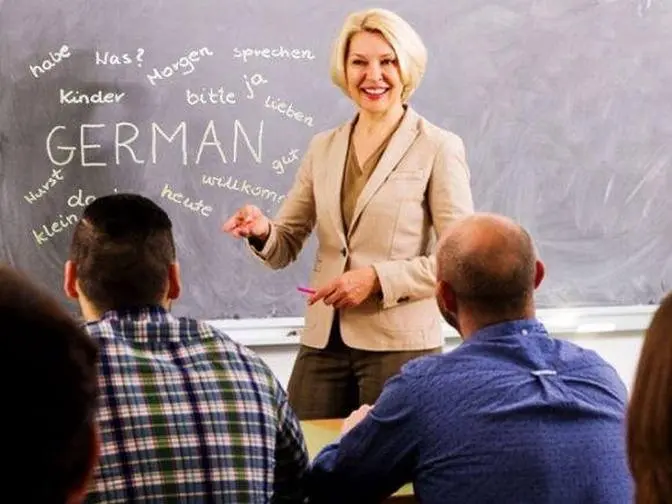
Are you unsure whether you have A2 or B1 level German?
Then this summer livestream is perfect for you.
Our topics include:
German A2 German B1 German Grammar Dative Case in German Perfect Tense with "haben" Perfect Tense with "sein" German Vocabulary German Pronunciation German Umlauts German Prepositions German Two-Way Prepositions German Connectors German Subordinate Clauses German Subjunctive II Dative Prepositions
Become a channel member and receive exclusive benefits:
/ @jannikadeutsch
AI Generated·May contain errors
Video Summary
AI Generated
German teacher Janika hosts a live session for A2 and B1 learners to correct frequent grammar and pronunciation errors. The lesson covers the nuances of prepositions, the distinction between causal and concessive connectors, the correct use of country articles, and the application of Konjunktiv II for politeness, while emphasizing the critical role of umlauts in meaning.
So, we're just waiting one minute.
I am opening my certificate preparation.
I open the last one.
So, 7 p.m. Good evening.
I hope you can all see me clearly.
So, I'm just waiting briefly for the chat.
Yes, I'm also reading the chat here.
Perfect.
So, then we will start now.
Oh no, a minute past seven.
But it's starting now, of course.
Good evening.
I'm so glad you're all here for the live stream.
To everyone who doesn't yet know me, my name is Janika.
And from today onwards, I am your German teacher.
That's right, I've already told you my name, haven't I?
I am Janika.
I am a German teacher, and we are now live on YouTube.
For everyone on TikTok, please go to YouTube Janika Deutsch
And tell me, what's your name? Where are you from?
I'm already reading the first ones.
Travis is here. Hello, Travis.
Stanley is here.
Maurice is here.
Good evening. How are you?
Is everything clear with you? Can you hear me well?
Can you see me well?
I'll wait briefly for your feedback.
Can you hear me well and can you see me well?
Nicolette is here too. Hello.
Bongani is here.
Hey, good to see you all here.
A bit louder.
Okay, I'm trying to speak a bit louder.
I have the microphone too.
I'm speaking a bit more into the microphone.
Then let's get started.
What are we doing today?
Of course, we learn German together.
We will look at and correct grammar and pronunciation errors together.
It is perfect, then.
It's perfect if you're currently learning German at the A2 or B1 level.
And to all TikTokers, please also go to YouTube, there's a PowerPoint presentation there.
So, let's begin with the first false sentence.
The first false sentence is
I'm driving into the lake.
What is wrong with this sentence?
I'm driving into the lake.
Just write the sentence properly, please.
What's wrong here?
Of course I read your comments.
Does anyone recognize what is wrong with this sentence?
Just in case I need to say the sentence again.
I'm driving into the lake.
Exactly, one person has already spotted the mistake.
Is there anyone else?
Exactly, the preposition is incorrect.
Exactly, let's stay briefly on the preposition—it's incorrect.
I'm driving into the lake; that's very strange here.
And what is the correct name for this sentence?
Ah, I can see already that Anna Kim has corrected the sentence superbly.
Does anyone else have the correct solution?
Oh my God, my TikTok just crashed here.
That is naturally wrong.
Also, the preposition "in" does not work here, and Anna Kim had already written the correct preposition.
So, I'm writing the correct sentence for you.
I drive remains naturally the same.
And now the important part.
The preposition in does not work, but the preposition an does.
I am going to the lake.
And now you're wondering, huh, why not into the lake then?
Why can't I drive into the lake?
So, let's take a look at this together in German.
Also, grammatically, you can drive into the lake.
But what does it mean when you sail into the lake?
If you say I'm driving into the lake, then you're driving your car into the water and your car will then be in the water.
Why? Also, I use the preposition "in" when I go into the interior of something.
For example, you could say, "I'm going to the supermarket."
You can also say, I'm going to the park.
To go into something is like entering something, yes?
So, we don't drive or ride our bike into the lake.
So, we need the preposition at here.
For example, I'm going to the lake.
Here you can generally note down: we need rivers, water bodies.
I am going to the lake.
I'm going to the sea, to the river.
So, for waters and at has here the meaning near.
We're heading to the lake, and I just need to quickly make my video smaller.
So, "an" means "in the vicinity of."
I'm driving near the lake, I'm driving to the lake or to the sea.
So, what else can I tell you here about both prepositions?
A tip: we're dealing with the question of where, and it doesn't matter whether you use in or an.
If we have the question "where to," then it is followed by the accusative case.
Where are you going to the lake?
That's a two-way preposition.
And when you have it, where are you?
Then we have "where" and then we have "at" plus dative.
Where are you? I'm by the lake or by the sea.
Very good.
That was already the first mistake.
That is a typical summer mistake.
Always says I'm going to the lake.
I am going to the sea.
Yes, very good.
Are you ready for number two?
Now let's move on to number two.
So.
That's a vocabulary item, uh, not a vocabulary error.
That is, um, yes.
I'm not allowed to tell you what the error is yet.
Otherwise, read the sentence on the next page.
I take a sip of water.
And take your time to carefully think about what's funny here.
I'll explain the vocabulary again, just a bit more.
We have a sunburn here.
Also, it says here that I have a sunburn,
because I used sunscreen.
Also, Sonnenbrand is here when the skin is so red,
Then it's sunburn.
Masculine, right?
Sunburn
And we also have the sunscreen here.
Sunscreen.
The sunscreen is, um, uh,
What is it called?
Sun protection, I believe, in English.
Sunburn, sunscreen.
And, um, let's see what's a bit wrong here.
I have a sunburn because I used sunscreen.
That sounds really strange.
Could you please correct the sentence?
Exactly, I see some good ideas.
So someone is writing because I didn't use sunscreen.
Yes, of course, that works too.
Also, that the negation is missing, so we could say that.
I'll give you one more hint.
Um, that's why I'd like you to change the connector.
Also, the connector is incorrect here.
The livestream is here A2, B1.
And for A2-level learners, this might be a bit difficult.
But I think the B1 people can manage to use a different connector here.
Well, please try changing the connector.
That won't work here.
Some have already realized it.
Also, um, one could deny this here if one takes "Weil."
But I want the sentence to stay like this.
But another connector.
So, I'll read the comments myself.
Can you find another connector?
One more tip: it's also a love phrase connector.
I have gone to the last position.
So someone writes therefore.
That's why that doesn't work either.
Therefore, it is merely a main clause.
And I just saw Bill Daniels.
Hey, Bill Daniels has found the correct solution.
We write as above.
I have a sunburn.
Exactly, uh, Travis found it too.
I have a sunburn.
And now, very important.
Although.
I have a sunburn even though I used sunscreen.
Although.
And, um, what's this here?
Well, although, what's the difference there?
Why do I need this "although" here?
What is Although?
We are happy to take a look at the solution.
Let's look at both sentences once again.
Also, the wrong sentence is.
I have a sunburn because I used sunscreen.
That's not possible. Why not?
Everything always has a cause or a reason.
Logic is always something.
And, um, let's also look down here.
How can we use Weil?
Also, we can say, for example.
I don't have a sunburn.
Because I used sunscreen.
I don't have a sunburn because I used sunscreen.
That is logical.
The reason I don't have a sunburn is because I used sunscreen.
And this although.
We go to the right side.
Although it is naturally correct.
I have a sunburn even though I used sunscreen.
Although it is concessive.
What does "konzessiv" mean?
Consecutive.
Now I've made a mistake.
Concessive means that there is a counter-argument.
Also, something is a bit illogical.
I have a sunburn even though I used sunscreen.
Also, although is "even if" in English.
Maybe some of you speak English.
Even if.
Although is a bit like but.
In A2 one learns a lot, but.
Also, I can say it quite simply.
I can say I used sunscreen, but I still got a sunburn.
It's kind of A2 level.
I used sunscreen, but I still got a sunburn.
And in B1 it becomes a bit more complex.
In B1 level, one can say "Obwohl" followed by a subordinate clause.
And then I got a sunburn, even though I used sunscreen.
Mirek asks it although despite.
Exactly, even though "Trotzdem" is a concessive connector, we use "Aber" plus main clause.
So, I've also written down a second example for you down below.
We are reading another example.
Although I have learned a lot, I failed the exam.
I have learned a lot, but I failed the exam.
But A2, although B1.
Although I have learned a lot, I failed the exam.
Also, I didn't pass the exam.
But so that you pass your German exam and can speak German well in everyday situations, of course we'll continue now.
And we proceed to the third error.
So, it's soon vacation.
You want to fly on vacation.
Now take a look at this sentence.
Here we have another error.
We are flying to Turkey.
What's the problem there?
We are flying to Turkey.
Take a look, please.
Just type it in the chat.
Ah, very good, Jana.
Jana has already found the error.
Super.
Ayman, oh dear.
Perfect.
Eyad has almost found the error.
Yes, very good.
Mirek also corrected the sentence.
So, here we have another error with the preposition "after" again.
And now we wonder, why is it wrong here?
After gives the direction.
After all, it states the goal.
Why can't I reuse this here?
I'll write down the correct sentence first.
The correct sentence is, we are flying to Turkey.
We are flying to Turkey.
And now we're faced with that big question again, huh, why Turkey?
So, we're flying to.
I use it only for countries without articles.
In Germany, there are countries with articles and countries without articles.
Most countries, really, most countries don't have an article.
Where are you flying to?
Then you can say I'm flying to Germany.
I am flying to Spain or I am flying to Argentina.
Where would you rather fly?
To Spain or to Argentina?
So, yes, most countries don't have an article,
such as Germany, Spain, Argentina, Poland, Sweden, and so on.
And then you can always reuse them.
I am saying it again.
We are flying to Germany.
I am flying to Spain.
I am traveling to Argentina.
And when do I use "in" now?
Also, I use the article for countries that require an article.
Those are just a few countries, and they also have a grammatical gender.
For example, Turkey is feminine.
Ukraine is also feminine.
But Iran is masculine.
Iraq as well.
Or the USA are plural.
And if we use it, then we also use the article.
Where to? To Turkey.
We are flying to Turkey.
I'm writing it here again too.
Where to? In the plus accusative.
We are flying to Turkey.
But if I have the question, where?
Where are you?
Then I say, I am in Turkey.
Also there.
What? In the dative case, plus.
Also, there are a few countries with articles.
I also have a YouTube video about it.
You can also take a look at that again if you'd like.
YouTube videos are always released on Wednesdays and Sundays.
Also, the lesson again.
Exactly.
And Mirek asks about Switzerland.
Exactly, I'm flying to Switzerland.
Switzerland also has an article.
So, very good.
The Philippines, precisely, do exist.
Good, my loves.
And it goes on to the next sentence.
This is very important now, I believe.
for summer,
if we want to order an ice cream.
So, let's say that sentence.
I would like an ice cream in a cup.
Something is really strange there.
Ice, that is, ice is frozen water,
but also the ice cream.
One can say the ice or the ice cream.
That exists as well.
We always say the ice.
I'll have an ice cream or something like that.
Or a scoop of ice cream.
So.
And the glass is where the ice is.
This is the cup.
Of course, there's also the waffle.
I always take ice in a cup.
Exactly.
Oh, and I can already see,
Many have corrected it correctly.
I would like an ice cream in a cup.
Exactly, something is missing with the verb here.
That is not what I had.
I'm already writing down the correct solution.
Many have already realized this.
I would like an ice cream in a cup.
Exactly, very good, very good.
You recognized that very easily.
Let's go to the solution.
And why couldn't we have said it?
"Hitte" is the past tense form.
It has always been for the past.
Past tense, past.
When can you use "hatten"?
You can use that one you have
when you talk about the past?
For example, yesterday, last week, and so on.
Yesterday I didn't have time.
Last week he had no desire to work.
There are still more past tense forms such as was.
or had to, could, and so on.
Yesterday I was at the cinema.
Yesterday I had to work.
Yesterday I couldn't learn German.
Because I had so much stress.
That is all the past tense.
So, and this would have.
What is this "would have"?
That's just an umlaut for now.
Not a, but ä.
I would like an ice cream in a cup.
Why am I using the subjunctive II here?
The subjunctive II is very important for politeness.
When we express a wish,
when placing orders, we express a wish,
Then we always like to say.
I would like an ice cream in a cup.
Please use this subjunctive II.
when you order something.
In the café, in the restaurant, for example.
For example, in the café you could also say,
I would like a coffee.
I would like a coffee.
I would like an espresso, please.
a cappuccino and so on.
Also in general, when expressing wishes.
For example, she would rather be in Spain right now
and not in Argentina.
Joke, don't take it seriously.
She would rather be in Spain right now.
That is also a wish.
Exactly, I would like to,
Very good, Travis has written,
I would like to, one could also say,
I would like to,
What would you like to do now?
I would like to go on vacation.
A wish.
Also Konjunktiv II,
We have the formulas,
we would have, would have been, would have to, could
or would plus infinitive
I'm thinking about whether I should soon
I give a YouTube course,
Live, then we can do something like that
Look at everything calmly.
If you feel like a
live YouTube course you have,
You could very well tell me that, please,
Then let's do that one time too.
Great!
So, and we are already at
last error and
Yes, the last error is
A bit embarrassing.
The last error is
A bit embarrassing.
This is also about pronunciation.
Take a look at the last sentence.
What is in the last sentence?
A bit strange.
The weather is gay.
Why?
My dears, why is this a bit strange,
If I say the weather is gay?
Maybe.
Perhaps you could correct this sentence.
What is the correct way to say the sentence?
The weather is gay.
But can the weather really be gay?
So, nobody knows the answer.
Does no one of you know the answer?
The weather is gay.
What's strange about this?
What is wrong with the sentence?
The weather is gay.
I'll give you a little hint.
Something's odd about the word "gay."
We have a mistake in the word.
Let's see.
The weather is bad, perhaps worse.
That's not what I mean.
There is a word that is very similar.
Of course, the weather can also be bad.
But that's not what I mean.
It's very hot, it's warm
and sometimes we also say,
The weather is humid.
Also Ü-Umlaut.
The weather is humid.
We have a U. here above.
I'll make it really big.
And down here, an Ü.
And this one letter,
this letter here,
Alters the entire word.
If a umlaut is missing,
Can the word have a completely new meaning?
And the correct sentence here is definitely,
The weather is humid.
U-Umlaut
And now we are going to take a look at
What does "schwul" mean, and what does "schwül" mean?
Also, gay.
What does gay mean?
Gay actually means homosexual.
That is the meaning of gay.
And for some, it is very difficult,
to pronounce a umlaut
Also many say U instead of Ü.
In the case of Ü, the lips are very pointed.
Look here, U without umlaut.
U or Ü.
My lips are just right this way.
Also, for example,
Gay is a completely different context.
Gay, for example, is
Thomas is gay.
She is soon marrying a man.
Over the weekend, I think,
also CSD in Berlin.
Then the word fits very well there.
Also Thomas is gay,
She is getting married to a man soon.
So now and then,
a letter changes,
From U becomes Ü.
And then we have the word muggy.
And what does humid mean?
Humid means,
when the humidity is very high.
There is high humidity.
It's also warm.
but somehow the air
Also a bit moist.
And that means humid.
When is the weather humid?
For example,
if we have a very hot day.
It's raining a little.
And then it's so humid
And it feels really strange.
For example,
It is very humid today.
Also it is very hot
And it has rained.
The weather is humid.
So and therefore it is also important,
that we train our pronunciation
that we train the vocabulary
but also,
that we train the grammar.
Yes?
So, then my last question to you
for today
I'm looking forward to it.
We have corrected five sentences.
We have corrected a total of five sentences
and I would like to know,
How many errors have you found?
And how many answers did you get right?
How many out of five?
Do you have one of five?
two out of five
Or did you get them all right?
Oh, some people ask me,
whether I can, no, I can in this livestream
Speak only German.
Sometimes my students ask me,
Whether I can speak English or Portuguese here.
In this livestream, I am speaking only German.
So.
How many?
Adrian had a real one.
Okay.
How many did the others get right?
Two.
Travis had two right.
Very good.
Perfect.
So.
Do you want more live streams?
Ah, you had two or three.
Two to three.
Okay.
That's already good.
Today was the first livestream
And we might do livestreams more often.
And my question to you now is,
Do you want even more live streams?
learning German on YouTube?
If yes, then subscribe to the channel,
shares the channel.
So, Luca writes,
Yes, the word was new to me.
Good that you've learned the word.
So.
Do you want even more live streams?
I am waiting for your responses.
My TikTok is crashing again here.
Yes, okay.
Yes, please more live streams.
So, what can you do?
Please like the live streams,
like this livestream,
Subscribe to the channel Janika Deutsch.
You can also become a channel member.
Exclusive videos for you are coming soon,
which only channel members can watch.
And I would also be very happy about that,
when you're there
I had a lot of fun with you today
and next Wednesday
Is there already the next livestream?
Also next Wednesday at 7 p.m.
Is there on this channel
Another livestream.
For everyone who is on TikTok
Please go to YouTube as well.
at Janika Deutsch.
There is a proper presentation.
Everything is visualized.
Also my dear ones,
Then, thank you so much for today.
We'll see each other again next Wednesday.
And goodbye to my YouTubers.