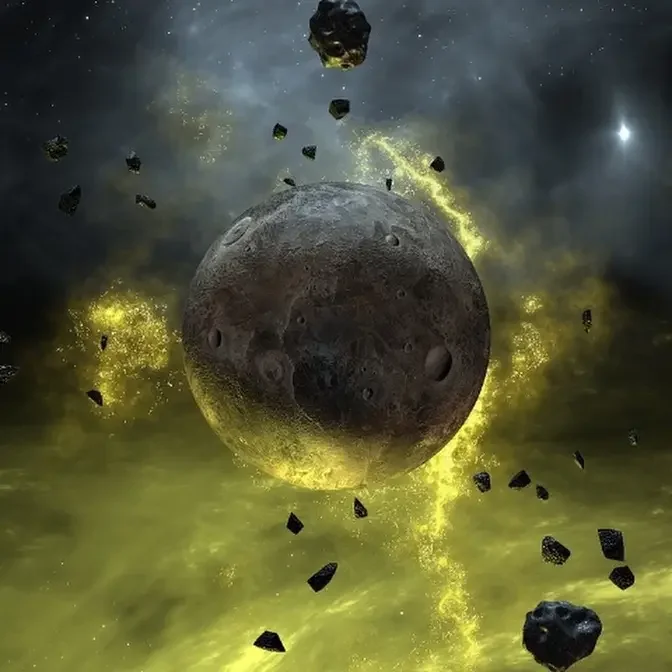
The nature and origin of black holes and their role in the evolution of the universe still puzzles scientists. Now, a new Discovery from the Webb Telescope suggests that the existence of black holes from the earliest moments of the universe could explain more than one astronomical mystery.
In 1971, Stephen Hawking gave a theory that explained how our universe evolved after the Big Bang. according to this theory Black holes in the universe have been around since there were no stars or galaxies in the universe. As new discoveries from the Webb telescope negate our current model of galaxy evolution, this primordial blackhole theory is becoming more discussed, scientists are saying that this Theory can solve the Webb Telescope's latest early galaxy puzzle without introducing new particles or new physics, we can solve mysteries of modern cosmology. But along with all this some questions have also arisen. Are the black holes of the early universe like the black holes of today or will they be different?. Will we be able to find them?
The recent discovery by the Webb telescope has made this questions even more complicated.
The nature and origin of black holes and their role in the evolution of the universe still
puzzles scientists. Now, a new discovery from the Webb telescope suggests that the existence of
black holes from the earliest moments of the universe could explain more than one astronomical
mystery. In 1971, Stephen Hawking gave a theory that explained how our universe evolved after
the Big Bang. According to this theory, black holes in the universe have been around since there
were no stars or galaxies in the universe. As new discoveries from the Webb telescope negate our
current model of galaxy evolution, this primordial black hole theory is becoming more discussed.
Scientists are saying that this theory can solve the Webb telescope's latest early galaxy puzzle
without introducing new particles or new physics, we can solve mysteries of modern cosmology.
But along with all this, some questions have also arisen. Are the black holes of the early universe
like the black holes of today, or will they be different? Will we be able to find them?
The recent discovery by the Webb telescope has made these questions even more complicated.
Well, before understanding all this, we have to understand a little about the early stages of the
universe. So let's start. Understanding the evolution of the early universe is an important
aspect of modern astronomy. One particularly important era in those early days was the time
of reionization, during which the first stars were born. Hubble has allowed us a first glimpse into
that time, but the James Webb Space Telescope will push the door wide open. 13.8 billion years ago,
the universe started with the Big Bang. Initially, the universe was a melting pot of hot free
particles. As it started to cool down, the protons and neutrons combined and attracted free electrons
to form neutral atoms, mostly hydrogen but also some helium. This event, called recombination,
left the universe with no free electrons and a hydrogen fog distributed throughout it.
The clouds of hydrogen would eventually collapse to form the first stars, but this process is very
gradual. For millions of years, the universe would have no sources of light. The cosmic dark ages
had begun. Then the gravity of denser regions began to attract the matter around them.
These regions collapsed to become the first stars and galaxies, eventually beginning to shine.
Thanks to recombination, there were no free electrons to scatter the starlight,
so it could travel freely throughout the universe, ending the cosmic dark ages. The first stars were
massive and energetic enough to strip the surrounding hydrogen atoms of their electrons
again. This time is called the epoch of reionization. This era began probably as early
as 400 million years after the Big Bang, and it lasted for several hundred million years.
There is much we don't know about this time in the universe's history, and even Hubble's
extraordinary cameras are only able to spot a few bright galaxies from that time.
Still, Hubble has provided some of the most detailed information we have about the abundance
and properties of the earliest star-forming galaxies. While providing some answers,
the results Hubble delivered also raised more questions. When and how did the first stars form,
and when did the first galaxies appear? How did the radiation of the first stars escape the dusty
environment of their parent galaxies to ionize the matter in between galaxies? Were the first
stars really powerful enough to reionize the universe, or did active black holes play a role
as well? The recent discovery of an ultra-luminous quasar at redshift z equals 6.30 has accentuated
the problem of supermassive black hole growth and evolution in the early universe. Each of the
approximately 50 previously discovered quasars at redshift z greater than 6 contains a black hole
with mass approximately 10 to the power 9 times mass of the sun, challenging the standard model's
predicted timeline, which would have afforded them fewer than 900 million years to grow after the
Big Bang, but likely even fewer than approximately 500 million years since the onset of population
two-star formation. The early appearance of supermassive black holes is an enduring mystery
in astronomy. Without some unusually high accretion rate or unusually massive seed formation,
such large aggregates of mass could not have formed so quickly in the lambda-CDM model.
Scientists have also said that neither of these two has ever been observed before.
This is a puzzling result, as at such early epochs, there is not enough time to grow such
hypermassive black holes, according to standard theories. Some scenarios have been proposed to
solve this conundrum. One possibility is that black holes, resulting from the death of the
first generation of stars in the early universe, have accreted material at exceptionally high rates.
But further observations denied this theory. The second theory says that these supermassive
black holes must have been formed by the union of many smaller black holes. And these tiny black
holes were formed when ancient gas clouds, not yet enriched with chemical elements heavier than
helium, could have collapsed directly into black holes of a few million solar masses.
But this theory raises a question, whether the first black hole that was formed in the early
universe, was not formed by the death of the star? If this theory is correct, then our standard
cosmological model would again be wrong, which states that stars form first in the early universe,
followed by black holes and galaxies. But a new discovery from the James Webb Telescope,
may dispel these misconceptions. A few days ago, with the help of the first image from the James
Webb Telescope, astronomers have discovered the two most distant candidate galaxies in the early
universe. But both these galaxies still had to go through a lot of tests, which will further
confirm their redshift. Recently in an observation scientists said, it may be that the redshift of
this candidate galaxy is correct. As recent observations, have proved the redshift of this
galaxy, and they are quite confident that it is a high redshift galaxy. Since this galaxy is a highly
redshifted galaxy, some scientists began to study the center of this galaxy. In the hope that,
there might be a black hole at the center of this galaxy, because every galaxy has a black hole at
its center. But surprisingly, they found no evidence of a black hole, and astronomers don't
understand why. The astronomer said that, our observation may be wrong, or there is really no
black hole in this galaxy. If we didn't really find any evidence of black holes, at the center of
these early galaxies then, the mystery of our early universe, will be complicated again. If in future
observations, we find any evidence of a black hole in this galaxy, then Webb Telescope's power will
help us understand how it formed. If it is known from these observations that, this early supermassive
black holes were made of smaller black holes, then we cannot say that, stars were the first to form
in the early universe. And this discovery will help us solve the mystery of this distant supermassive
black hole, detected by the Hubble Telescope. In future new discoveries from the Webb Telescope
will reveal the mysteries of the universe. And stay connected with us to get more interesting
new discoveries like this. Don't forget to like share and subscribe, thank you.