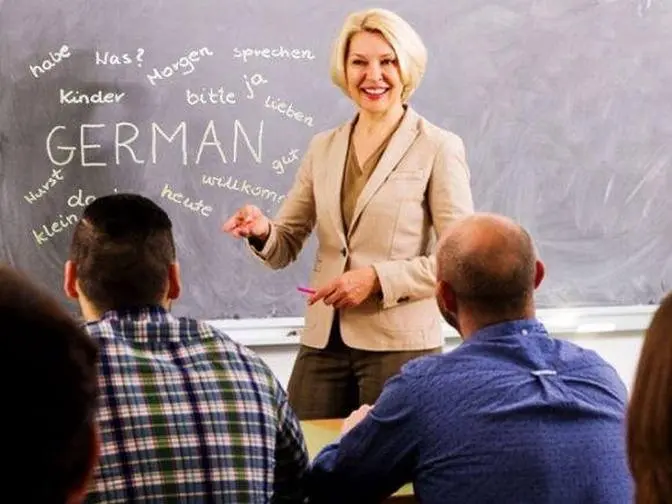
https://tinyurl.com/yc664rcd ← How good is your German? Click here to test your German and find out. First you complete the assessment test. When completed you will be given a score and a personalized learning path to improve your German.
After watching this video you will know how to ask for a word in German. These Can Do lessons are about learning practical German skills. Each lesson brings you closer to natural, fluent German.
If you are an absolute beginner German learner, this video is made for you. This is THE place to start if you want to start learning German.
Also, please LIKE, SHARE and COMMENT on our videos! We really appreciate it. Thanks!
Welcome to Can Do German by GermanPod101.com
Hallo zusammen, ich heiße Katrin Preußler. Hi everyone, I'm Katrin Preußler. In this lesson,
you'll learn how to ask what a word is in German.
Expand your vocabulary with our Core 2000 Words eBook. It's free and packed with essential
expressions that you'll use on a daily basis. Start building your vocabulary today. Click the
link in the description below to download your free German eBook before it's gone.
This is Ben Lee, and he's at a cafe doing a language exchange with his classmate,
Carla Koenig. It's the German portion of the exchange, and he points at the textbook and asks,
How do you say book in German?
Listen to the conversation and focus on the question. Ready?
Once more with the English translation.
How do you say book in German?
You say book. Let's take a closer look at the conversation.
Do you remember how Ben says, How do you say book in German?
The standard way to ask for the meaning of a word in German follows a simple pattern.
First is, Wie. How. Wie. Wie.
Next is, Sagt man. One says. Sagt man.
First is, Sagt. Says. Sagt. Sagt. Sagt.
Is from the verb, Sagen. To say. Sagen.
Next is, Man. Roughly translating as, One. As in, One says.
Together, Wie sagt man? Literally, How says one?
But translates as, How does one say?
After this is the English word, Book. Last is the phrase, Auf Deutsch.
Meaning, In German. First is, Auf. Meaning, In. In this context.
After this is, Deutsch. German. As in the language.
All together.
Literally means something like, How says one book?
In German. But translates as, How does one say book in German?
And in more natural English, How do you say book in German?
Note the rising intonation of the sentence to mark that it's a question.
Let's take a closer look at the response.
Do you remember how Carla says, You say book?
First is the phrase, Man sagt. One says. But translates here as, You say.
After this is the answer to the question.
All together.
Literally means something like, One says book. But translates as, You say book.
The pattern is,
How do you say English word in German?
To use this pattern, simply replace the English word placeholder with the word you want to know.
Imagine you want to know the German word for pen.
Ask, How do you say pen in German?
Ready?
How do you say pen in German?
This lesson introduces a grammatically complex but commonly used pattern.
The impersonal form with man.
The man construction is used to express what people do in general
rather than point to a specific person.
The pattern is man plus a verb in the third person.
The example used in this lesson was, Man sagt. One says.
Let's quickly look at a few more examples.
Man liest. One reads. As in, One reads a book.
Man isst. One eats. As in, One eats a lot at Christmas.
Man schläft. One sleeps. As in, One sleeps late on Saturday.
Let's look at some examples.
Listen and repeat or speak along with the native speakers.
Wie heißt das auf Deutsch? Das ist ein Buch.
Wie heißt das auf Deutsch? Did you notice how I used a different sentence pattern?
Wondering how you can master these conversations even faster?
Here's how.
One, read along.
You get the lesson conversation and translations inside our dialogue tool,
so that you see each word as you hear it and understand it all.
Two, practice speaking.
By shadowing what you hear,
you can also record and compare yourself with native speakers with our voice recording tools.
And three, take our assessment tests and see how much you remember.
These tools are part of our CanDo course.
Just click the link in the description to get them.
Wie heißt das auf Deutsch?
What do you call this in German?
To create this pattern, simply replace,
Sagt man.
One says, with,
Heißt das.
Call this.
Heißt das.
First is,
Heißt.
Calls.
Heißt.
Is from the verb,
Heißen.
To be called.
Heißen.
Next is,
Das.
Meaning this.
Das.
Together.
Heißt das.
Literally, calls this.
But translates as,
Call this.
Heißt das.
The pattern is,
Wie heißt das auf Deutsch?
What do you call this in German?
This is a very useful pattern for using German to learn German.
Do you remember the response?
This is a book.
Das ist ein Buch.
Let's start with the word,
Buch.
Book.
Buch.
In German, all nouns have grammatical gender and are either singular or plural.
Buch.
Is neuter and singular.
A fact which will determine the form of other words in the sentence.
Before,
Buch.
Is,
Ein.
Something like,
A.
As in,
A book.
In this context.
Ein.
Is neuter and singular to agree with,
Buch.
Let's move to the start of the sentence.
Das.
This.
Das.
Next is,
Ist.
Is.
Ist.
Is from the verb,
Sein.
To be.
Sein.
Together it's,
Das ist ein Buch.
This is a book.
Das ist ein Buch.
Let's review the key vocabulary.
Tasche.
Bag.
Tasche.
Kugelschreiber.
Pen.
Kugelschreiber.
Bleistift.
Pencil.
Bleistift.
Das.
This.
Das.
Let's review.
Respond to the prompts by speaking aloud,
then repeat after me,
focusing on pronunciation.
Ready?
Do you remember how to say German as in the language?
Deutsch.
And how to say in German?
Auf Deutsch.
Do you remember how to say,
How?
Wie?
Do you remember how Ben asks,
How do you say book in German?
Wie sagt man,
Buch,
auf Deutsch?
Wie sagt man,
Buch,
auf Deutsch?
Do you remember how to say,
Book?
Buch.
And do you remember how Carla says,
You say,
Book.
Man sagt,
Buch.
Do you remember how to say,
This?
Das.
And how to say,
What do you call this in German?
Wie heißt das auf Deutsch?
Let's practice.
Imagine you're Karen Lee,
and you're having a language exchange lunch with Bertha Bauer.
You point to the pen and ask,
How do you say pen in German?
Ready?
Wie sagt man,
Pen,
auf Deutsch?
Man sagt,
Kugelschreiber.
Listen again and repeat.
Wie sagt man,
Pen,
auf Deutsch?
Wie sagt man,
Pen,
auf Deutsch?
Now you want to know the word for bag.
Ready?
Wie sagt man,
Bag,
auf Deutsch?
Man sagt,
Tasche.
Listen again and repeat.
Wie sagt man,
Bag,
auf Deutsch?
Wie sagt man,
Bag,
auf Deutsch?
Let's try one more.
Imagine you're Sasha Lee,
and you're studying with your classmate.
Point at a pencil and ask,
What do you call this?
Ready?
Wie heißt das auf Deutsch?
Das ist ein Bleistift.
Listen again and repeat.
Wie heißt das auf Deutsch?
This is the end of this lesson.
Now here's what you can do to cement this conversation in your head.
Review the conversation with our dialogue tool and lesson transcripts.
Study the key words and phrases with our spaced repetition flashcards.
Review the key grammar and cultural tips inside the lesson notes.
And test yourself with our assessment tests.
So click the link in the description right now
and sign up for your free lifetime account to access our CanDo course.
Now you know how to ask what a word is in German.
That's all there is to it.
Keep practicing and move on to the next lesson.