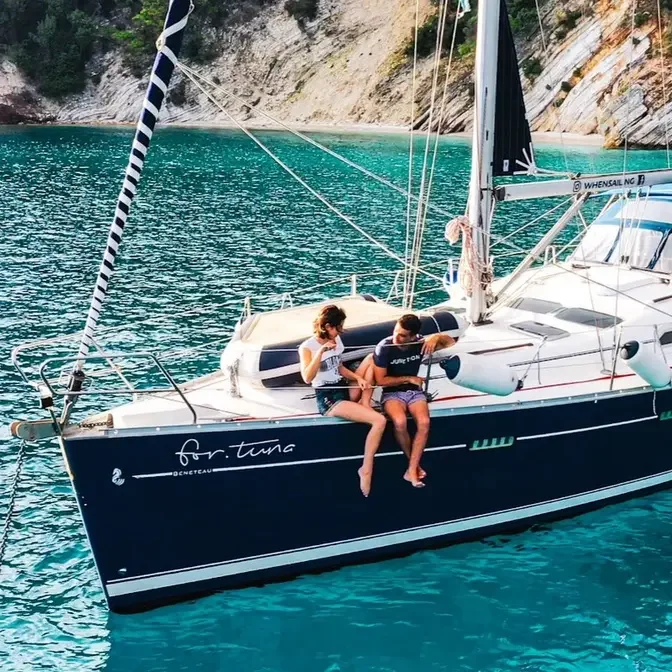
the perfect Bluewater Sail Set Up for liveaboards and ocean crossings. Bluewater sailing is very different then coastal sailing and when it was time for us to sail into the ocean and leave the coastal waters for bluewater adventures it was time to upgrade our sails and sail set up. after testing our 6 sails for 7 months we finally share with you our review of the Rolly Tasker Sails we have chosen to be our live-aboard sail set up and which have brought us across the atlantic ocean and who knows maybe will cross the pacific ocean too one day.
Follow along as we travel the Caribbean and the world aboard of our sailboat, one caribbean island at the time, sharing our sailing vlog weekly with you. Hope you enjoy our sailing channel, would love to hear your feedback on our sailing videos and your opinion about sustainable travel.
We would love to hear about your feedback on the Guide and Tips we share and if you have already experienced an Ocean Crossing let us know your experience and best tips.
Fair Winds, Greta and Michael
🚨 Liiike and help us to create more videos ⛵ support us on Patreon: http://bit.ly/3d7ZoWb
🚨 You liked our Atlantic crossing videos? It would be awesome if you subscribe to our sailing channel to not miss out on the next sailing episode every week! Your support means the world to us! 😃
👩🏻🤝👨🏽 Want to know who we are? Check out our website, where you find our sailing story and lot of tips about sailing and sustainable travel: [http://bit.ly/2OCLLEn]
📩 Updates: To be the first subscribe to our mailing list here: http://bit.ly/3b6CrzY
🙏🏽Thanks you so much for ❤️ watching & binge watching=) ❤️ following along ❤️ subscribing ❤️ leaving a comment (we also speak Italian 🇮🇹 and German 🇩🇪) ❤️ checking our website ❤️ or even becoming a Patreon ❤️ all your awesome likes
🍀 Did someone say pizza? 🍕 Greta craves it more then anything (maybe Michael🤷🏻♀️) you want to buy us some mozzarella? check out: 🌟 Paypal: http://bit.ly/3pbDeow 🌟 Patreon: http://bit.ly/3d7ZoWb
Hello everyone and welcome back to a new episode. Today we are going to sail along the beautiful
coast of Curaçao and we are going to show you the blue water sail setup we decided to put on
our sailboat in order to safely cross the Atlantic Ocean and now have the perfect sail setup for all
conditions that live a boat like us will face out there. This is me and this is the love of my life
and partner in crime. Two years ago we traded our stable corporate lives for more adventurous and
sustainable lives as digital nomads at sea. Follow along as we discover new places and build our
businesses one anchorage at a time. So after sailing for 18 months in the Mediterranean we
got a lot of winds and a lot of experience there and we decided it was time to head out in the
To do so we had to improve our sail setup immensely. So today after seven months in the
Atlantic Ocean and the Caribbean Sea we would like to show you why we chose this setup and why we
think we made the right decisions. When you alter your sail setup sometimes it also means that you have to
alter the sail rigging of the whole sailboat and that's what we had to do because we had no second
forestay but we wanted to have a second smaller jib in case for higher winds and in case also if
we went into storms to be able to use a storm sail. A second forestay always means bigger duration for the
boat because you have to sometimes re-rig the mast and also take a lot of space away from the deck
actually. As we live on the boat space for us is really important so we needed a solution that would
take the less space possible. And here comes in the idea of Swaggen Furler and Rolly Taskersail
who ideated a second forestay which is actually really cool. Our 2-2-1 halyard system consists of
a Dyneema halyard which we can throw away to the mast so we have nothing in front. It comes from
top of the mast and goes down to a fixing point to a chain plate in the deck where we can fix
the furler and the sail. On top the Swaggen Furler consists of a swivel so we fix the sail here and
then we can furl the sail. On the bottom we have the removal of a furler so we can take it off and
we have the whole space for ourselves and we can install an endless furling line which goes back
to the cockpit so we are safe and sound when we furl in the sail or take it out and we can do
everything from the cockpit. The first thing we want to show you is our heavy wind chip which is
the one we mostly use on our 2-2-1 halyard system. The sail itself is pretty strong and it has an
anti-torsion rope inside. The anti-torsion rope is actually the part that works as forestay so we
don't need any aluminum forestay to do that. So the anti-torsion rope in combination with the 2-2-1
halyard system allows us to have a flexible and easy to use system. This allows us also to
furl in the sail, take it away and we don't have any sheets running back to the cockpit when we
don't use the sail. So the cockpit is clean and especially for sailing and if we want to sail
with the Genoa there is no forestay when we tack. So we can tack from starboard to port side very
easily without having to furl in the Genoa or without having the fear to damage the forestay.
So the heavy wind chip is up, our second forestay is in place and we are finally ready to go sailing.
The wind is definitely here already. We are finally on the move and it looks like we have
a lot of wind so we definitely are going to meet the heavy wind chip today. When we got the
opportunity to work together with Rolly Tasker Sails on our dream sail setup for us it was really
important to find a balance between safety, speed and amount of sails because as you know we are
living on Fortuna so dragging around a lot of sails was just not an option for us. Nevertheless
we needed to be prepared for all the conditions that could be happening out on the Atlantic Ocean
or in the Caribbean Sea. So at the end we decided on a sail setup with six different sails from which
two are always up. The two sails that are always in action are our main sail and our Genoa. While
about Fortuna she still had the original sails which means they were standard OM sails mainly
meant for cruising inshore or in the Mediterranean. But as we now were ready to go offshore across the
Atlantic Ocean and explore the Caribbean Sea it was time to get proper cruising blue water sails
with a durable cloth and the right enforcement to stay with us for many many years and for many many
adventures.
Now we are sailing and it is just beautiful we are on a perfect downwind course with our sails
up in our butterfly and we're just surfing down the waves with five to seven knots so it's really
perfect right now. We have five ton winds about 20 knots so we're very happy to have out our heavy
wind jib. I have to admit that when we got the heavy wind jib we were not really sure how to use
it. We have been sailing with our main sail and our Genoa for yeah 18 knots on the max so we were
so sure on our two sails that we were used to use. But once we started using the heavy wind jib it's
just such an amazing sail. It helps you out when there is not a lot of wind. We started using it
in our free sail constellation with the main sail, the Genoa, the pole and the jib so it gives you this
little extra when there is not a lot of wind. And obviously when there is a lot of wind you just can
throw in the Genoa and totally trust on your heavy wind jib. It's a sail we definitely recommend to
everyone. Definitely if you're going for an Atlantic Ocean crossing or start sailing offshore
a heavy wind jib is a must. And I would even say recollecting the winds and waves we had in
the Mediterranean a heavy wind jib would have come easy in a lot of situations.
Wow that is quite some wind today but the heavy wind jib is doing an excellent job.
Unfortunately this will mean that we are not really able to take out any other sails today.
But I still want to explain to you our sail setup and why we decided to go for it.
As mentioned at the beginning we have a total of six sails on board which in combination allows
us to sail all different kind of wind speeds and wind angles. So far we have talked about our blue
water main sail with durable craft, reinforced leeches and multiple stitching. We have a
Genoa sail with an extra foam in the last which allows the sail to keep its form also when it is
being reefed. And we have the heavy wind jib. So these three sails allow us to sail between
10 to 25 knots on pretty much most of the angles. What is now still missing in our sail setup
is a light wind sail. The fourth sail we have decided to take on board is our beautiful
Gamma curl who all of you people have helped us to design. At the beginning we were a little bit
scared using it because we heard so many scary stories about Gamma curl dropping into the water
or ripping in the middle of a sail. But we have to say it has become our favorite sail and whenever
we have the chance we take it out and go and sail with it. One of the reasons why we are so happy
with this Gamma curl is also because it is an offshore Gamma curl. So it is made of a little bit of thicker
cloth which means you need four or five knots in order to be able to hoist it. And it is not only
stitched but also glued. Something that has been very helpful to us on the Atlantic Ocean as our
gennaker decided to fly freely in 20 knots of wind but did not get damaged at all. These sails allow
us to sail until 25-30 degrees. Afterwards the sea can get pretty rough so we decided to also get a
storm jib and a tri-sail on board. Luckily we never had to use them so far but we did a trial
once with our storm jib which we're going to show you now. So we got two storm sails. One basically
for the jib. We decided for the two-to-one inner forestay system to hoist it. So we will show you
that. And one as a tri-sail instead of the main sail. We are very lucky because we have a furl in
main sail which means we would have to take down the main sail in order to hoist it. Not an option
because in case of a storm we need to hoist it quickly. So luckily there is a rail left to the
furler where we can put in the tri-sail and lift it up with the topping lift. So a really nice
solution for normal full batten main sails. It should not be an issue because you have already
the rail and it's free when you hoist the tri-sail. Beside our two orange beauties we
had to get two blocks for the tri-sail. It's the same we use for the gennaker
and a few more sheets for tri-sail and the storm jib basically. Oh and a small soft jacket
to fix it. And that's it. Really easy setup at the end. This brings us to a conclusion. In total
our sail setup is made up of six sails and one telescopic boat which allows us to sail
all the different kinds of weather and wave situations we have found ourselves
so far. To quickly recap we have an offshore main sail, a 130% offshore genoa, a heavy wind jib,
a gennaker, a tri-sail and a storm sail. We hope you liked this episode. Don't forget to hit the
subscribe button and leave us a like and a comment which really helps us to grow. If you have any
questions about our sail setup feel free to leave them in a comment and we will for sure answer
them as quickly as possible. Thanks so much for watching. See you all next week!