
Scotland's Highlands
58 Video Views·Dec 26, 2022
Hi, I'm Rick Steves, back with more of the best of Europe.
This time, we're packing light, but there's always room for puppies, sheepdog puppies.
We're in the Highlands of Scotland.
Thanks for joining us.
The Highlands are where dreams of Scotland are set.
The land of kilts, clans, and lonely castles, the Highlands offer the quintessence of Scottish
charms.
In this episode, we'll connect with clan heritage, be awestruck by Highland beauty, marvel at
early British engineering, join in the search for a monster, time travel back to the Iron
Age, watch sheepdogs do their thing, and check out some traditional folk music.
The United Kingdom includes England, Wales, Northern Ireland, and Scotland.
Scotland includes a third of Britain's land.
Its main cities are Glasgow and Edinburgh.
To the south is the Lowlands, and to the north, the Highlands.
Focusing on the Highlands, we'll visit Inveraray, Oban, and follow the Caledonian Canal to Lochness,
Inverness, and the battlefield at Culloden.
Here in Scotland, the Highlands have more than half the land and only 5% of the people.
Still, it's these Highlands, so vast yet so sparsely populated, that give us the classic
image of Scotland.
The highest mountains in Britain are here in Scotland, in the Highlands.
While only around 3,000 feet in altitude, they offer a dramatic welcome and a backdrop
of constantly changing views for road-trippers.
Long lakes, called lochs here, cut like fjords into a land where the heritage remains strong.
In this region, so much seems proudly Scottish.
Clans gather to celebrate traditional sports.
Girls grow up dreaming to dance like their mothers did.
Whiskey is savored with reverence for the culture.
And pipers still stir the Scottish soul.
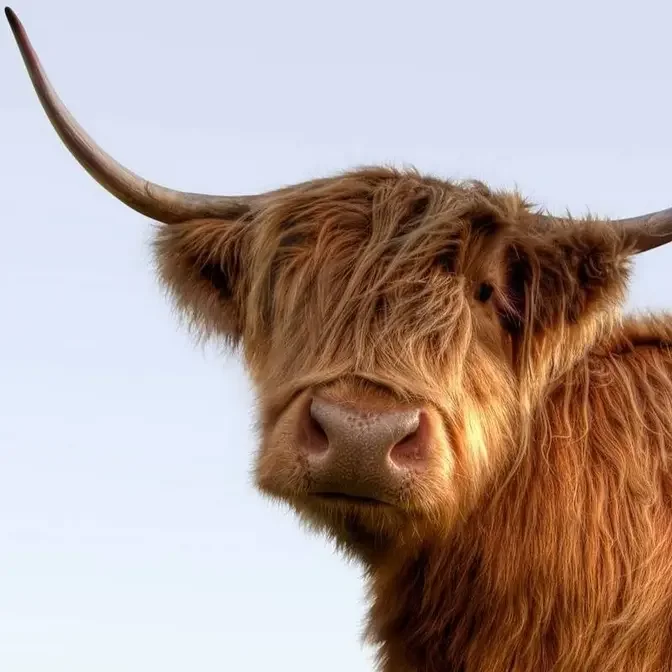
And in this land so steeped in culture, Scotland's beloved hairy coo feels perfectly at home.
These shaggy Highland cattle have evolved to fit the environment.
Their adorable bangs protect their eyes from both insects and the persistent wind.
Historically, Highland society was centered around the clan system.
In medieval times, long before being tamed by any central government, the Highlands were
inhabited by a collection of proud and often bickering tribes or clans, each with its
own chief and deep-seated traditions.
Castles dotting the landscape evoke this strong clan heritage.
Scottish people, whether in Scotland or abroad as part of the Scottish diaspora, still relate
to their historic clan.
And many venerate a particular castle as their historic capital and almost spiritual center.
Inveraray Castle, the residence of the 13th Duke of Argyle, has a stately turreted exterior
set in a delightful garden.
Historically a stronghold of the Campbell clan, its walls are well hung with portraits
of the many dukes who've called this palace home.
Here's the first duke, with Dukes No. 2 and 3 on deck.
As with many such castles, the aristocratic family still lives here, like clan royals.
Displays are like the family scrapbook, showing the current duke and his family, who still
occupy the private half of this palace.
The public half is a museum, filled with precious, if you're a Campbell, artifacts.
This case features pendants of esteemed family members through the ages.
This one's filled with dirks and daggers, set against a nice Campbell tartan.
A highlight is the armory hall, which fills the main atrium.
Here, swords and rifles are artistically arrayed in starburst patterns.
Docents are standing by and happy to answer questions.
So our halberds here date from the 1600s.
They come from the earlier castle before this one.
Now what is a halberd?
So a halberd could be used against charging cavalry, and you'll notice they've got tassels
on them.
It's not just for decoration.
I don't know about you.
If you're killing someone, you don't want their blood dripping down your weapon, making
it all slippy.
So the tassels actually had a function.
That's right.
So the tassels would soak up the blood.
And these muskets?
So this is our brown bass flintlock muskets, all dating from the 1740s.
These are all original.
And they were last used at the Battle of Culloden, 1746, the last battle fought on British soil.
Yes, so we have in this cabinet some of the belongings of Rob Roy MacGregor, a famous
folk hero.
The famous Rob Roy.
That's right.
Rob Roy MacGregor.
So this is his spawn in here.
And what is his spawn?
So his spawn, if you think of a kilt, there's no pockets in a kilt, so you'd have your spawn.
And in your spawn, you'd have maybe a wee bag of oatmeal.
So this is your bag of essentials.
Exactly.
Hanging right here in front.
You'll find castles like this all over the Highlands.
Today, countless Scottish Americans make a pilgrimage of sorts to their ancestral clan
capital.
If you're a Campbell, you'd come here to Inveraray.
The main town of the west coast of the Highlands is Oban.
With the arrival of the train in 1880, Oban became the unofficial capital of this region
and a destination for tourists.
Today, Oban's harborfront seems eager to please its many visitors.
Victorian facades recall those early days of tourism.
Before then, its economy was dominated by whiskey.
Its venerable distillery has been busy since 1794, and by fishing.
Even today, a tiny fleet stays busy.
When the rain clears, sun-starved Scots enjoy their esplanade.
And the beach brings joy to young families.
The town's port has long been a lifeline to Scotland's Hebrides Islands, earning Oban
the nickname the Gateway to the Isles.
But we'll save the islands for another episode.
We're driving north, deeper into the Highlands.
Of course, here in Britain, you drive on the left-hand side of the road.
You get used to it.
The roads are good, the traffic's light, and the scenery is gorgeous.
The stunning valley called Glencoe offers the essence of the wild and stark beauty of
the Highlands.
While the valley is massive in scale, at its entrance is a tiny and practical home base.
Glencoe Village is basically a one-street town gathered around its church.
There's the Humble Folk Museum, plenty of B&Bs, we're staying with Jackie and Ian, and
a memorial to a terrible tragedy.
A tragedy that, while three centuries old, still resonates.
To be sure we get the story right, we're joined by my friend and fellow tour guide, Cullen
Mares.
This is a beautiful valley.
Yeah, well, it does have a sad story, though.
In 1692, there was a massacre here, and government troops, redcoats, made up mostly of Campbells,
they were sent here by the king.
They were given the orders to arrive to the homes of the MacDonalds of Glencoe and to
await further instruction.
So they enjoyed the hospitality, the Highland hospitality of the MacDonalds of Glencoe,
and after 12 days, the further instruction arrived for the Campbells to massacre the
MacDonalds of Glencoe.
As the MacDonalds slept in their beds, the Campbells carried out the order.
We know that 38 MacDonalds were killed as they slept, others fled for the hills.
This was mid-winter in the Highlands of Scotland, and many others perished and died in the cold.
Ever since then, this has been known as the Weeping Glen.
It's fitting that such an epic, dramatic incident should be set in this equally epic and dramatic
valley, where the cliffsides still seem to weep.
Glencoe Valley leads up into the vast Rannoch Moor.
This moor, the biggest expanse of uninhabited land in Britain, is hundreds of desolate square
miles, much enjoyed by hikers and lovers of nature.
When filmmakers want a stunning, rugged backdrop, when hikers want a scenic challenge, and when
Scots want to remember their hard-fought past, they all think of Glencoe.
As we drive north from Glencoe, we find a massive fault line slashing about 60 miles
across the Highlands, nearly cutting Scotland in two.
The drive from here northeast to Inverness follows three long, skinny lakes created by
the Great Glen Fault and a series of 19th-century canals that lace them together.
This is the Caledonian Canal. Perhaps the most idyllic stop along the canal is the little
town of Fort Augustus, built around an impressive staircase of locks.
Today, this historic piece of British engineering is a welcoming park.
Two hundred years ago, as Britain was at full steam during the Industrial Age, it connected
these lakes with about 20 miles of canals and locks. That was so its ships could avoid
the long journey around the north of the country. The Caledonian Canal took 19 years and cost
a fortune to construct. It opened in 1822.
While these locks were an engineering marvel in their day, they were quickly antiquated
and a disaster commercially. Shortly after the canal opened, ships were built too big
to fit. And shortly after that, with the advent of steam trains, the Caledonian Canal became
almost useless, except for Romantic Age tourism. And today, the canal remains a hit with holiday
goers.
The most famous part of the Caledonian Canal route is the long and skinny Loch Ness. Twenty-two
miles long and over 700 feet deep, it's essentially the vast chasm of that fault line filled with
water. They say Loch Ness contains more water than all the lakes of England and Wales combined.
Loch Ness is deepest near Arkhart Castle. While thoroughly ruined and little more than
an empty shell to climb through, in its medieval heyday, this strategically situated castle
was one of the most important in the highlands, controlling traffic along the Great Glen.
Today, so gloriously situated with a view of virtually the entire lake, it's extremely
popular with tourists and the perfect place to look for the Loch Ness Monster.
While the lake is, frankly, boring, the local tourist industry thrives on the legend of
the Loch Ness Monster. It is a thrilling thought, and there have been several seemingly reliable
sightings. And, of course, there's a touristy exhibit that would love to tell the story.
The Loch Ness Exhibition is spearheaded by scientist and naturalist Adrian Schein, who
spent decades studying the Nessie phenomenon.
Adrian, can you tell me the mission of this exhibition?
Our mission is to be part of the essential sense of place. We are not a monster show,
but we will tell you a lot, whether you like it or not, about Scottish lochs by arguing
about the Loch Ness Monster. But we do it in a fairly entertaining way, I like to think,
because we're talking about the one thing we would all like to have in Loch Ness.
What we do is take you through the history of the search for an unusual animal in Loch
Ness. In the 60s, it was surface surveillance with big telephoto lens cameras. Having failed
in the 70s, we went underwater, partly in my own little photographic hide, Micham. Having
failed to encounter a beast, we resorted to sonar in the 1980s, sort of underwater radar.
We built a flat-packed sonar search vessel on a beach in 1981, patrolled up and down
the loch. The contact led in the end to Operation Deep Scan in 1987 with the fleet.
In the 90s, we got a bit canny. We used an indirect method, and we have been ever since,
and it's general science. What can the loch support in terms of food resources? What do
the temperatures tell us about what could live in Loch Ness? And finally, we have the
environmental message in terms of the record within the Loch Ness sediments.
I would like our visitors to go away thinking about what could live in Loch Ness when we
have explained Loch Ness. Go and see Loch Ness, but if you want to understand it, come
here. And at the same time, and above everything, we want them to go away knowing a lot more
about Scottish lochs.
Just beyond Loch Ness, I feel the real spirit of Scotland most deeply at Culloden, the site
of the last major land battle fought on British soil.
About 300 years ago, Scotland was embroiled in a bloody civil war with England. Well,
it's a complicated story. Basically, the Scots were fighting for their culture — to put
a Catholic king on the throne and to keep their ancient clan traditions. The last leader
of this cause was Prince Charles Edward Stuart, fondly known as Bonnie Prince Charlie. His
forces were called the Jacobites, named for his grandfather, the deposed King James. James
was Catholic, and his name was Jacobus in Latin. That's why the rebels were called Jacobites.
For a long time, Bonnie Prince Charlie confounded the English and their Protestant monarch.
Slipping from valley to valley, hiding behind clever disguises and in sympathetic farmhouses,
Charlie kept the Scottish dreams of his Jacobite followers alive.
Those dreams ended here, at the decisive Battle of Culloden in 1746. The on-site museum tells
the story vividly. Docents demonstrate battle techniques to give visitors context. And a
small theater captivates its audience with a dramatic reenactment.
The Scottish clans gathered every possible warrior, but they were outnumbered and outgunned
by the British Redcoats. While the clans fought fiercely, the British were cool, methodical,
and ruthless. The hour-long battle was a catastrophe for the Highlanders as the British army finally
and thoroughly defeated the Jacobites. Survivors broke ranks and ran for the hills.
After the battle, the British army hunted down and killed clan chiefs and sympathizers.
They banned kilts, tartans, bagpipes, and even the local language. Scottish Highland
culture would never fully recover.
On the battlefield, flags mark where the two armies lined up. This is where most of the
hand-to-hand fighting took place. As visitors wander the battlefield, they pass mass graves
and ponder how entire clans fought, died, and were buried here at this Scottish Alamo.
For many, this is an emotional visit.
Nearby, the town of Inverness straddles the River Ness near the eastern end of the Caledonian
Canal. This town's charm lies in its normalcy. Inverness is a simple, mid-sized Scottish
city that gives you a taste of the urban highlands. It has a disheveled, ruddy-cheeked grittiness
and is well-located for enjoying nearby sights. Check out the bustling, pedestrianized downtown
and stroll the riverside.
Inverness is a great place for music in the pubs. Tonight, McGregor's is hosting a session
— not a formal concert, but just an open table for local musicians to get together
and jam. While this is a modern pub, it embraces traditional Scottish music, which is clearly
alive and well. Music brings the people of the highlands together, even today.
It's an inviting conviviality. Everyone seems eager to get to know each other, and visitors
feel welcome. You enjoy amazing music for the cost of a beer. And the beer is great.
We're driving south to learn how some of the original Highlanders lived. Across Cotland,
little round islands on lakes are the remains of prehistoric fortified homes. These are
called crannogs and date back centuries before Christ. Here at the crannog center on Loch
Tay, one's been rebuilt using mostly traditional methods and now welcomes visitors.
This is the Scottish crannog center. It's a reproduction of a 2,500-year-old crannog
that the archaeologists are excavating as we speak in Loch Tay right now. It was built
out in the loch itself for defensive purposes. In Scotland then, you had bears, you had wolves,
you had big cats called lynx, other people roaming the countryside. And if you're out
here in the water, there's only one way in and out, and that's the walkway. So if you
can keep that secure, you yourself in here are going to feel a lot safer.
Guides demonstrate Iron Age technology, turning a lathe, grinding flour, and even starting
a fire the really old-fashioned way.
You can give the tools a try yourself and discover how easy the guides make it look.
Scotland is littered with reminders of prehistoric people from an even earlier age. At Clavau
Cairns, three Bronze Age burial chambers date from about 4,000 years ago. Each was once
buried under turf-covered mounds and surrounded by a stone circle. The central ring cairn
has an open space in its middle. The two passage cairns each have an entrance shaft that, on
the winter solstice, lines up with the setting sun. Visitors are caught up in the peaceful
wonder of this ancient and sacred site.
Enjoy the mystery of this place. Were these stone circles part of a celestial calendar?
Was the soul of the deceased transported into the next life when the sun was just right?
Nobody really knows.
But everyone knows sheepdogs are fun. A favorite experience when touring Scotland is to visit
a working sheep farm and meet the farmer and his dogs. Each afternoon, Neil Ross takes
a break from farming to show off his well-trained sheepdogs. And his son, Tristan, is learning
from the master.
The main purpose of the dog is to go down the field, get the sheep, and bring them up.
The voice commands, I'll explain the voice commands to you. This command means stop that dog.
Stop command. The dog's hearing is like electric. The command wait to me means right.
Wee murk. Wee murk. Wee murk. Stop is lie down. Wee murk.
The voice command come by is left.
Go come by.
That whistle sound means left. Means right.
Great. Another foreign language I can't understand.
The show ends with a demonstration on how to shear sheep, with the kids getting a chance to help.
The dogs love some attention when they're on break, and there's always lambs to be fed.
We connected with spectacular landscapes, shared traditional music, felt the power of
history, and were inspired by the pride of this resilient culture.
I hope you've enjoyed our look at Scotland's Highlands, with its rich heritage and majestic nature.
Thanks for joining us. I'm Rick Steves. Until next time, keep on travelin'.
Rob Roy's sport.
Yeah, for sure, yeah.
This is my new dog for next year.
I hope you've enjoyed our look at Scotland's Highlands, with its rich heritage.
Loch Ness Monster, I just don't like.