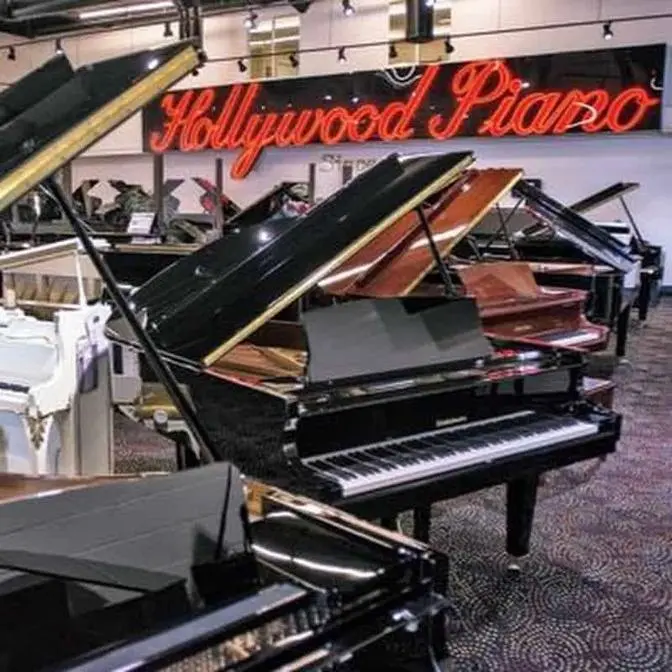
This is Seminar #2 from April 19th of our Roland Piano Sale-Abration series: 👉 Is a Big Box Store Keyboard Enough to Start? This is one of the BIGGEST questions beginners ask, and honestly… most people get it WRONG. We break down: 🎹 The difference between cheap keyboards vs real digital pianos 🎧 Sound quality that actually matters 🖐️ Why key action can make or break your progress 💰 When it’s worth upgrading (and when it’s not) If you’re starting your piano journey — or buying for your kids — this video could save you hundreds (or thousands) of dollars 💯 🔥 This is part of our 3-part seminar series, and we’ll be dropping the other videos for those who missed out 📘 BONUS: We gave out exclusive info documents at the seminar 👉 Come into the store and ask one of our piano experts 👉 Or ask for Glenn Treibitz to get your copy 💬 Be honest… did YOU start on a cheap keyboard or a real piano? Would you do it differently? #fyp#piano#music#beginner#viral
Hey everyone, this is Glenn Shrivets for Hollywood Piano
and another one of our seminars
from our Roland Celebration Month.
Now these seminars were all given live except for one
which we did specifically to a video
and is being broadcast live.
This one is one that I gave last week
and the subject is, is a big box store keyboard
good enough to get started with?
And the answer to that is, maybe.
You know, we found industry-wide that statistics
are people who start to play on a keyboard
from a big box store, be it a Walmart, a Target, a Best Buy.
I mean, these are not the most professional keyboards
in the world and it lacks the inspiration factor.
You know, if you have $100 keyboard and you're playing it,
you're not gonna be all that inspired
with the sound that it produces.
I mean, there's a reason why there are $100 keyboards
and there are $10,000 keyboards and they all plug in
but they're all very different.
So the difference is what you're getting back.
So yeah, I mean, you can learn the basics,
you can learn the notes, you know, the scale is the scale
whether it's on a $100 keyboard
or whether it's on a $10,000 keyboard
but the difference is, will you continue to play it?
Because the whole idea of learning to play is continuing,
getting enjoyment and enrichment in your life
from learning to play the piano.
So learning to play a keyboard
is a different, different story.
So I have my notes in front of me here every now and then,
you'll see me looking down referring
because I don't wanna miss anything
but what those keyboards do well
is they let you have an understanding of the key.
So tonight I'm gonna show you what these keyboards do well,
where they fall short
and why most people who start there don't continue.
So what are big box keyboards good for?
They're affordable.
It's an affordable way to start with an instrument.
They're easy to bring home.
You can just carry the box under your arm
when you're not at home.
It's good maybe for a young child
to kind of get them interested in banging keys
and getting the response of they play the keys,
they make a sound and maybe for a very young child,
not necessarily for lessons, just for playing.
If somebody just wants to experiment casually,
they're good for that too.
Short-term curiosity where you already know
I'm not gonna stick with anything like this.
Yeah, it serves that kind of purpose.
There's nothing wrong with somebody getting a keyboard.
The problem is most people don't realize
what they're missing
and that's why they stop playing after a very short time.
So the biggest problem on these things is the feel.
They have lightweight keys.
Like I said earlier, like an organ, it's a piano.
No matter how you play a piano, you get different sound.
You play it soft, you play it hard, you get hard sound.
Many keyboards are just fixed at one sound.
Now there are keyboards, of course,
which are touch sensitive,
but that again is not a real piano
because it's not infinite touch sensitivity.
It's just controlling a recording
and you're playing back that recording when you hit the keys
and those recordings could be loud, they could be soft,
but it's not infinite.
So you're not really getting the experience
of playing the piano and controlling a piano keyboard.
There's no resistance on these inexpensive keyboards.
So a piano isn't just easy to push down the keys
as an organ would be.
You have to give a little exertion to get the keys to move.
And the last point is you don't really have control
of the sound.
If you have a piano that does not,
or a keyboard that does not have touch sensitivity,
you have no control.
If you have touch sensitivity,
well, you have a little bit of control.
You can go loud to soft,
but you're not getting much control
and it's really lacking in storage.
A piano really is not just about pressing notes,
it's about controlling them.
And that's the difference between a keyboard and a piano.
If the instrument doesn't respond to you,
you can't develop what we call technique
and technique is we build up the muscles
in the hand to control.
We have the muscle memory.
So all of that, if you invest in a keyboard,
you're not really developing that at all.
So let's talk about the inspiration factor
because a lot of people don't take that into account
when they say, oh, just the cheapest thing we'll do
and that'll get me started
or that'll get little Johnny or Mary started.
The thing is, these inexpensive keyboards
have very thin sound.
It's not a sound that's gonna inspire anybody.
I mean, imagine if you're listening to your best CDs,
your favorite band, your favorite orchestra,
and it's coming out of little speakers
and that's what you get on a keyboard.
It's not gonna move anybody to do anything.
There's no depth, there's no resonance.
You don't experience anything.
It's just there.
You're pressing the keys
like you can do on your computer keyboard.
But instead of the computer keyboard
and making things happen on the screen,
you're pressing the keyboard and you're hearing a response,
but it's a thin, not necessarily inspirational response.
When you play a great piano, acoustic or high-end digital,
you don't just hear the sound.
You feel it, you feel it in here.
And that's something you don't get
when you buy a big box keyboard.
You can't pull inspiration from a sound
that doesn't move you.
So that's an important thing to keep in your mind.
So the experience gap between an acoustic piano
and a keyboard, no dynamic range, no nuances,
no connection to sound, no inspiration.
A real piano responds differently
depending on how you play.
Most keyboards don't.
The real reason people quit,
our industry has done survey after survey on this.
The majority of big box keyboard buyers
stop within three or four months
and never develop consistency.
People don't quit because they lack talent.
They quit because the instrument doesn't reward them.
There's something magical about playing an instrument
that you get the feedback from.
You hear this sound,
whether it's a light tinkling sound or a thunderous bass,
and you feel it, you feel it in here.
You not only feel it in here,
you feel it in your fingers because the keys vibrate.
And the best digital pianos,
in addition to acoustic pianos, do that.
They let you feel it,
they let you feel the vibrations in the keyboard,
and that's something you don't get
with a big box keyboard.
So if every note feels the same and sounds the same,
there's nothing pulling you back to play again.
So when you're playing,
and you're playing very, very, very slow,
and you're playing something magical and real to you,
and you feel it in your chest,
and it's almost to the point of making you tear up
because it's so beautiful.
Well, you don't have that experience
when you're hearing that thin sound
through a couple of small speakers on a keyboard.
And that is really what keeps someone playing,
is that emotional connection,
that connection between you and the instrument.
You feel the vibrations in the air.
You feel the keys vibrating beneath your fingers.
You are in control of that instrument,
and you're getting feedback from it.
That's what keeps people coming back and back and back,
the inspiration, the connection.
So the important thing in a keyboard versus a piano
is the keyboard doesn't have proper key acting.
It doesn't have the rich sound
that creates the emotional response.
Better instruments encourage people to sit at them more.
If you're getting some pleasure from practicing
on something that sounds great
and does something to you inside,
you're gonna go back again and again.
But if you're sitting at something
where it's just a lackluster sound,
it's not inspirational,
you're not going back there again.
You're like, I don't need to do that.
I can do something else.
I look at my computer.
I look at my iPad, watch YouTube.
So it's about inspiration.
It's about encouraging to sit down.
It's the reward of improving at a piano.
And you create momentum as you practice
and enjoy it more and more.
So the right instrument doesn't just make music.
It makes us want to play.
That's why a keyboard that you get from a big box store
is not necessarily doing you a service.
The advantage of coming to a piano store is expert guidance.
You know, in most piano stores,
you have people who really know pianos.
In our store here at Hollywood Piano,
everybody here is a pianist, is an expert.
I'm a composer.
I'm a pianist.
One of our staff here just finished
a classical piano concerto for 60 piece orchestra.
Another one is a fantastic jazz player.
Another one has been playing piano all of his 70 years.
I mean, we've got experts here
who really know pianos inside and out.
Someone like myself, I've been doing this all my life.
I love piano.
Pianos are my life.
I go to every trade show, every event,
whether it's worldwide.
I was in Acoustica, the European trade show.
Last year I was in Shanghai, the Chinese trade show.
Now this year I was at the NAM, the American trade show.
I keep up on these things and I really know these things.
So does our staff, the trade information.
So we're your experts.
Come here, pick our brains.
We can help you find the right instrument.
We can also help you avoid maybe a mistake
of spending $200 that you're actually throwing away
in the end.
We have things here you can't get in a big box store
like trade up options.
You can start at a lower level
and then we allow 100% trade off to a bigger one
and you can keep doing that.
We have people who have done this literally for decades,
moving up and up and up because you know,
we're a rare piano store here with 600 pianos,
25,000 square feet of pianos.
We have something for every price point,
no matter what you're looking at,
whether it's something for a half a million dollars
or for $500.
We have it.
No other store has that diversity of product.
So we can help you grow as you grow.
And then we provide, of course, long-term support.
On our digital instruments, we give you lifetime support.
So if you don't know how to do something
on your instrument, we're there for you.
We'll show you how to do it.
We'll say, come on in, sit with and we'll show you
how to play certain things.
Or on the phone, we'll give you support
for as long as you own that instrument.
We'll give you advice.
And we have community events where you can meet
other people who are into digital pianos,
electronic instruments, and we have events
with manufacturers and performers from the manufacturers.
So there's a sense of community as well.
And you don't get that in a big box store.
When you buy a piano from a dedicated piano store,
you're not just buying a piano.
You're entering a system designed to help you succeed.
Because if you succeed, we succeed,
and we're gonna succeed more as you succeed more.
So to recap this, can you start on a big box keyboard?
Yes, you can.
Will it give you the best chance of success?
The simple answer is no.
And historically, it's been that.
The goal is just to not start playing.
It's to keep playing once you start.
So the right instrument doesn't make sound,
just make sound, it creates a connection.
And that connection is what causes people
to keep coming back to a piano.
You feel it, you experience it, and it makes you feel good.
I encourage you to check keyboards all around,
and then go to professional piano stores,
come to Hollywood Piano.
We'll be happy to advise you,
show you what things you need to look at.
Cheap instruments don't create great habits.
It's not inspiring, it's not working.
Most people don't quit piano, they quit their instruments.
A keyboard is a device, a piano is an experience.
If you have questions about anything at all
I've covered in this video or the other videos,
please don't hesitate to contact us.
Our number is very easy.
It's 1-800-MY-PIANO.
That's 1-800-MY-PIANO for your piano.
And that in numerical is 1-800-697-4266.
Hollywood Piano.
This is Glenn Tribetz for Hollywood Piano saying,
there's no life without music,
and there's no music without life.
Bye for now.