What if one of the most promising breakthroughs in diabetes research was hidden inside your cells all along?
In this video, we explore MOTS-c, a remarkable peptide discovered within mitochondrial DNA that is changing how scientists think about metabolism, insulin resistance, aging, and type 2 diabetes.
For decades, researchers believed they had uncovered nearly everything there was to know about mitochondria—the tiny powerhouses that generate energy inside every cell. Then, in 2015, scientists made a groundbreaking discovery: a previously unknown peptide encoded within mitochondrial DNA itself. This tiny molecule, known as MOTS-c, has since become one of the most exciting areas of metabolic research.
Could MOTS-c help improve insulin sensitivity? Could it play a role in regulating blood sugar levels, enhancing energy production, and supporting metabolic health? Researchers are actively investigating these questions, and the early findings are generating significant interest in the scientific community.
In this video, you’ll discover:
✅ What MOTS-c is and why its discovery shocked scientists ✅ How mitochondria influence metabolism and blood sugar control ✅ The connection between MOTS-c and insulin resistance ✅ What current research says about diabetes and metabolic health ✅ The relationship between exercise and natural MOTS-c production ✅ The future potential of mitochondrial peptides in medicine ✅ Important limitations and unanswered questions surrounding the research
Whether you’re living with diabetes, interested in longevity science, or simply fascinated by cutting-edge medical discoveries, this video offers an engaging look at one of the most intriguing developments in modern health research.
⚠️ Medical Disclaimer: This video is for educational purposes only and should not be considered medical advice. MOTS-c is still being studied, and it is not currently an approved treatment for diabetes. Always consult your healthcare provider before making any medical decisions.
👍 Like this video if you found it helpful 💬 Leave a comment and share your thoughts on MOTS-c research 🔔 Subscribe for more videos on diabetes, metabolism, longevity, and the latest breakthroughs in health science
Let me take you back about a decade.
Scientists were studying the mitochondria, that tiny powerhouse living inside every single one
of your cells. They thought that they knew everything about it. They mapped it. They
studied it for decades. And then in 2015, a team of researchers at the USC made a discovery that
genuinely shocked the scientific world. Hidden inside that mitochondrial DNA, a place nobody
thought to look, they found a brand new peptide, a signaling molecule the human body actually
produces on its own. Something that had been there for all along, quietly doing something
remarkable. And they called it MOTC, M-O-T-S dash C. Now, when they started studying what it does,
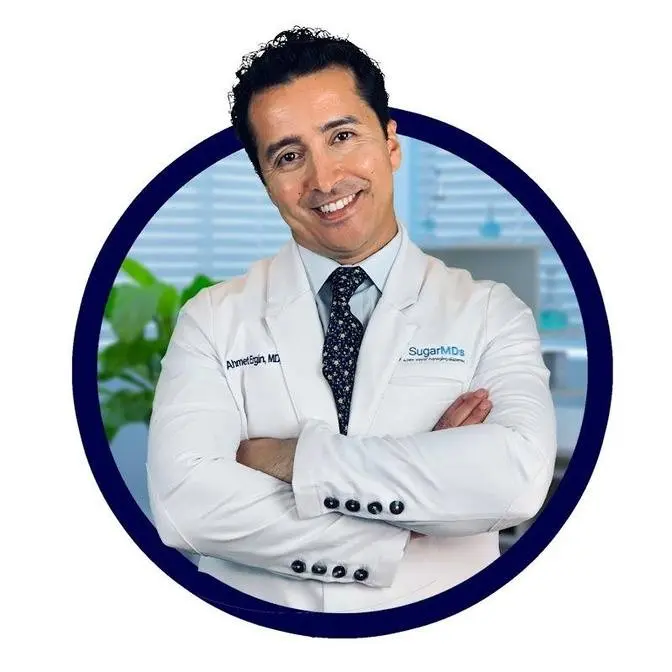
especially in the context of metabolic disease, results were extraordinary. I am Dr. Ahmet Ergin
from SugarMD, from sugarmds.com and the Diabetes, Thyroid and Hormone Center of the Treasure Coast.
Today, I want to talk to you about one of the most exciting and most misunderstood compounds
in metabolic medicine right now. Because if you have diabetes, insulin resistance, or
stubborn metabolic dysfunction, you need to understand this. What MOTC is, what it does,
and most importantly, how to approach it safely. So what exactly is MOTC? Your mitochondria have
their own DNA, completely separate from your nuclear DNA. It's ancient, compact, and scientists
assumed for a long time that its only job was to encode the proteins needed to produce energy.
But MOTC is not an energy protein. It is a signaling peptide, a messenger. When it's released
from the mitochondria into the cell, and eventually into the bloodstream, it starts
communicating with your entire metabolic system. And what it says is essentially this. Get more
efficient. Burn more fuel. Become more sensitive to insulin. Here is where it gets fascinating for
anyone dealing with diabetes or insulin resistance. MOTC activates a pathway called AMPK.
Think of AMPK as your body's master metabolic switch. When AMPK is activated, your cells become
dramatically more responsive to insulin. Glucose gets pulled into your muscles more efficiently.
Fat burning increases. Inflammation drops. Sound familiar? That's exactly what metformin does,
one of the most prescribed diabetes drugs in the world. Metformin works largely by activating AMPK.
MOTC activates the same pathway. But it does it in a way that feels more native to the body.
Because in many ways, it is native to the body. Your body already makes it. The problem is,
just like growth hormone, just like testosterone, just like so many other vital compounds,
MOTC levels decline with age. Researchers have found that older individuals and people with
metabolic disease have significantly lower circulating MOTC compared to younger, metabolically
healthy people. The signal gets quieter. The metabolic switch gets harder to flip.
Now let's talk about what the research actually shows, because this is where I want you to pay
close attention. In animal studies, MOTC has demonstrated the ability to prevent and even
reverse diet-induced obesity and insulin resistance. When researchers gave MOTC to
mice on a high-fat diet, the mice did not become obese. Their insulin sensitivity was preserved.
Their blood glucose stayed controlled, even under metabolic stress. In muscle tissue specifically,
MOTSC appears to improve glucose uptake independently of insulin. That same mechanism
we talked about with exercise—GLUT4 transporters pulling glucose into muscle—MOTSC appears to
amplify that process. It essentially mimics some of the metabolic benefits of exercise at a cellular
level. There is also emerging evidence that MOTSC plays a role in reducing visceral fat,
improving mitochondrial efficiency, and decreasing systemic inflammation—all
of which are root drivers of type 2 diabetes that we address every single day in our clinic.
Human trials are still early. I want to be transparent with you about that.
This is a cutting-edge area of research. But the mechanistic science is compelling,
and the early clinical observations are genuinely exciting. Now I need to stop and talk to you about
something critically important, because this is where I see people make dangerous mistakes.
You can find MOTSC for sale online, on random supplement websites,
on international platforms shipping out of China or India, and I'm going to tell you directly—do
not buy it. Here's why. MOTSC is a peptide, a fragile biological molecule. Its integrity,
its purity, its sterility, its dosing precision is everything. A contaminated batch does not
just fail to work, it can cause serious harm. Immune reactions, infections,
unknown long-term effects from impurities. Products coming out of unregulated international
markets have zero quality control. You have no idea what is actually in that vial. You don't
know the purity, you don't know the sterility, you don't know if what you're injecting is even
MOTSC at all. I have seen patients come to my clinic with complications from peptides
purchased this way, and it is completely avoidable. MOTSC currently does not have FDA approval.
That is the reality. Which means the only legitimate, safe, and responsible way to access it
is through a licensed compounding pharmacy with a prescription from a qualified physician who has
evaluated you, reviewed your labs, and determined it is appropriate for your specific situation.
Compounding pharmacies that specialize in peptide therapies operate under strict
pharmaceutical standards. The product is tested, the dosing is precise, the sterility is verified.
That is non-negotiable when you are talking about something you are putting into your body.
At our clinic, DTH, Diabetes, Thyroid, and Hormone Center of the Treasure Coast,
this is exactly how we approach peptide therapy. We evaluate you as an individual. We look at your
labs, your metabolic health, your history. We work with accredited compounding pharmacies.
We monitor you. We adjust. We do this properly. This is not something you figure out on your own
with a vial from the internet. This is precision medicine, and when done correctly,
with the right candidate, under proper supervision, the results we are seeing are remarkable.
MOTSC is not a magic bullet. Let me be clear about that. The foundation is always lifestyle.
Nutrition, movement, sleep, stress management. We have talked about all of that on this channel.
But for the right patient, someone who has done the work, who is still facing metabolic resistance,
whose mitochondrial signaling has declined with age or disease,
MOTSC may be one of the most powerful tools we have ever had access to.
The science is young. The potential is enormous. And the key is doing it safely,
doing it legally, and doing it with a doctor who actually understands the metabolic medicine.
If you want to explore whether MOTSC is right for you, come see us at Diabetes, Thyroid,
and Hormone Center of the Treasure Coast. The link is in the description.
And I'm Dr. Ergin, your sugar MD. I will see you in the next video.